


Vietnam E-visa Application 2026: A Step-by-Step Guide to Stress-Free Entry
Imagine standing at the check-in counter for your 2026 Hanoi flight, only to realize a single digit typo on your vietnam e-visa application has grounded your entire trip. This isn’t just a travel nightmare; it’s a reality for thousands of visitors whose documents are rejected for minor clerical errors every year. You likely feel that the visa process is the most stressful part of your journey, especially with strict photo requirements and non-refundable fees. It’s frustrating to wait the standard five working days for a response when your departure date is looming and you’re unsure if your paperwork is perfect.
We’re here to eliminate that anxiety by helping you master the application process with our expert walkthrough. We promise to help you secure a guaranteed approval for your 2026 trip by providing the document precision you need. This guide provides a step by step breakdown of the requirements, tips for avoiding common mistakes, and options for emergency 24/7 processing if you need your approval letter in as little as two hours.
Key Takeaways
- Identify the precise 2026 photo and passport criteria to prevent automated system rejections before they happen.
- Navigate the vietnam e-visa application using our professional walkthrough to ensure 100% accuracy between your personal data and passport MRZ.
- Avoid the common name order trap and other clerical errors that frequently lead to immediate visa denial at the airport.
- Learn the protocols for obtaining an urgent private approval letter in under 8 hours for high-stakes, last-minute travel situations.
Essential Requirements for Your Vietnam E-visa Application
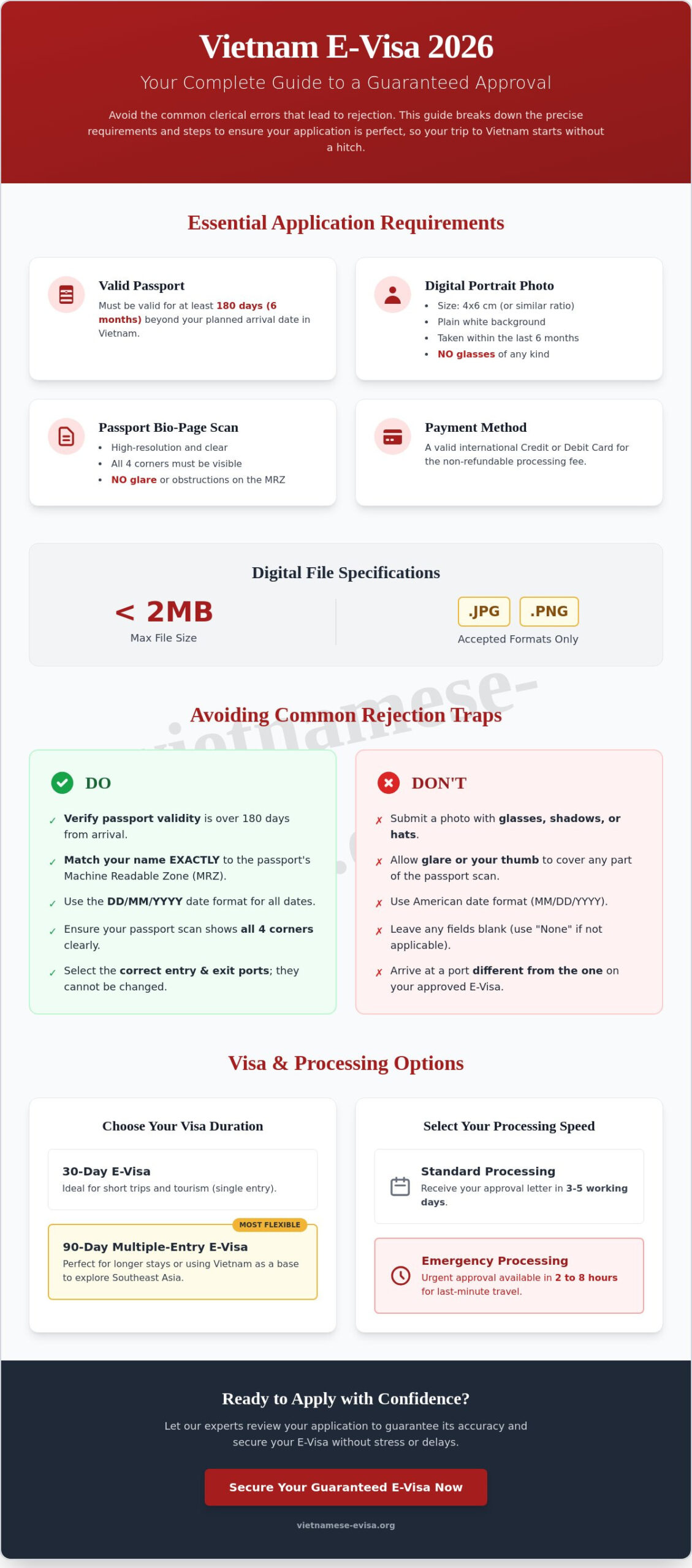
Precision is non-negotiable when preparing your documents. A single oversight in your paperwork can lead to an immediate rejection, forcing you to restart the process and potentially miss your flight. Your passport must be valid for at least 180 days beyond your planned arrival date. This is a foundational rule of Vietnam’s visa policy that immigration officers strictly enforce at every checkpoint.
Digital photos are another common failure point. You need a 4×6 cm portrait with a plain white background, taken within the last six months. Don’t wear glasses in the photo; even thin frames can cause the automated system to flag your application. Your expression should be neutral, and your entire face must be clearly visible without any shadows or hair obstructions.
The scan of your passport bio-page is perhaps the most critical element. Automated systems at the Immigration Department scan the Machine Readable Zone (MRZ) at the bottom of the page. If there’s glare from a camera flash or a thumb covering any part of the text, the system won’t be able to read your data. Ensure the scan is high-resolution and shows all four corners of the page to avoid being asked for a resubmission. Finally, have a valid international credit or debit card ready for the non-refundable processing fee.
Technical Document Specifications for 2026
The government portal has strict digital limits that you must follow to ensure your files upload correctly. Keep your images under 2MB. Use only .jpg or .png formats; the system won’t accept PDFs for the photo or bio-page fields. If your file is too large, use a basic image compressor to reduce the size without sacrificing the clarity of the text. Clarity check: if you can’t read every letter of your passport number on your screen, the immigration officer won’t be able to either.
Entry and Exit Port Selection
You must identify your exact entry point before submitting your vietnam e-visa application. Whether you’re landing at Tan Son Nhat in Ho Chi Minh City or crossing a land border from Cambodia, accuracy is vital. You cannot change your entry port once the visa is issued. If you arrive at a different port than the one listed on your document, you’ll be denied entry. Review the Vietnam Visitor Checklist 2026 to confirm which of the 83 international ports currently accept electronic visas.
Step-by-Step Guide: Completing the Vietnam E-visa Application
Start your vietnam e-visa application by accessing the official portal and uploading your digital documents. The system uses automated character recognition to pull data from your passport bio-page. If your scan is clear, the form will auto-fill several fields, but you must verify every character. Any discrepancy between your digital form and the physical passport will result in a “data mismatch” rejection. This process requires your full attention for approximately 15 minutes to ensure every detail is perfect.
Once your images are uploaded, you’ll move to the personal data section. This is where most travelers make critical errors. Ensure your name matches the Machine Readable Zone (MRZ) at the bottom of your passport exactly. If your passport lists “Smith, John Jacob,” don’t simply write “John Smith.” Follow the sequence of characters provided in that bottom ICAO line to satisfy the immigration system’s logic.
Navigating the Personal Information Section
Formatting is everything in this section. Vietnam utilizes the DD/MM/YYYY date format. If you’re traveling from the United States, don’t use the MM/DD/YYYY format, as this will lead to an incorrect validity period on your issued visa. For the religion field, write “None” if you don’t have a specific affiliation; leaving it blank may cause the form to return an error. Similarly, for occupation, provide a simple, clear title like “Software Engineer” or “Retired” to avoid administrative follow-up questions.
Choosing Your Visa Type and Duration
As of May 2026, you can select between a 30-day or a 90-day stay. The 90-day multiple-entry option is the most flexible choice for travelers planning to use Vietnam as a hub for exploring Southeast Asia. Your “Grant E-visa from” date is the earliest day you can enter the country. You can arrive after this date, but never before it. To begin this process with expert oversight, you can Apply for your Vietnam visa here to ensure your data is reviewed before submission.
Before you pay, perform a final review of your passport number and email address. After submitting the non-refundable fee, you’ll receive a registration code. Record this number immediately; it’s the only way to track your status. For peace of mind regarding local laws and safety, consult the U.S. State Department travel advisory before finalizing your itinerary. If you’ve realized your flight is sooner than the standard processing window allows, an emergency vietnam visa service can expedite your approval letter in just a few hours.
Common Pitfalls and How to Avoid Rejection
Rejection of a vietnam e-visa application often happens at the final hurdle. Even if you’ve followed the steps, minor technicalities can trigger an automatic denial. The most frequent cause of entry denial at the airport is name order confusion. Vietnamese systems prioritize Surname first, while many Western passports list Given Names first. If you invert these on your form, your visa won’t match your passport’s Machine Readable Zone, and airlines will refuse your boarding pass. Always double-check that your names appear exactly as they do in the ICAO line at the bottom of your passport page.
Automated government systems also flag blurry or cropped passport scans for immediate rejection. If the software cannot clearly “read” the four corners of your bio-page or the MRZ text, your application will stall. Another critical error is selecting the incorrect entry port. Unlike some other countries, Vietnam’s e-visa is port-specific. If you list Noi Bai Airport but attempt to enter via Da Nang, you’ll be turned away. This mistake cannot be edited; it requires a completely new application and another fee payment.
Many travelers fall into the “Processing” trap. If your status hasn’t changed for more than five working days, don’t assume it’s just slow. The system may be waiting for you to fix an error that you haven’t seen yet. If you are facing a deadline, you should apply for a rush vietnam visa to bypass these bureaucratic delays.
Troubleshooting a Pending Application
Log in to the portal daily using your registration code. Look for the status “Amending” or “Requested for correction.” This means an immigration officer has found an issue, such as a blurry photo, and is waiting for a resubmission. Standard processing times often stretch beyond the usual five days during peak seasons like Tet, which falls on February 17, 2026. For a detailed breakdown of current wait times, consult our Vietnam E-visa Processing Time 2026 Guide.
What to Do if Your Visa is Rejected
If you receive a rejection notice, analyze the reason code immediately. “Incorrect information” is the most common vague descriptor used by the department. Remember that government fees are non-refundable, regardless of the outcome. If you’ve been rejected once, the risk of a second denial increases if you don’t identify the specific data mismatch. This is the point where you should stop the DIY approach and seek professional document review to ensure your next submission is flawless.
Emergency Solutions: When You Need a Visa Immediately
Panic sets in when you’re at the boarding gate and realize your vietnam e-visa application is still “In Processing” despite your flight departing in a few hours. Official government portals offer no “urgent” button or expedited track; they operate strictly on a three to five working day schedule. If you find yourself in this high-stakes situation, you need a professional facilitator who can bypass the standard queue. Our emergency services are designed for travelers who either forgot to apply or discovered a critical error on their issued document just before departure.
We provide multiple tiers of speed to match your level of urgency. Our rush services deliver approval in four to eight working hours, while our super-urgent same-day processing is built for travelers already at the airport. This isn’t just about speed; it’s about expert oversight. We provide 24/7 support to monitor your file’s progress through the Immigration Department’s internal systems. If you’ve already received an e-visa but noticed a typo in your passport number, our correction services can often rectify the legal data without requiring a completely new multi-day wait.
How Our Emergency Process Works
The standard bureaucratic process is slow because it lacks a prioritization mechanism. When you submit your details via our Emergency Vietnam Visa portal, our experts take immediate action. We review your documents for the pitfalls mentioned in previous sections, such as name order and photo clarity, before submitting them for an expedited Immigration Department review. This streamlined path allows you to receive a valid e-visa via email in as little as two hours, ensuring you don’t miss your flight or your holiday.
2026 Holiday and Weekend Processing
Timing your application is difficult when the calendar works against you. The government’s “working days” do not include Saturdays, Sundays, or public holidays. This becomes especially problematic during the Vietnamese New Year (Tet), which begins on February 17, 2026. While official channels shut down for a week, our private service remains operational. We understand that international travel doesn’t stop for local holidays. We work around the clock to ensure your travel plans remain on track, regardless of whether the government offices are officially open or closed.
Secure Your Vietnam Entry Today
Your 2026 journey to Vietnam starts with a single document. Success depends on extreme precision with your passport data and photo quality. Simple name order errors or blurry scans often jeopardize travel plans at the final hour. By following the specific technical specifications and verifying your entry port, you eliminate the risk of being turned away at the boarding gate. Document accuracy is the only way to ensure your holiday begins without a legal headache.
Completing your vietnam e-visa application doesn’t have to be a source of anxiety. We bring over 15 years of specialized immigration expertise to every file we process. Our team provides a guaranteed error-free review to catch mistakes before they reach the government portal. If your departure is imminent, our same-day emergency processing is available to secure your entry in as little as two hours.
Start your Vietnam E-visa application with 24/7 expert support and travel with absolute confidence. We handle the bureaucratic heavy lifting while you focus on your itinerary. Vietnam is waiting for you.
Frequently Asked Questions
How long does the Vietnam e-visa application take to process in 2026?
Standard processing for the vietnam e-visa application takes between 3 and 5 working days. This timeline excludes Saturdays, Sundays, and Vietnamese public holidays. To avoid travel disruptions, you should submit your documents at least 14 days before your flight. If you’re facing a tight deadline, emergency processing can deliver an approval letter in as little as 2 to 4 hours on weekdays.
Can I change my entry port after submitting my Vietnam e-visa application?
No, you cannot change your entry port once the application is submitted or the visa is issued. The document is legally tied to the specific airport, land border, or seaport you selected during the process. If you arrive at a different checkpoint than the one listed on your visa, immigration officers will deny you entry. You’ll need to submit a completely new application and pay the fee again to correct this mistake.
What is the total cost of a Vietnam e-visa including service fees?
The official government fee is 25 USD for a single-entry visa and 50 USD for a multiple-entry visa. These fees are non-refundable regardless of whether your application is approved or rejected. If you utilize a private service for expert document review or expedited processing, additional service fees will apply based on your required turnaround time. Unlike older visa types, there are no additional stamping fees to pay upon arrival at the airport.
Do I need a physical photo for my Vietnam e-visa application?
No, you only need a digital portrait for the online submission. The file must be in .jpg or .png format, measuring 4×6 cm with a plain white background and no glasses. While you don’t need to bring physical photos to the immigration counter for the e-visa process, it’s a smart travel habit to keep two passport-sized photos in your bag for other administrative needs while exploring Southeast Asia.
What happens if I make a mistake on my Vietnam e-visa application?
A mistake usually triggers an “Amending” status or an immediate rejection of your vietnam e-visa application. If the status is “Amending,” you can log in with your registration code to fix the specific error identified by the officer. However, if the visa is already issued with incorrect data, such as a typo in your passport number, it’s legally invalid. You must apply for a new visa immediately to ensure your paperwork matches your passport’s machine-readable zone.
Can US citizens apply for a 90-day multiple-entry Vietnam e-visa?
Yes, US citizens are fully eligible for the 90-day multiple-entry e-visa in 2026. This visa type is the standard choice for travelers who plan to use Vietnam as a hub for visiting neighboring countries. It allows you to enter and exit the country as many times as you like within the 90-day validity window. Just ensure your passport has at least two blank pages and remains valid for six months beyond your arrival date.