


Visa at Arrival Checklist: Everything You Need for Vietnam in 2026
Landing at Tan Son Nhat or Noi Bai without the correct paperwork isn’t just a minor inconvenience; it’s a guaranteed way to be denied entry before you even reach the baggage carousel. Many travelers still assume the visa at arrival is a simple walk-in service, but as of April 2026, this process is strictly reserved for emergency cases and pre-arranged landing permits. If you haven’t secured your private approval letter or completed the mandatory Digital Arrival Card required since April 15, 2026, you won’t even make it past the departure gate.
We know the fear of being turned away at the airport or stuck in a long immigration queue is real. You’ve planned this trip for months, and you don’t want a paperwork error to stand in your way. This article provides a complete, expert-verified checklist of every document and step required to secure your Vietnam visa at the airport without delays. You’ll learn exactly how to handle the “Approval Letter” requirement, how to generate your mandatory QR code within 72 hours of landing, and how to navigate the 2026 immigration protocols for a stress-free arrival.
Key Takeaways
- Understand the critical distinction between a standard landing permit and the Vietnam visa at arrival, which requires a pre-arranged Private Approval Letter to board your flight.
- Follow our streamlined two-step protocol to secure your official documentation online before presenting it at the airport’s Landing Visa window.
- Verify your readiness with the 2026 essential checklist, covering specific passport validity rules and mandatory physical printout requirements.
- Learn how to utilize VIP Fast-Track services to bypass potential two-hour immigration queues at major international airports.
- Identify the immediate emergency actions to take if you reach the departure gate without your required entry documents.
What is a Visa at Arrival and How Does It Work for Vietnam?
In the technical sense, a visa at arrival is a travel permit granted at the entry port of a destination country rather than through a local consulate or embassy. While many global destinations allow travelers to simply walk up to an immigration counter, the Visa policy of Vietnam functions differently. You cannot simply land in Hanoi or Ho Chi Minh City and ask for entry. Instead, this system acts as a pre-arranged landing permit that requires a specific digital document before you even leave your home country.
The “Vietnam Nuance” is the most critical factor for travelers to understand in 2026. To use the visa at arrival method, you must possess a Private Approval Letter issued by the Immigration Department. Without this physical or digital printout, airlines will deny you boarding at your departure airport. This method remains popular for travelers who need flexibility for 90-day stays or those facing an emergency where standard processing times are too slow. It is currently supported at major international hubs including Noi Bai (Hanoi), Tan Son Nhat (Ho Chi Minh City), and Da Nang.
Visa at Arrival vs. E-visa: Key Differences
As of 2026, the standard e-visa has become the primary entry method for most tourists because it’s entirely digital and processed in 3 to 5 working days. However, the Vietnam E-visa (30 & 90-day) might not suit travelers who need immediate, same-day approval for last-minute business or family emergencies. While the e-visa is sent directly to your email, the arrival visa requires you to stop at the “Landing Visa” counter upon arrival to pay a stamping fee and receive a physical visa in your passport.
Common Misconceptions About ‘Just Showing Up’
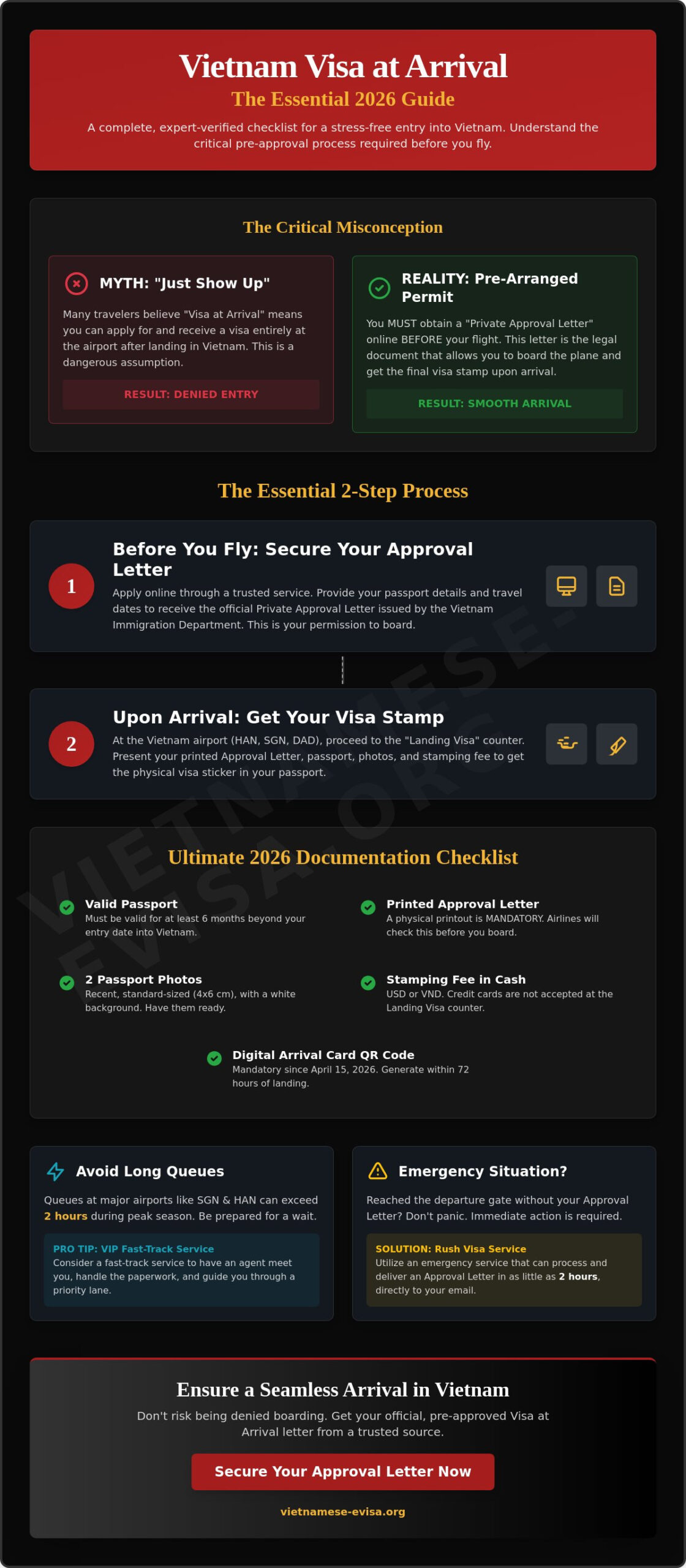
One of the most dangerous myths is that “at arrival” means you can handle the entire application at the airport. This is false. Arriving without a pre-approved letter results in immediate deportation or being blocked from your flight. The Visa on Arrival letter is a legal permit issued by the Vietnam Immigration Department that authorizes your entry and allows the airline to fly you into the country. Remember, the “at arrival” portion of the name refers only to the final stamping process, not the legal authorization itself. Ensure you have your printed letter and two passport-sized photos ready before you touch down.
The Essential 2-Step Process for a Vietnam Visa at Arrival
Securing a visa at arrival involves a precise sequence of actions that must begin long before you reach the tarmac. While the official Vietnam e-Visa application portal serves standard travelers with 3 to 5-day lead times, those needing flexibility or speed often rely on a two-step agency-led process. This method bridges the gap between administrative requirements and the high-stakes reality of international travel, offering a safety net for those who cannot wait for standard government processing.
The first step requires you to apply online through a trusted agency to obtain your Private Approval Letter. This document is your legal entry permit. Once you have this letter in hand, the second step takes place at the airport where you present your paperwork at the Landing Visa window. For travelers facing sudden schedule changes, our Emergency Vietnam Visa service is vital. We can reduce the standard 2-day turnaround to a 2-hour rush service, ensuring you don’t miss your flight due to a missing document.
Obtaining Your Private Approval Letter
To start, you’ll need to provide your exact passport details, planned entry date, and arrival airport. Accuracy is paramount; even a single digit error in your passport number can lead to boarding denial. Once processed, this letter acts as your official permission to board the aircraft. Always verify that the information on your letter matches your passport exactly before you head to the airport. If you’re ready to begin, submit your details today to ensure your letter is ready before departure.
Navigating the Airport Landing Visa Counter
Upon landing at Tan Son Nhat (SGN), Noi Bai (HAN), or Da Nang (DAD), follow the signs to the “Landing Visa” or “Visa on Arrival” counter. During peak travel seasons in 2026, queues can be significant, so it’s best to have your printed approval letter and stamping fee ready in your hand. Hand over your documents with professionalism and wait for your name to be called. Immigration officers work efficiently, but patience is necessary as they verify each visa at arrival application against the department’s database.
The Ultimate 2026 Visa at Arrival Documentation Checklist
Your preparation for a visa at arrival culminates in a physical document kit that you must carry by hand. Digital records on a smartphone are frequently rejected by immigration officers at the Landing Visa counter, as they require physical copies to stamp and file for official records. Ensure your passport remains valid for at least six months beyond your intended stay; anything less will result in immediate boarding denial at your point of origin. Beyond your passport, your kit must contain four mandatory items to guarantee a smooth entry process.
- A printed copy of your Private Approval Letter: As established in the previous section, this is your legal authorization. Black and white or color prints are both acceptable, but the text must be clear.
- Two recent passport-sized photos: These must be 4x6cm with a plain white background. Ensure you aren’t wearing glasses or headgear and maintain a neutral expression.
- Completed Entry and Exit Form (NA1): This form is the primary administrative record for your stay.
- The Stamping Fee in cash: This is a separate cost from the service fee paid to obtain your letter.
Preparing Your Physical Document Kit
Pro-tip: Download the NA1 Form (Entry and Exit Form) and fill it out before you land. Doing this saves you at least 20 minutes of standing at a crowded desk in the arrival hall. Always keep these documents in your carry-on bag rather than your checked luggage. If your suitcase is delayed or lost, you won’t be able to process your visa at arrival and will be stuck in the immigration holding area. For photo quality, use a professional service to ensure the likeness is current; officers may reject photos that look significantly different from your current appearance or those with a colored background.
Cash and Fees: Avoiding the ATM Trap
One of the most common mistakes travelers make is assuming they can withdraw cash at the airport. There are no reliable ATMs located before the immigration line at Tan Son Nhat or Noi Bai. You must arrive with the correct amount already in your pocket. Check the current Vietnam Visa Fees to confirm the exact amount for single versus multiple entry permits. While Vietnamese Dong is accepted, USD is the preferred currency for the immigration department. Ensure your bills are crisp, clean, and free of any tears or markings, as heavily worn currency is often rejected by government officials.
Don’t leave your entry to chance. Start your application for a Private Approval Letter today to ensure your documentation kit is verified and ready for your 2026 trip.
Avoiding Delays: Fast-Track Services and Emergency Tips
Even with a perfect document kit, the airport experience can be unpredictable. The visa at arrival queue at Tan Son Nhat or Noi Bai can swell during peak arrival windows, often turning a smooth landing into a two-hour wait. To bypass this frustration, many travelers utilize a VIP Fast Track service. This is particularly critical if you’re traveling on a tight schedule or if you discover a last-minute discrepancy in your paperwork that requires immediate attention.
Before you leave for the airport, perform a final audit of your flight tickets against your approval letter. Ensure your entry and exit dates align perfectly. If your return flight departs even one day after your visa expires, you’ll face significant fines and administrative delays. If you identify a mistake while at the departure gate, don’t wait until you land in Vietnam to address it. Contact an expert immediately to rectify the error before you touch down.
When to Use Airport Fast Track
This service is the preferred choice for business travelers, families with small children, or those with tight domestic connections. A personal assistant meets you at the arrival gate with a name board, collects your visa at arrival documents, and navigates the Landing Visa window on your behalf. This ensures your stamping process is handled by a professional who knows exactly how to interact with immigration officers. It removes the stress of the unknown and allows you to head straight to the luggage carousel or your next destination.
Emergency Troubleshooting at the Border
Realizing you’ve arrived without an approval letter is a high-stakes emergency, but it’s one that can be solved with the right partner. Our Urgent Vietnam Visa services are designed for these exact scenarios, offering 1-hour approvals for travelers in distress. Emergency visa processing can be completed in as little as 30-60 minutes for stranded travelers. Choosing an agency with 24/7 support is essential because travel emergencies don’t stick to business hours. Whether it’s a typo on your letter or a forgotten document, having an expert available around the clock ensures your trip stays on track.
Secure Your Vietnam Entry Today
Navigating the 2026 immigration landscape requires more than just a passport and a plane ticket. You’ve learned that the visa at arrival is a specialized process that hinges entirely on your Private Approval Letter and a precisely prepared physical document kit. By securing your legal permit in advance and carrying the correct currency, you eliminate the bureaucratic stress that often ruins international trips. Whether you’re planning a 90-day adventure or a quick business visit, having an expert partner ensures you never face the Landing Visa counter alone.
With over 15 years of expert facilitation, we specialize in removing the complexity from your travel plans. We provide 24/7 Emergency Support and can deliver urgent processing in under 2 hours for those high-stakes situations. Don’t leave your entry to chance at the departure gate. Apply for your Vietnam Approval Letter now to secure your Visa at Arrival and travel with the confidence that your documentation is 100% verified. Vietnam is waiting for you; let’s make sure you get there without a single delay.
Frequently Asked Questions
Can I get a Vietnam visa at arrival without an approval letter?
No, you cannot obtain a visa at arrival without a pre-arranged Private Approval Letter. Airlines are legally mandated to verify this document before you are permitted to board your flight to Vietnam. If you reach the airport without this letter, you’ll be denied boarding immediately. In emergency cases, our team can facilitate an urgent letter in under two hours to ensure you don’t miss your flight.
How much is the stamping fee for a Vietnam visa at the airport in 2026?
As of April 2026, the official government stamping fee is $25 USD for a single-entry visa and $50 USD for a multiple-entry visa. This fee must be paid in cash at the Landing Visa counter upon your arrival. We strongly recommend carrying the exact amount in crisp, unmarked USD bills, as immigration officers frequently reject torn or heavily worn currency.
Do I need to bring physical photos for a visa at arrival?
Yes, you must provide two physical passport-sized photos measuring 4x6cm with a plain white background. Digital versions on your mobile device aren’t accepted for official processing. While some airports offer on-site photo services for a small fee, this often adds 20 to 30 minutes to your wait time. Preparing these in advance is the most efficient way to navigate the immigration hall.
What happens if my passport expires in less than 6 months?
You’ll be denied entry into Vietnam if your passport has less than six months of validity remaining from your date of arrival. This is a non-negotiable legal requirement that airlines strictly enforce at the check-in counter. If your passport is nearing its expiration date, you must renew it before applying for your approval letter to ensure your travel plans remain secure.
Is the visa at arrival available at all Vietnamese land borders?
No, the visa at arrival system is exclusively available at major international airports, including Hanoi, Ho Chi Minh City, and Da Nang. Land borders and seaports require a pre-approved e-visa or a traditional visa from an embassy. If you’re crossing into Vietnam from Cambodia or Laos, verify that your entry point is one of the 83 international entry points that accept digital documentation.
How long does it take to get the visa stamped at the airport?
Processing times typically range from 15 to 60 minutes, though this depends entirely on the volume of international arrivals. During peak travel seasons in 2026, wait times can extend to two hours if multiple large aircraft land simultaneously. To expedite this, ensure your NA1 form is completed before you touch down or consider a VIP fast-track service to move to the front of the queue.