


Vietnamese New Year 2026: A Complete Guide to Tet Traditions and Travel Planning
The most culturally rich week of the 2026 travel calendar is also the most challenging period for international logistics. If you’re planning to witness the vietnamese new year, you’re preparing for a time when government offices and many of the 83 entry points operate on emergency-only schedules. Most travelers worry that a simple delay in their electronic visa application will result in being locked out of the country during the week-long Tet shutdown. It’s a valid concern, as standard processing times of 3 to 5 working days are often disrupted when the entire nation pauses to celebrate.
We understand that the uncertainty of holiday dates and the fear of a bureaucratic freeze can make trip planning feel like a high-stakes gamble. This guide provides the exact 2026 holiday schedule and the tactical advice you need to secure your travel permits before the administrative freeze begins. You’ll learn how to handle the non-refundable $25 single-entry fee, utilize the 90-day validity period, and ensure your passport meets the 6 month validity requirement for a stress-free arrival.
Key Takeaways
- Identify the exact 2026 lunar dates to avoid arriving during the peak of the nationwide transportation sell-out.
- Discover the regional variations of the vietnamese new year, from the peach blossoms of the North to the specific arrangements of the Five-Fruit Tray.
- Plan for a three-day closure of local markets and restaurants by coordinating your dining and shopping needs before the festivities begin.
- Secure your travel documentation early to bypass the seven-day immigration department shutdown that halts all standard electronic visa processing.
- Access expert guidance on navigating emergency entry requirements and utilizing private approval letters during the high-stakes holiday period.
Understanding Tet Nguyen Dan: The Essence of the Vietnamese New Year
Tet Nguyen Dan, literally translated as the “Feast of the First Morning,” marks the most significant cultural event in the country. It is the vietnamese new year, a time that transcends simple celebration to become a total spiritual reset for the nation. Unlike the Gregorian calendar, this festival follows the lunar cycle, meaning the dates shift annually. In 2026, the transition officially occurs on February 17, ushering in the Year of the Horse. This specific zodiac sign represents energy, decisive progress, and a passion for travel, making it an auspicious year for those looking to explore the region. You can find a deeper historical context of the traditions associated with Tết (Vietnamese New Year) through academic records, but the modern reality is a vibrant, high-energy atmosphere that requires careful planning.
The 2026 Holiday Timeline: Key Dates to Remember
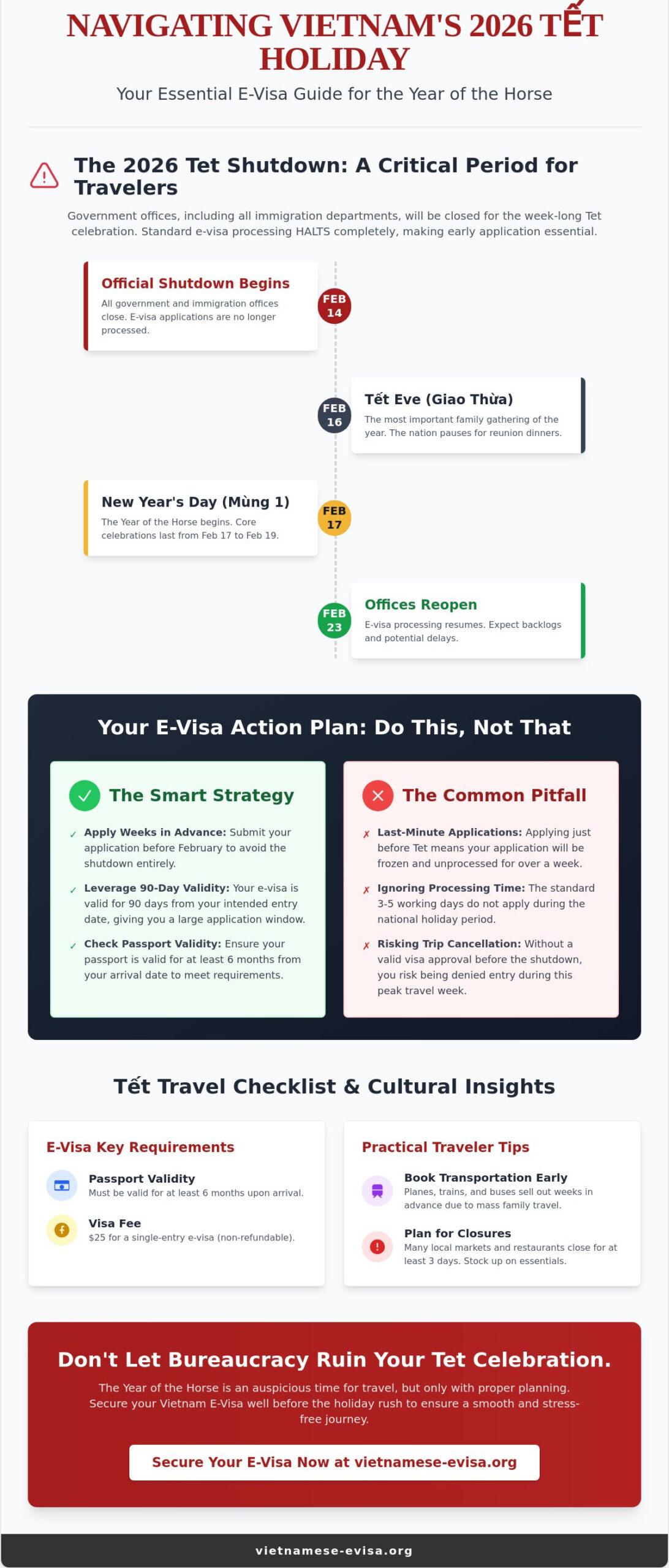
The administrative and social landscape of the country changes completely during the “Golden Week” of Tet. For 2026, expect government offices, including immigration departments, to close from February 14 through February 22. The most critical moment is February 16, 2026, known as Tet Eve, when families gather for their most important dinner of the year. The core celebrations follow from February 17 to February 19. If you’re applying for documentation, refer to our ultimate 2026 application guide to ensure your entry is secured before these dates. Missing this window means waiting until the offices reopen on February 23.
The Spiritual Core: Ancestor Worship and Renewal
At its heart, Tet is about homecoming. Millions of people travel across the country to reunite with family, a migration that begins well before the official holidays. This period starts with the ritual of the Kitchen Gods (Ong Cong and Ong Tao) on the 23rd day of the 12th lunar month. Families believe these deities depart for heaven to report on the household’s affairs. To prepare for their return and the new year, every home undergoes a vigorous cleaning. This isn’t just chores; it’s a symbolic ritual to sweep away the bad luck of 2025 and make room for the prosperity of the Horse year. For the vietnamese new year, a clean house is a clean soul, ready for the blessings of ancestors who are invited back to join the festivities.
Essential Customs and Rituals: How Vietnam Welcomes the New Year
Walking through the streets during the vietnamese new year is a sensory experience defined by specific floral displays. In the cooler climate of Northern Vietnam, families decorate their homes with pink peach blossoms (Hoa Dao), symbolizing growth and prosperity. Conversely, Southern homes are bathed in the golden hue of yellow apricot blossoms (Hoa Mai), which represent wealth and the sunshine of the coming spring. These aren’t just aesthetic choices; they are foundational symbols of the season’s arrival.
The spiritual center of every home is the “Five-Fruit Tray” (Mam Ngu Qua) placed on the ancestral altar. In the North, the tray usually includes bananas, pomelos, peaches, persimmons, and pears to represent the five elements. In the South, the selection is based on a linguistic pun: soursop, coconut, papaya, mango, and figs. When spoken in the Southern dialect, these fruits sound like the phrase “Praying for just enough to spend.” This focus on future prosperity is echoed in the Xong Dat ritual. The first person to enter a home after midnight on February 17, 2026, is believed to determine the family’s luck for the entire Year of the Horse. Families often pre-arrange a visitor whose zodiac sign and temperament align with the new year’s energy.
Social interactions during Tet revolve around Li Xi, the tradition of red envelopes. Elders give these to children to encourage academic success, while the younger generation offers them to parents as a sign of gratitude and longevity. If you’re visiting during this time, carrying small denominations of crisp, new bills is a respectful way to participate in local customs. Before you finalize your travel budget, review the official visa fees to ensure your administrative costs are accounted for before the holiday shutdown.
Tet Flavors: Traditional Foods You Must Try
Culinary traditions are split by geography. The North favors Banh Chung, a square sticky rice cake filled with mung bean and pork, wrapped in dong leaves. The South prefers Banh Tet, a cylindrical version of the same ingredients. You’ll also find Thit Kho Tau, a hearty dish of caramelized pork and boiled eggs, and Mut Tet, which are trays of candied ginger, coconut, and lotus seeds offered to every guest who enters the home.
Regional Celebrations: Hanoi vs. Ho Chi Minh City
Hanoi offers a traditional atmosphere with mist-covered flower markets and ancient temple rituals. Ho Chi Minh City is the opposite, featuring the massive Nguyen Hue Flower Street and high-energy public displays. For a historical perspective, Central Vietnam provides a glimpse into the royal heritage of the vietnamese new year, where the ancient Citadel in Hue hosts traditional court ceremonies and folk games that have remained unchanged for centuries.
Traveling During Tet 2026: Practical Guidance and Etiquette
Navigating the country during the vietnamese new year requires a shift in travel strategy. This is the largest annual migration in the region, meaning the logistics of moving between cities become complex. Domestic flights, buses, and the North-South railway frequently sell out 3 to 4 months before the holiday begins on February 17, 2026. If you haven’t secured your tickets by November 2025, your options will be limited to expensive last-minute airfares or private car hires. Additionally, the service industry operates under a “Tet surcharge” model. Expect to pay a premium of 15% to 30% at restaurants and hotels that remain open to cover the increased cost of holiday labor.
Daily life also pauses significantly during the first three days of the year. Local markets and family-run shops will close their doors from February 17 through February 19. While major international hotel chains and large shopping malls in tourist hubs stay operational, the authentic street food scene effectively disappears for 72 hours. We recommend stocking up on essential supplies and snacks by February 15 to avoid the pre-holiday rush. To ensure your entry process is as smooth as the festivities, start your evisa application today before the government systems enter their scheduled maintenance period.
Planning Your Itinerary: Where to Go (and Where to Avoid)
During the first two days of Tet, major metropolitan centers like Hanoi and Ho Chi Minh City can feel like ghost towns as residents return to their home provinces. While this offers a unique opportunity for quiet photography, many attractions will be closed. For a more active experience, head to beach destinations like Da Nang or Phu Quoc. These areas remain busy and fully operational. Hoi An is another excellent choice, as the ancient town hosts a spectacular lantern festival atmosphere specifically for the lunar transition.
Tet Etiquette for International Visitors
- Dress Code: Wear bright colors such as red or yellow to symbolize luck and energy. Avoid wearing all-black or all-white outfits, as these colors are traditionally reserved for mourning and funerals.
- Greetings: Use the traditional greeting “Chuc Mung Nam Moi” (pronounced: chook moong nahm moy) when entering a home or business.
- Financial Taboos: Never haggle or ask for a discount during the first days of the vietnamese new year. Sellers believe that a difficult first transaction or a loss of profit during Tet will bring bad luck to their business for the entire year.
Securing Your Entry: Visa Planning and Emergency Solutions
The administrative reality of the vietnamese new year is a total cessation of standard government processing. From February 14 to February 22, 2026, the Vietnam Immigration Department officially closes its doors. This means standard electronic visas, which usually require 3 to 5 working days for processing, cannot be issued once the holiday begins. If you submit a standard application on February 13, it’s highly likely your approval won’t arrive until February 23 or later. This creates a high-stakes situation for travelers arriving mid-festival who realize too late that their documentation is missing or contains errors.
Proactive Planning vs. Emergency Needs
We recommend that you apply for your Vietnam entry visa at least 21 days before the holiday starts. This provides a critical safety buffer for any minor data discrepancies that could lead to a rejection. For those planning an extended stay to witness the transition into the Year of the Horse, exploring Vietnam E-visa 30-90 day options is essential. Always verify your visa expiry date before the holiday begins. Overstaying during Tet is a serious administrative violation that’s difficult to resolve when government departments are inactive.
How to Get an Emergency Visa During the Tet Shutdown
If you find yourself at the airport without an approval letter during the vietnamese new year shutdown, standard government portals won’t help you. You’ll need a professional facilitator to secure a private approval letter. This specialized document allows you to board your flight and obtain a visa on arrival at one of the international airports even when the main offices are closed.
- Contact our 24/7 support team immediately to initiate an emergency Vietnam visa request.
- Provide your passport details and flight itinerary for rapid processing through our established channels.
- Receive your private approval letter via email, often in under two hours, to present at the check-in counter.
Our team remains vigilant throughout the “Golden Week” to handle these high-stakes scenarios. For travelers on a tight deadline, we provide Urgent Vietnam Visa solutions that bypass the standard holiday freeze. Don’t let a bureaucratic oversight derail your 2026 Tet experience; secure your documentation early or rely on our expert guidance for last-minute resolutions.
Secure Your 2026 Tet Journey Today
Experiencing the vietnamese new year in 2026 offers a rare glimpse into the spiritual heart of the nation as it enters the Year of the Horse. You now have the exact calendar dates for the February 17 transition and a clear roadmap for navigating the logistical challenges of the “Golden Week” shutdown. Success during this period depends entirely on proactive preparation and securing your documentation before the administrative freeze begins. Remember that domestic travel usually sells out months in advance and local markets will pause for at least three days starting February 17.
Don’t let a bureaucratic delay at the border interrupt your celebrations. Since 2007, we’ve helped thousands of travelers navigate these complex holiday windows with expert precision. Our team remains active while government offices are closed, providing 24/7 support even during the height of the festivities. Whether you need a standard 90-day e-visa or an emergency approval letter in under two hours, we’re ready to ensure your entry is seamless and secure.
Don’t let the Tet shutdown ruin your trip—Apply for your Vietnam Visa today!
Prepare your itinerary, pack your brightest red attire, and get ready for an unforgettable cultural immersion. We’ll handle the paperwork while you focus on the festivities.
Frequently Asked Questions
When exactly is the Vietnamese New Year 2026?
The 2026 Vietnamese New Year officially falls on February 17, marking the start of the Year of the Horse. While the core lunar festival lasts for three days, the national public holiday typically extends for 7 to 9 days. For 2026, expect government offices and schools to remain closed from February 14 through February 22.
Can I get a Vietnam visa during the Tet holiday?
Standard immigration offices and government portals close entirely during the holiday period, meaning official electronic visas won’t be processed. If you haven’t secured your documentation by February 13, 2026, you’ll be unable to use the standard government website until offices reopen on February 23. You’ll need an emergency service to obtain a private approval letter during this shutdown.
Is it a good idea to visit Vietnam during Tet as a tourist?
Visiting during the vietnamese new year is a unique opportunity for cultural immersion, but it requires tactical planning. You’ll experience vibrant flower markets and traditional rituals that aren’t visible at any other time of year. Be prepared for a 15% to 30% increase in service prices and ensure you book all transportation at least 90 days in advance to avoid sold-out routes.
Are restaurants and shops closed during the Vietnamese New Year?
Most family-run businesses and local street food stalls close for the first three days of the festival, specifically from February 17 to February 19. Large international hotels and major shopping malls in tourist hubs like District 1 in Ho Chi Minh City stay open. We suggest identifying open dining options or stocking up on essentials by February 15 to ensure you aren’t left without supplies.
How do I say ‘Happy New Year’ in Vietnamese?
The traditional way to greet locals during the vietnamese new year is by saying “Chuc Mung Nam Moi.” This is pronounced roughly as “chook moong nahm moy.” Using this phrase is considered very respectful, especially when visiting a local home or entering a business that has remained open to serve travelers during the festive week.
What should I do if I realize I don’t have a visa on the day of my flight during Tet?
Contact an emergency visa facilitator immediately to secure a private approval letter. Since the official government systems are inactive during the holiday, a professional intermediary is the only way to get the documentation needed to board your plane. These urgent services operate 24/7 and can often provide the necessary paperwork in under 2 hours, even on the day of the lunar transition.