


Vietnam Visa 2026: The Ultimate Guide to Entry Requirements & Urgent Processing
You are standing at the check-in desk with your bags packed and excitement building, only to hear the gate agent say your travel documents contain a critical typo or simply haven’t arrived. It is the nightmare scenario every traveler to Southeast Asia fears, particularly when trying to secure a bietnam bisa under tight departure deadlines. We understand that the bureaucratic maze of 30-day versus 90-day regulations, combined with the pressure of official forms, can turn a dream holiday into a high-stakes ordeal. You shouldn’t have to risk your entire trip because of a single character error or a slow government portal.
Our guide empowers you to master the 2026 visa landscape, ensuring your entry documents are flawless and ready in as little as two hours for those in urgent situations. You will discover the latest 2026 requirements, including the mandatory pre-arrival QR codes for Tan Son Nhat International Airport and the new UĐ1 visa categories for skilled professionals. We provide a clear roadmap to navigate these administrative hurdles with expert review and 24/7 support, moving you from uncertainty to a guaranteed arrival in cities like Hanoi, Da Nang, or Ho Chi Minh.
Key Takeaways
- Navigate the 2026 landscape with ease by understanding the 90-day e-visa rules and multiple-entry options for your upcoming trip.
- Avoid costly boarding denials by learning how to eliminate common application typos, such as accidentally searching for or entering “bietnam bisa” on official forms.
- Secure your travel documents in as little as two hours using super-urgent processing, perfect for last-minute flights or emergency travel needs.
- Protect your itinerary from the “Friday Afternoon Trap” by timing your application correctly to account for weekends and holiday processing delays.
- Utilize expert review services to ensure your digital documentation and passport scans meet strict government standards before submission.
Understanding Vietnam Visa Requirements for 2026
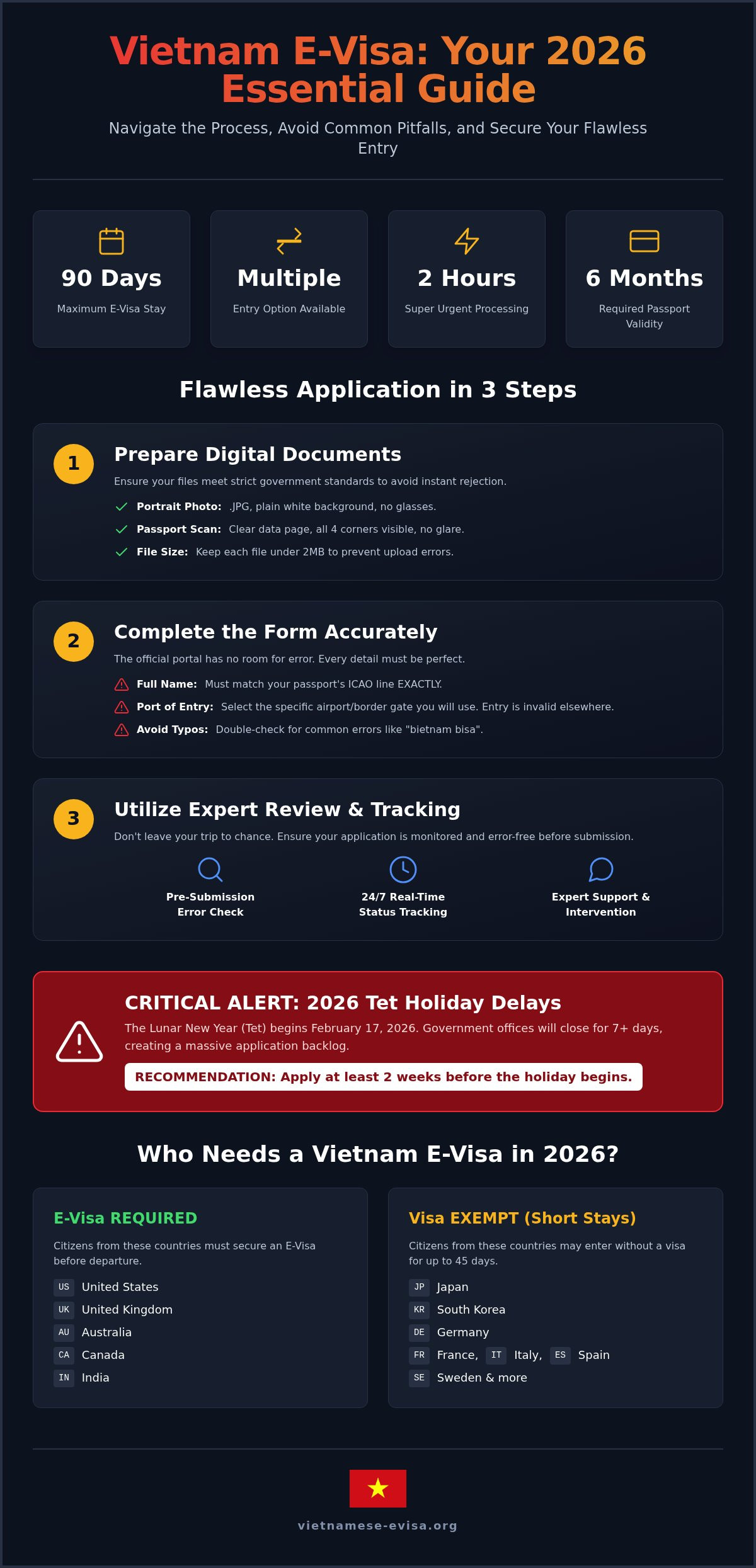
Entering Vietnam in 2026 requires a clear understanding of the electronic visa (e-visa) system. This digital authorization is now the standard entry method for all travelers, replacing the old paper-based systems for most visitors. The updated 2026 regulations allow for a 90-day stay; you can choose between single-entry or multiple-entry options depending on your itinerary. Whether you’re visiting Sapa or exploring the streets of Ho Chi Minh, this document is mandatory. Many travelers mistakenly search for a “bietnam bisa” due to quick typing, but ensuring your official application uses the correct terminology is the first step toward approval.
Your passport must remain valid for at least six months beyond your arrival date. Ensure you have at least two blank pages for entry stamps. It’s vital to distinguish between the official government fee and private administrative service fees. While the government fee covers the processing of the document itself, our service fees provide the expert review and 24/7 monitoring necessary to prevent rejections. You can view a detailed breakdown of Vietnam visa fees to plan your travel budget accurately before you submit your data.
Who Needs a Visa for Vietnam in 2026?
Most international visitors require a visa, though Vietnam’s visa policy grants exemptions to specific nationalities. Citizens from countries like Japan, South Korea, and several European nations often enjoy visa-free entry for up to 45 days. However, travelers from the United States, United Kingdom, and Australia must secure an e-visa before departure. This rule applies regardless of whether you’re arriving by air at Tan Son Nhat, crossing a land border from Cambodia, or arriving via a cruise ship at Da Nang.
Planning Around the 2026 Tet Holiday
The 2026 Lunar New Year (Tet) begins on February 17, and it significantly impacts administrative timelines. Government offices typically close for at least seven days during this period, creating a massive backlog of applications. Don’t wait until the last minute. We recommend submitting your application at least two weeks before the festivities begin to ensure your travel plans remain on track. If you find yourself in a bind while official offices are shuttered, our emergency Vietnam visa services remain active to handle time-sensitive requests that standard portals cannot accommodate during the holiday season.
How to Apply for Your Vietnam E-visa: A Step-by-Step Walkthrough
Applying for an e-visa is a precise administrative task. The official portal offers no room for error, and technical glitches are common. A single character mistake, such as searching for or submitting a bietnam bisa, can lead to travel delays or boarding denials. You must approach this process with methodical attention to detail to ensure your entry into Vietnam is seamless and secure.
Step 1: Digital Document Preparation
You need two high-quality files: a portrait photo and a scan of your passport data page. The portrait must be a .jpg file, taken against a plain white background without glasses or headwear. Your passport scan must be clear enough for optical character recognition software to read. If any of the four corners are cut off or if there’s a glare on the laminated surface, the system will likely reject the file. Keep file sizes under 2MB to prevent the portal from crashing during the upload phase.
Step 2: Completing the Application Form
Accuracy is paramount when entering your personal data. Your full name must appear exactly as it does on the ICAO machine-readable line at the bottom of your passport. Typos here are the most common reason for rejection, often caused by mobile autocorrect changing destination names to phrases like bietnam bisa. You also need to select the correct visa type; most travelers choose the Tourist option for leisure trips to Visit Ha Giang or Hue. Selecting your arrival point is equally critical. There are 42 designated border gates in Vietnam, and your visa is only valid at the specific port you select. Arriving at a different gate than the one listed will result in denied entry.
Step 3: Payment and Tracking
Once you submit your data, the official status often remains stuck on “Processing” without further explanation. Our 24/7 tracking system provides real-time updates and expert intervention if a delay occurs. If you’re on a tight deadline, you can Apply for your Vietnam visa online here to benefit from our proprietary error-checking technology. This ensures your application is verified by a specialist before it reaches government officials, removing the stress of potential rejection. For those planning to Visit Nha Trang or Sapa soon, this professional oversight acts as your documentation insurance.
Common Mistakes and the Emergency Processing Factor
Submitting an application with a typo like bietnam bisa might seem trivial, but it’s a primary reason for boarding denial. Airline check-in agents are strictly prohibited from allowing passengers to board if the name, passport number, or entry port on the visa doesn’t match their travel documents exactly. If you find an error on your approved document, you can’t simply edit it. You must start the entire process over, which is impossible when you’re already at the airport. This is why a search for bietnam bisa often leads travelers to our expert review services, where we catch these mistakes before they become expensive travel disasters.
The “Friday Afternoon Trap” is another common pitfall. Government processing stops on weekends. If your flight is scheduled for Sunday and you realize on Friday evening that your visa is missing, standard channels won’t help. This leads to missed flights and non-refundable hotel losses. We act as a tireless intermediary, providing a safety net by reviewing your data for errors before submission and monitoring the process 24/7, even when official offices are closed.
The Most Frequent Application Errors
- Inconsistent Date Formats: Vietnam follows the DD/MM/YYYY format. Mixing this up with the American MM/DD/YYYY style is a frequent cause for rejection.
- Mismatched Passport Numbers: Entering a “0” instead of an “O” is an easy mistake that invalidates your entry. Always double-check the alphanumeric sequence.
- Wrong Border Gate: Your visa is gate-specific. If you plan to Visit Hanoi but select the border gate for Da Nang, you’ll be denied entry upon arrival. You cannot change this after approval.
When to Switch to Emergency Processing
Sometimes, professional intervention is the only way to save a trip. If your flight departs in less than four hours and you haven’t received your approval, you need our Emergency Vietnam Visa Services. We handle super-urgent requests in as little as two hours, even during weekends or public holidays when official portals are unresponsive. This service also covers travelers who have lost their passports or had them stolen while in transit. We act as a seasoned specialist, navigating the pressure of time-critical requests so you don’t have to.
If you’ve already faced a rejection from the official government portal, don’t panic. We specialize in correcting data and resubmitting applications for rapid approval. Secure your emergency processing now to ensure you don’t miss your flight to Visit Ho Chi Minh or Da Nang. Our team is ready to resolve your documentation issues immediately, providing the certainty you need for international travel.
Expedited and Emergency Vietnam Visa Services
Time is your most valuable asset when traveling internationally. If you’re standing at a check-in counter and realize your documentation is missing or contains a critical error like bietnam bisa, you don’t have days to wait for a government response. Our 2-hour “Super Urgent” processing is designed for these exact high-stakes moments. We provide a specialized safety net that official portals simply cannot match, ensuring you don’t miss your flight to Visit Hanoi or Ho Chi Minh. For business travelers with tight schedules, our same-day and next-day expedited options offer the professional reliability required for corporate travel.
We operate as a tireless intermediary, providing 24/7 support for travelers who find themselves stranded at airports or border crossings. Unlike the official government channels, which often remain unresponsive during weekends or public holidays, our team is always available to intervene. We utilize a “Guaranteed Approval” review process where every application is manually checked by a documentation specialist. This prevents the common typos and data mismatches that lead to immediate rejection, giving you the certainty that your travel plans are in capable hands.
Why Choose an Expedited Agency Over Official Portals?
Official government portals are automated systems with no human oversight. If you make a mistake, the system rejects it, and you lose your fee. We offer direct communication with immigration officers to resolve bottlenecks and speed up the approval process. Our specialists perform a comprehensive error check on every passport scan and portrait photo before submission. We also provide flexible payment options and a transparent administrative fee structure, allowing you to understand exactly what you’re paying for. For a deeper look at costs, you can review Vietnam visa fees explained in our dedicated pricing guide.
How the Rush Process Works
The transition from a state of emergency to a state of action is streamlined for speed. First, submit your request via our Emergency Visa Portal. Our team immediately prioritizes your data, correcting any errors like bietnam bisa before they reach the immigration department. Once processed, you’ll receive your digital approval letter via email or WhatsApp. Simply present this document on your smartphone or as a physical printout at the border gate for a seamless entry. Whether you’re planning to Visit Da Nang or Sapa, our Vietnam e-visa ultimate guide provides all the additional context you need for a successful 2026 trip.
Secure Your Seamless Entry to Vietnam for 2026
Success in international travel depends on the precision of your documentation. You now have the tools to navigate the 2026 visa landscape, from understanding the 90-day multiple-entry rules to avoiding the technical glitches of official portals. We’ve seen how a simple mobile autocorrect to bietnam bisa or a minor typo on a birth date can ground a traveler before they even reach the gate. By preparing your digital files correctly and planning around major events like the Tet holiday, you ensure your trip remains on schedule.
Don’t leave your travel plans to chance or slow government processing times. Since 2007, we’ve acted as a trusted intermediary, offering 24/7 expert support to resolve even the most complex documentation hurdles. Whether you need a standard application review or a 2-hour super-urgent document to save a last-minute flight, our team is ready to assist. Take the final step toward your journey now. Apply for your Urgent Vietnam Visa now and travel with the confidence that your entry is guaranteed. Your adventure in Hanoi or Ho Chi Minh is just one click away.
Frequently Asked Questions
How long does it take to get a Vietnam visa in 2026?
Standard e-visa processing typically requires three to five business days through official channels. However, you should apply at least two weeks before your trip to account for government backlogs or holidays like Tet. If you’re on a tight deadline, our expedited services provide approval in as little as two hours. This is essential for travelers who accidentally searched for a bietnam bisa and realized they are out of time.
Can I get a Vietnam visa on arrival if I have an emergency?
You cannot simply arrive at the airport without prior documentation. The traditional Visa on Arrival process still requires a pre-approval letter obtained through a private agency before you board your flight. For true emergencies, we recommend our super-urgent e-visa processing instead. This digital document is sent directly to your email, allowing you to board with total confidence and zero delays at the border.
What happens if I made a typo on my Vietnam e-visa application?
Even a minor typo like bietnam bisa will result in boarding denial or entry rejection at the border. Government systems don’t allow you to edit an approved visa; you must submit a completely new application. If you discover an error while at the airport, use our emergency processing to secure a corrected document immediately. Our specialists review every detail to ensure your data matches your passport exactly.
Is the 90-day multiple entry visa available for all nationalities?
Yes, the 90-day multiple-entry e-visa is currently available to citizens of all countries and territories. This option is ideal for travelers planning to visit neighboring countries and return to Vietnam during their trip. Ensure you select the multiple entry box during the application process. We verify this selection for you during our expert review to prevent the need for costly secondary applications later.
Do I need a visa if I am visiting Vietnam for less than 15 days?
It depends entirely on your nationality. While some European and Asian citizens enjoy visa exemptions for stays up to 45 days, others, like US and Australian passport holders, require a visa for any duration. Always check the current exemption list before booking your flight. If you’re unsure, our support team is available 24/7 to confirm your specific requirements and prevent an illegal entry attempt.
Can I change my entry port after my Vietnam visa is approved?
You cannot change your entry port once your visa is issued. Your document is strictly valid only for the specific border gate or airport listed on the approval letter. If your travel plans change and you must enter through a different gate, you’ll need to apply for a new visa. We can expedite this new request in two hours to keep your itinerary on track.