


Vietnam E-visa Taking Too Long? 2026 Guide to Solving Delays
You have refreshed the “In Processing” page for the tenth time today, but your flight to Hanoi departs in less than 48 hours. The pit in your stomach grows as you realize the official three-day window has come and gone without an update. If you find that your vietnam evisa taking too long, you aren’t alone; while approximately 90% of applications are approved within three working days, thousands of travelers face unexpected bottlenecks every month due to system errors or peak season surges. It is incredibly stressful to have your entire 2026 itinerary hanging by a thread because of a vague status message or a minor typo you didn’t know you made.
We understand that missing an international flight isn’t just a logistical nightmare; it is a significant financial loss. This guide explains exactly why your application is stalled, including the impact of the nine day Lunar New Year break from February 14 to 22, and how you can secure an emergency vietnam visa in as little as two hours. You will learn how to decode portal messages and discover the fastest path to immediate approval so you can travel with total peace of mind. We provide the expert guidance needed to navigate these high-stakes delays and ensure your documentation is ready before you head to the airport.
Key Takeaways
- Distinguish between standard processing windows and the 7-10 day delays common in the 2026 immigration system.
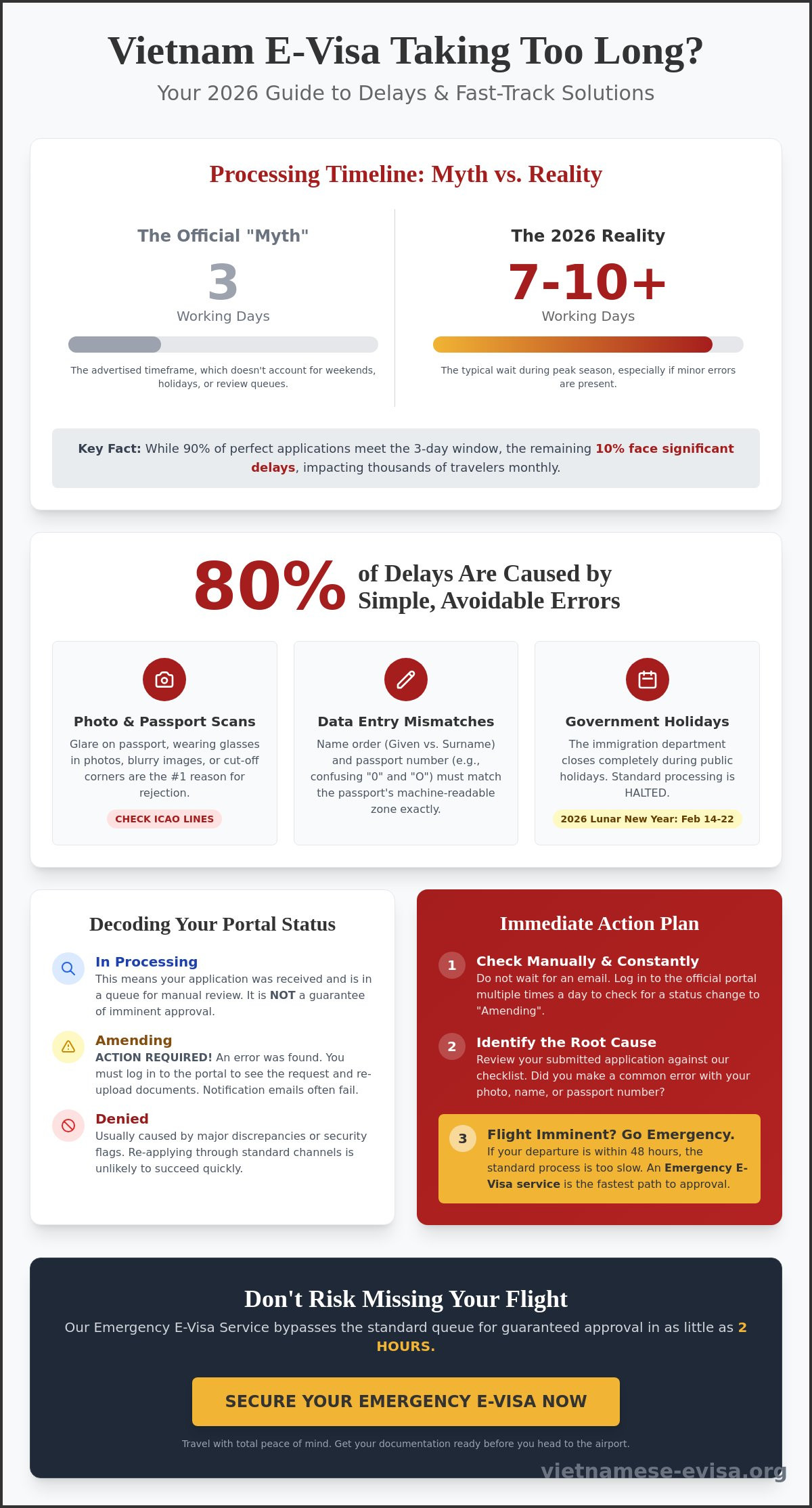
- Identify the specific data entry errors, such as ICAO line mismatches, that account for 80% of application delays.
- Account for the 2026 Vietnamese holiday schedule to prevent your application from stalling during government closures.
- Learn the exact steps to transition to an emergency vietnam visa or expedited vietnam visa when your departure is hours away.
- Follow a structured triage plan if you find your vietnam evisa taking too long to ensure approval in as little as 2 hours.
Why Your Vietnam E-visa is Taking Too Long: Myth vs. Reality in 2026
Many travelers assume the digital application process is automated and instantaneous. This is rarely the case. In 2026, the Vietnam Immigration Department handles significantly higher volumes than previous years because the e-visa program now covers every country and territory. While 90% of complete applications are approved within the standard window, the remaining 10% face technical or administrative hurdles that push the timeline into the 7-10 day range. Understanding Vietnam’s visa regulations is the first step in realizing that the government portal provides estimates, not legal guarantees. If you discover your vietnam evisa taking too long, it’s usually because your file has fallen into this high-volume backlog.
The 3-Day Processing Myth
The phrase “3 working days” is the most misunderstood part of the application process. Working days strictly include Monday through Friday and exclude all Vietnamese public holidays. For instance, the nine day Lunar New Year (Tet) break from February 14 to 22, 2026, completely halts all standard processing. If you submit your application on a Thursday afternoon before a holiday weekend, your clock might not start until the following Tuesday. Any request for additional information or a photo re-upload resets this timeline completely. In 2026, the average wait time for a standard, error-free application typically spans five to seven working days during peak travel months.
Decoding Portal Status Messages
When you see “In Processing,” it doesn’t mean your visa is approved and sitting in a queue. It simply means the department has received your data and it’s awaiting manual review by an officer. If your status changes to “Amending,” you must act immediately. This status indicates a mistake was found, but the system often fails to send the notification email to your inbox. You should check the portal manually every few hours to catch these requests early. A “Denied” status is less common but usually stems from security flag matches or major passport data discrepancies. If you are stuck in this cycle, an emergency vietnam visa can provide a bypass to these bureaucratic stalls.
Common Mistakes Causing Vietnam E-visa Delays
Statistics from recent travel seasons indicate that 80% of application delays stem from simple, avoidable data entry errors. While you might feel that your vietnam evisa taking too long due to government bureaucracy, it’s often a specific field in your form that triggered a manual review. When the system detects a discrepancy, it moves your file to “Amending” status. This shift adds an average of 3-5 working days to your timeline because it requires a manual re-review after you submit the correction. Understanding the nuances of the 2026 application process is vital, as most travelers ignore how a single typo can double their wait time.
Photo and Passport Scan Requirements
The most common technical failures involve the quality of your uploaded documents. Glare on the passport data page or wearing glasses in your portrait photo are leading causes for rejection. If the scan is even slightly blurry, the Immigration Department’s software can’t verify your identity, triggering an automatic stall. For a compliant photo, use your smartphone in natural daylight without a flash. Ensure the entire passport page is visible, including all four corners and the machine-readable ICAO lines at the bottom. These two lines of text are what the system uses to verify your data; if they’re cut off, your application stops immediately.
Name Order and Passport Number Errors
Western name structures frequently cause confusion during the application process. You must enter your “Given Name” and “Surname” exactly as they appear in the machine-readable zone of your passport, not as you usually write them. Another frequent culprit is the confusion between the number “0” (zero) and the letter “O” in passport numbers. Even a single character error will result in your vietnam evisa taking too long or being rejected at the boarding gate. You can verify your submitted data by logging into the portal even while the status is “Processing.” If you spot an error now, it’s often faster to secure an emergency vietnam visa than to wait for the government’s amendment request.
- Match the ICAO line character for character.
- Upload a portrait with a plain background and no glasses.
- Ensure the passport scan has zero glare on the laminated surface.
- Double-check “0” (zero) vs “O” (letter) in the document number.
- Verify that your entry and exit ports are 100% accurate.
External Factors: 2026 Holidays and System Overloads
Even with a perfect application, external factors can derail your travel plans. The 2026 calendar features several extended public holiday periods that completely shut down the Immigration Department’s processing centers. If you find your vietnam evisa taking too long during the months of December through April, you’re likely caught in the peak tourism surge. This period sees the highest volume of applications, often stretching the system’s capacity to its absolute limit. During these months, the standard three to five day window frequently becomes a ten day wait as officers prioritize the sheer volume of incoming files. Systemic delays aren’t just a possibility; they’re a statistical reality during the high season.
Tet 2026: The Ultimate Visa Bottleneck
The Vietnamese Lunar New Year, known as Tet, is the most significant cause of documentation delays. For 2026, government offices will observe a 9-day break from February 14 to February 22. Processing doesn’t just slow down; it stops entirely. The “Pre-Tet Rush” begins in late January as travelers scramble to secure approvals before the closure. Conversely, the “Post-Tet Backlog” creates a second wave of delays as staff work through thousands of applications submitted during the holiday. To avoid a disaster, you should submit your application no later than February 1, 2026. Applying any later than this date puts you at high risk of your approval being stuck in a digital queue until late February.
Peak Season and System Maintenance
Other critical dates include Reunification Day and Labour Day, creating a 4-day break from April 30 to May 3, and National Day from August 29 to September 2. These holidays often involve weekend bridges, meaning a short delay can easily turn into a full week of silence from the portal. Beyond holidays, Monday mornings are notorious for system instability. The portal often struggles to handle the massive influx of data submitted over the weekend, leading to technical glitches or unplanned maintenance windows. If the site feels slow or returns an error page on a Monday, it’s likely undergoing a temporary load-balancing reset. For long-term travelers, our Vietnam E-visa 2026 application guide provides a full calendar of these high-risk dates.
If your flight is scheduled during a holiday and your approval is missing, don’t wait for the offices to reopen. You can still secure a rush vietnam visa through our expedited channels to ensure you don’t miss your trip.
What to Do If Your Vietnam E-visa is Delayed: Immediate Action Steps
When your flight is approaching and your status remains unchanged, you need a decisive strategy. Waiting for a government email that may never arrive is a risk you can’t afford. If you find your vietnam evisa taking too long, the first step is to stop refreshing the portal and start a tactical triage plan. Most travelers lose precious hours hoping for a last-minute update, but in 2026, administrative backlogs often require professional intervention to bypass the standard queue. We’ve designed this plan to help you navigate the final 48 hours before departure with administrative precision.
The 24-Hour Triage Plan
Your actions should be dictated by the time remaining before your departure. Follow this sequence to protect your travel investment:
- Step 1: Log into the official portal and check for “Amending” notes. If the status is “Processing” but it’s been more than five working days, your file is likely stalled in a manual review queue.
- Step 2: If your flight departs in less than 24 hours and you have no approval, don’t wait for the government system to reset. Automated emails are often delayed by several hours even after a status change occurs in the database.
- Step 3: Contact a specialized intermediary to secure an urgent Vietnam visa. This moves your data into a priority lane that standard applications can’t access.
How Our Emergency Service Works
We specialize in resolving situations where a standard application has failed to materialize. Our team offers multiple processing tiers, including 2-hour, 4-hour, and same-day options. We don’t just start a new application; we can often pull an existing “Processing” file into our fast-track system to expedite the final approval. To begin the process, you only need to provide a clear passport copy, a compliant portrait photo, and your confirmed flight ticket. This documentation allows us to verify your identity and urgency level with the department immediately. Our emergency Vietnam visa service is the only reliable path for travelers with sub-24h departures who can’t risk the financial loss of a missed flight. We remain ready to assist across different time zones, ensuring that your 2026 trip stays on schedule despite any portal delays.
Secure Your Vietnam Entry Today
Navigating the complexities of the 2026 immigration system requires more than just patience; it requires a proactive approach to administrative hurdles. Whether your vietnam evisa taking too long because of a minor photo glare or the massive Tet holiday backlog, you now have the tools to diagnose the delay and take immediate action. Remember that the official portal’s status is often a placeholder for manual reviews that can stretch well beyond your departure date if left unaddressed. Relying on expert intervention is the most effective way to protect your travel investment and avoid the high costs of missed international flights.
With over 15 years of experience in inbound tourism, our team provides the vigilance needed to resolve high-stakes documentation crises. We offer 24/7 expert support and a same-day approval guarantee to ensure your plans remain intact. Don’t let bureaucratic stalls dictate your itinerary. Get Your Emergency Vietnam Visa Approved in 2 Hours and travel with the confidence that your documentation is in professional hands. Your journey to Vietnam is just a few hours away from being fully secured.
Frequently Asked Questions
How long can a Vietnam E-visa stay in “Processing” status?
A Vietnam E-visa typically stays in “Processing” status for three to five working days, though this window frequently extends to seven or ten days during peak travel periods. If your file remains stuck for over a week, it’s likely flagged for a manual data review or caught in an administrative backlog. You should check the portal manually twice every day to ensure the status hasn’t shifted to “Amending” without a notification being sent to your inbox.
Can I speed up my Vietnam E-visa after I have already submitted it?
You can speed up an existing application by transitioning to an expedited vietnam visa service that offers priority handling. A specialized intermediary can pull your current “Processing” file and move it into a faster approval lane within the immigration database. This is the most effective solution if your vietnam evisa taking too long and your international flight departs within the next 24 to 48 hours.
What happens if my Vietnam E-visa is still processing on my flight day?
You cannot board your flight if your visa is still in “Processing” status on your departure day. Airlines are legally required to verify a valid approval letter or e-visa during the check-in process to avoid heavy fines. If you find yourself at the airport without an approved document, your only option is to apply for an emergency vietnam visa to get your clearance in as little as 2 hours.
Is it possible to get a Vietnam E-visa on a Saturday or Sunday?
Standard government processing is unavailable on Saturdays and Sundays because the Immigration Department offices are closed. However, travelers can still secure a rush vietnam visa through private channels that maintain specialized support for urgent weekend requests. These services are essential for those who realize their documentation is missing or delayed just before a weekend departure, as they bypass the standard Monday-Friday business cycle.
Why haven’t I received an email about my visa correction?
Automated notification emails from the government portal are frequently blocked by spam filters or delayed by server synchronization issues. It’s common for a status to change to “Amending” on the official website several days before an email notification is generated. To prevent unnecessary delays, you must log in to the portal manually using your registration code to check for any required data or photo corrections.
Can I apply for a new E-visa if my first one is still processing?
Submitting a second application while your first one is still “In Processing” usually triggers a duplicate entry error in the immigration system. This conflict can cause both files to be flagged for additional manual scrutiny, which actually increases the total wait time. It’s much safer to upgrade your existing application to an urgent vietnam visa status rather than risking the complications of a double submission.