


Vietnam E-visa Processing Time 2026: Standard vs. Emergency Options
Your Vietnam E-visa shows “In Processing” and your flight departs in 48 hours. That single status message has derailed more travel plans than most people realize, and if you’re reading this right now, you’re probably already feeling that pressure. The uncertainty around Vietnam evisa processing time is one of the most stressful parts of planning a trip to Vietnam, particularly when non-refundable hotel bookings and connecting flights are sitting in the balance.
You already know the standard advice: apply early, double-check your documents, and wait. But in 2026, that guidance isn’t always enough. Public holiday surges, portal backlogs, and shifting approval windows mean that even a well-prepared applicant can find themselves staring at a pending status with a boarding gate closing in the background.
This article gives you the full picture. You’ll get a clear breakdown of standard versus expedited processing timelines for 2026, a practical look at how Vietnamese public holidays affect approval windows, and a concrete Plan B for travelers who can’t afford to wait. Whether you’re planning months ahead or scrambling today, you’ll leave with the information you need to protect your trip.
Key Takeaways
- Vietnam evisa processing time officially runs 3 working days, but 2026 peak season realities mean travelers should budget 5 to 7 working days to avoid last-minute pressure.
- Small data entry errors and non-compliant photos are the two leading causes of application resets in 2026 — knowing what triggers a delay puts you ahead of most applicants.
- Your registration code is the key to tracking your approval status in real time; this article shows you exactly how to use it and what to do if it never arrived.
- If standard processing won’t meet your departure window, expedited options exist — including urgent tiers as fast as 2 hours for travelers already at the check-in counter.
- Vietnamese public holidays create approval blackout windows that catch thousands of travelers off guard every year; you’ll learn exactly when those gaps fall in 2026.
Standard Vietnam E-visa Processing Timelines in 2026
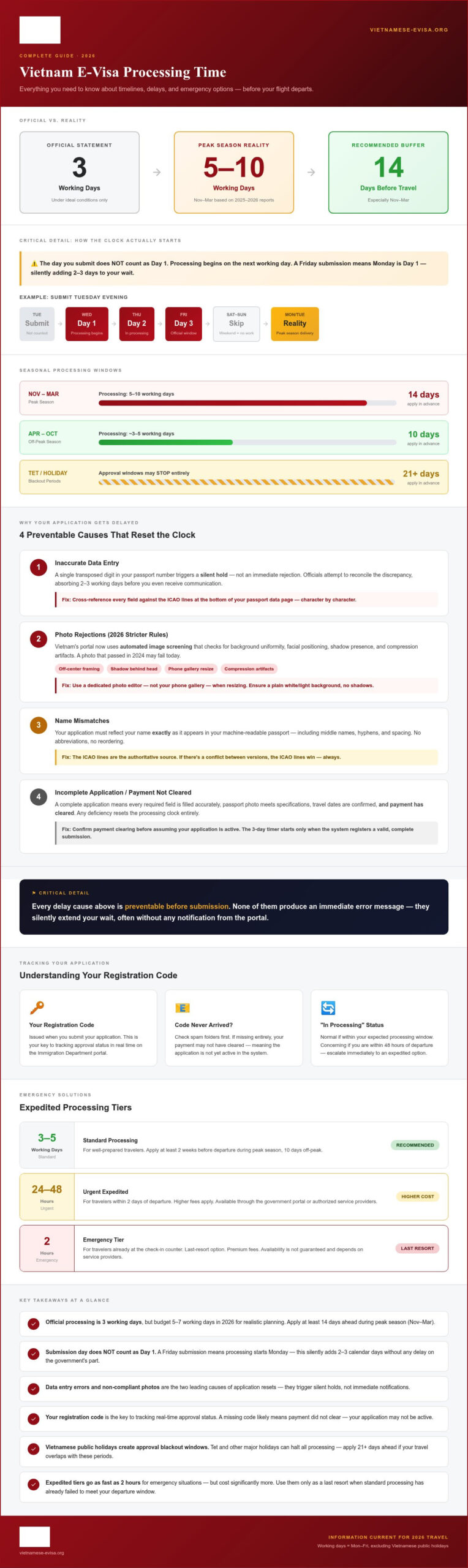
The official government position is straightforward: Vietnam e-visa applications take 3 working days to process. That figure appears on the Immigration Department’s portal, and it’s technically accurate under ideal conditions. The problem is that “ideal conditions” describes a narrow window that doesn’t reflect what most travelers experience during busy travel periods.
Travelers posting on forums throughout 2025 and into 2026 consistently report waits of 5 to 10 days during peak months, even with complete, error-free applications. The gap between the official timeline and lived experience is real, and it’s the most important thing to understand before you book anything non-refundable.
One detail the official portal doesn’t emphasize clearly enough: the day you submit your application does not count as day one. Processing begins on the next working day. Submit at 11:59 PM on a Tuesday, and Wednesday is day one. Submit at any point on a Friday, and Monday is day one. That distinction can silently add two to three days to your actual wait without any delay occurring on the government’s end.
A complete application, for timing purposes, means every required field is filled accurately, your passport photo meets the specified format, your travel dates are confirmed, and payment has cleared. Any deficiency resets the processing clock. The 3-day timer doesn’t start until the system registers your submission as complete and valid.
Working Days vs. Calendar Days: Calculating Your Arrival
In the context of Vietnam evisa processing time, “working days” means Monday through Friday during standard Vietnamese government office hours, excluding all public holidays. A Friday afternoon submission sits untouched until Monday morning. Using that logic, here’s a practical example: submit on Tuesday, and under the official 3-working-day window, you’d expect a result by Friday. In practice, during high-volume periods, that result may not arrive until the following Monday or Tuesday. Always calculate using working days, then add a buffer of at least two additional days before your departure.
Seasonal Variations: When to Expect Longer Waits
Vietnam’s peak inbound tourism window runs from November through March, driven by the dry season across the south and a surge in international arrivals for the Lunar New Year period. Flight capacity into Hanoi and Ho Chi Minh City increases substantially during these months, and visa application volume follows that curve directly. During this window, the realistic vietnam evisa processing time shifts from 3 working days to 5 to 7 working days as a baseline. The practical recommendation is firm: apply a minimum of two weeks before your intended travel date if you’re departing between November and March. Outside peak season, 10 days in advance provides a reasonable buffer for most travelers.
Why Your Vietnam E-visa Might Be Delayed
Understanding the official timeline is only half the equation. The other half is knowing what quietly extends that timeline without any notification, error message, or explanation from the portal. Most travelers in a delay situation are not dealing with a systemic problem. They’re dealing with one of four specific, preventable causes.
Inaccurate Data Entry
A single transposed digit in your passport number doesn’t trigger an immediate rejection. It triggers a silent hold while officials attempt to reconcile the discrepancy. That process can absorb two to three working days before you receive any communication. The same applies to name mismatches: your application must reflect your name exactly as it appears in your machine-readable passport, including middle names, hyphens, and spacing. No abbreviations. No reordering.
The most reliable way to eliminate this risk is to cross-reference your application against the ICAO lines at the bottom of your passport data page, character by character, before submitting. Those two lines are the authoritative source. If there’s a conflict between how your name appears elsewhere and how it appears there, the ICAO lines win.
Photo Rejections in 2026
Vietnam’s immigration portal uses automated image screening that has become significantly more rigorous. Photos are now checked for background uniformity, facial positioning, shadow presence, and compression artifacts introduced by resizing. A photo that passed the system in 2024 may not pass today. Common rejection triggers include slightly off-center framing, any visible shadow behind the head, and images that have been resized using standard phone gallery tools rather than dedicated photo editors. If your photo is flagged, your vietnam evisa processing time resets from zero.
The “In Processing” Loop
If your status has read “In Processing” for more than four consecutive working days with no change, you’re likely in one of two situations: your application is queued behind a volume backlog, or a soft hold has been placed pending manual review. The portal doesn’t distinguish between these states. Submitting a new application at this point creates a duplicate record and complicates your case. The correct action is to wait until day five, then contact the Immigration Department directly with your application reference number. Document every contact attempt.
Critical 2026 Holiday Dates to Avoid
Vietnamese public holidays are the single most underestimated cause of extended visa delays, and they affect travelers who submit applications days before the closure window opens. The Immigration Department operates on the Vietnamese government calendar, which includes several multi-day closures.
- Tet (Lunar New Year) 2026: Tet falls in late January 2026, with government offices typically closing for seven or more consecutive days. Official closure dates for 2026 have not been finalized at time of publication; confirm the exact window on the Vietnamese government portal before you book. Any application submitted within ten working days before Tet closures begin carries a meaningful risk of processing delays extending into the post-holiday backlog period.
- National Day 2026: The September 2 National Day holiday creates a five-day closure window from August 29 through September 2. Applications submitted in the week prior routinely see approvals delayed until mid-September as the queue clears.
- Post-holiday backlogs: When offices reopen after any multi-day closure, the accumulated queue doesn’t clear in a day. Travelers submitting immediately after a holiday period should expect the realistic vietnam evisa processing time to run seven to ten working days as normal volume resumes alongside the backlog.
Common Application Mistakes and How to Fix Them
Beyond data entry errors, two structural mistakes cause a disproportionate share of delays. First, applicants frequently select the wrong entry port. Vietnam e-visas are port-specific documents; an e-visa listing Noi Bai International Airport (Hanoi) cannot be used to enter through Tan Son Nhat (Ho Chi Minh City). If your routing includes a connecting flight that changes your first point of entry into Vietnam, your port selection must reflect that first entry point, not your final destination. Second, travel date ranges must account for your actual arrival time. A visa valid from March 10 does not cover a flight that lands at 1:00 AM on March 10 if the departure was on March 9 in a different time zone.
For a detailed walkthrough of every field in the application form and how to complete it without triggering a reset, the Ultimate 2026 Vietnam E-visa Application Guide covers each section with specific examples. If your situation is already time-sensitive, reviewing that resource before resubmitting can prevent a second delay from compounding the first.
If you’ve identified an error in a submitted application and your departure window is shrinking, an emergency Vietnam visa service may offer the fastest path to a clean, correctly submitted application with expedited processing.
How to Check and Manage Your Visa Status
Once your application is submitted, the official portal at evisa.gov.vn is your primary tracking tool. To run a status check, you’ll need three pieces of information ready: your registration code (issued immediately after submission), the email address used during the application, and your date of birth. Enter all three exactly as submitted. A single character mismatch will return an error, not a status update.
Before you check the portal, check your spam folder. Amendment requests and status notifications from the Immigration Department are routinely filtered by email providers. Set a daily reminder to scan both your inbox and spam folder throughout the processing window. Missing an amendment request by even one day can compress your available response time significantly.
Tracking Your Application Progress
Three status messages cover the vast majority of applicant situations. “Unpaid” means your payment hasn’t been confirmed by the system; contact your payment provider before resubmitting anything. “In Processing” is the standard active state and requires no action until it exceeds four working days without movement. “Amended” is the status that demands immediate attention: it means the Immigration Department has identified a discrepancy and is requesting additional information or corrected documentation before the vietnam evisa processing time clock can continue.
If you never received a registration code after submitting, don’t assume your application went through. Check your spam folder first. If nothing is there, log back into the portal using your passport number and date of birth to retrieve it. If the portal shows no record, your session may have timed out before the submission completed and you’ll need to reapply.
The “Amended” Status: How to Respond Quickly
An “Amended” flag most commonly appears because of a blurry or unreadable passport data page scan, or because the name entered doesn’t exactly match the machine-readable zone of the passport. Respond to the amendment request through the portal as quickly as possible, uploading a corrected document or photo. Don’t submit a new application to resolve an amended status. Doing so creates a duplicate record and typically resets the three-day processing clock on a fresh submission while the original case remains open and unresolved.
If your departure is inside 48 hours and your status is still “In Processing” or “Amended” with no resolution in sight, waiting is no longer a viable strategy. At that point, the fastest path forward is professional intervention. An emergency Vietnam visa service with rush processing capability can often move faster than the standard government queue, including expedited turnarounds for travelers already approaching their check-in window. That option exists precisely for this scenario, and using it early in the 48-hour window gives it the best chance of working.
Document every portal check and every contact attempt with timestamps. If you need to escalate or dispute a processing delay, that record is your evidence.
Emergency and Expedited Processing Solutions
Standard processing failed to meet your window. That’s the reality you’re now managing, and the only productive question is what happens next. The good news: a parallel track exists specifically for this scenario, and it moves significantly faster than the government queue.
Specialized intermediary services operate outside the standard vietnam evisa processing time queue by working directly with immigration contacts to prioritize flagged applications. Where the public portal processes submissions in batch order, these services route urgent cases through dedicated channels. The result is a compressed turnaround that the government portal simply doesn’t offer to individual applicants.
Processing tiers typically available through rush services include same-day approvals, 4-hour turnarounds for travelers departing that evening, and 2-hour emergency processing for those already at or approaching the check-in counter. The 2-hour tier exists precisely because airport emergencies are a documented, recurring scenario, not an edge case.
When to Switch to Urgent Processing
Apply the 48-hour rule without exception: if your departure is two days away and your portal status hasn’t moved, stop waiting and act. Hoping the status updates overnight is a strategy that fails regularly. The window to use an expedited service effectively closes the longer you wait, because even rush processing requires a minimum lead time to execute.
If you’re already at the airport with no approval in hand, you’re not out of options. The 2-hour processing tier was built for exactly this situation. Submit your request immediately, before you reach the check-in desk, to maximize the available time. Emergency Vietnam visa processing is available for travelers in this position and has resolved cases at the check-in counter.
Why Vietnam-Evisa.Org Is the Right Call Under Pressure
Operating since 2007, Vietnamese-Evisa.Org has handled time-critical visa cases across every peak season, public holiday closure, and portal backlog scenario on record. That depth of operational experience matters when your situation is non-standard and the clock is running.
Key advantages for travelers in a deadline situation:
- Direct immigration channel access: Stuck applications get escalated rather than queued, which is the core difference between a 2-hour result and a 3-day wait.
- 24/7 availability: Support operates through Tet, National Day, and every other closure window that shuts down the standard government portal.
- Proven track record: Nearly two decades of successful urgent approvals provides a documented baseline that generic services can’t match.
Think of it as travel insurance for your entry documents. You hope you don’t need it, but when you do, the alternative is a missed flight and non-refundable losses that dwarf the cost of the service. For a full breakdown of what urgent processing covers and how to submit a time-sensitive request, the emergency Vietnam visa page walks through every step. If you want to understand the full scope of what rush vietnam evisa processing time options look like across different urgency tiers, that resource covers the complete picture.
Don’t wait for the portal to update. If the timeline is already tight, act now.
Your Vietnam Trip Starts With a Visa That’s Actually Approved
Vietnam evisa processing time is rarely as simple as the official 3-day figure suggests. Peak season backlogs, public holiday closures, photo rejections, and data entry errors all compress the window between application and approval faster than most travelers expect. The core lesson from everything covered here: apply early, calculate using working days, and never assume a clean submission guarantees a fast result.
If your timeline is already tight, waiting isn’t a strategy. Travelers who act at the first sign of a stalled application consistently have better outcomes than those who hope the portal updates overnight. A trusted intermediary with nearly two decades of experience handling stuck, amended, and last-minute cases can deliver approvals in as little as 2 hours when the standard queue can’t move fast enough.
Don’t let a pending status turn into a missed flight. Fast-track your Vietnam E-visa application now and travel with the confidence that your entry documents are in expert hands.
Frequently Asked Questions About Vietnam E-visa Processing Time
How long is the Vietnam E-visa processing time in 2026?
The official government timeline is 3 working days, but that figure reflects ideal conditions. During peak travel periods from November through March, realistic vietnam evisa processing time runs 5 to 7 working days for most applicants. The day you submit doesn’t count as day one, and weekends plus public holidays don’t count at all. Budget at least two weeks before departure to avoid any last-minute pressure.
Can I get a Vietnam E-visa in 2 hours?
Yes, but not through the standard government portal. The 2-hour turnaround is available through specialized intermediary services that route urgent cases through dedicated immigration channels rather than the public queue. This tier exists specifically for travelers already at or approaching the check-in counter. If you’re in that position, submit your request immediately rather than waiting to see if the portal updates on its own.
Does the Vietnam E-visa process on weekends?
No. The Vietnamese Immigration Department operates on a Monday through Friday schedule, and weekends don’t count toward the processing window. A submission made on Friday afternoon won’t enter the queue until Monday morning. If your departure falls on a Monday or Tuesday, a Friday submission leaves you with very little working-day buffer, even under the official 3-day timeline.
What happens if my Vietnam E-visa is still “In Processing” on my flight day?
Don’t wait at the portal hoping for an update. Airlines cannot board passengers for Vietnam without a confirmed visa approval, so an unresolved status on departure day is a genuine boarding risk. Contact an emergency visa processing service immediately, before you reach the check-in desk. The earlier in the day you act, the more time a rush service has to resolve your case before the gate closes.
How far in advance should I apply for my Vietnam E-visa?
Apply at least two weeks before departure if you’re traveling between November and March. Outside peak season, ten days in advance provides a reasonable buffer for most travelers. The two-week minimum accounts for potential photo rejections, data entry holds, or portal backlogs that can reset your processing clock without any warning notification. Earlier is always safer, particularly if your trip includes non-refundable bookings.
Are there delays for the Vietnam E-visa during Tet 2026?
Yes, and they’re significant. Tet is the longest government closure window of the year, typically spanning seven or more consecutive days in late January. Any application submitted within ten working days before that closure risks spilling into the post-holiday backlog, when accumulated queues can push the realistic processing window to seven to ten working days. Confirm the exact 2026 Tet closure dates on the official Vietnamese government portal before you finalize your travel timeline, as dates aren’t always confirmed far in advance.