


Vietnam E-visa Port of Entry Change: A 2026 Guide to Correcting Your Travel Plans
What if you arrive at the check-in desk only to realize your flight lands in a different city than the one you originally selected on your application? It’s a gut-wrenching moment that leads to immediate anxiety about being denied boarding or wasting your visa fees. You’ve likely heard that a vietnam evisa port of entry change is a rigid legal requirement that demands a completely new application, and with your departure date looming, you don’t have time for bureaucratic delays or portal errors.
We understand the high-stakes pressure of time-sensitive travel and the stress of navigating complex government instructions. This 2026 guide clarifies the latest immigration resolutions, including Government Resolution No. 389/NQ-CP, which significantly changed how entry checkpoints are handled. You’ll learn exactly how to verify your document’s validity across the 83 eligible international checkpoints so you can head to the gate with total confidence. We’ll also provide a fast-track solution for correcting critical errors and explain the new mandatory Digital Arrival Card requirements to ensure your entry is seamless and secure.
Key Takeaways
- Understand the strict nature of your Vietnam E-visa: Your approved entry port is binding, and arriving at any other checkpoint will result in immediate boarding denial or immigration rejection.
- Learn why a vietnam evisa port of entry change is not permitted: Despite 2026 digital advancements, your E-visa is strictly tied to your declared entry point, making modifications impossible post-approval.
- Identify critical passport and biographical errors that necessitate a new visa application to avoid boarding denial by your airline.
- Master the mandatory Digital Arrival Card, which must be completed online within three days of your arrival at primary international airports.
- Access urgent visa rescue services from Vietnamese-Evisa.Org, providing valid entry documents in as little as four hours for time-critical travel emergencies, including those stemming from incorrect port declarations.
Can You Change Your Vietnam E-visa Port of Entry After Approval?
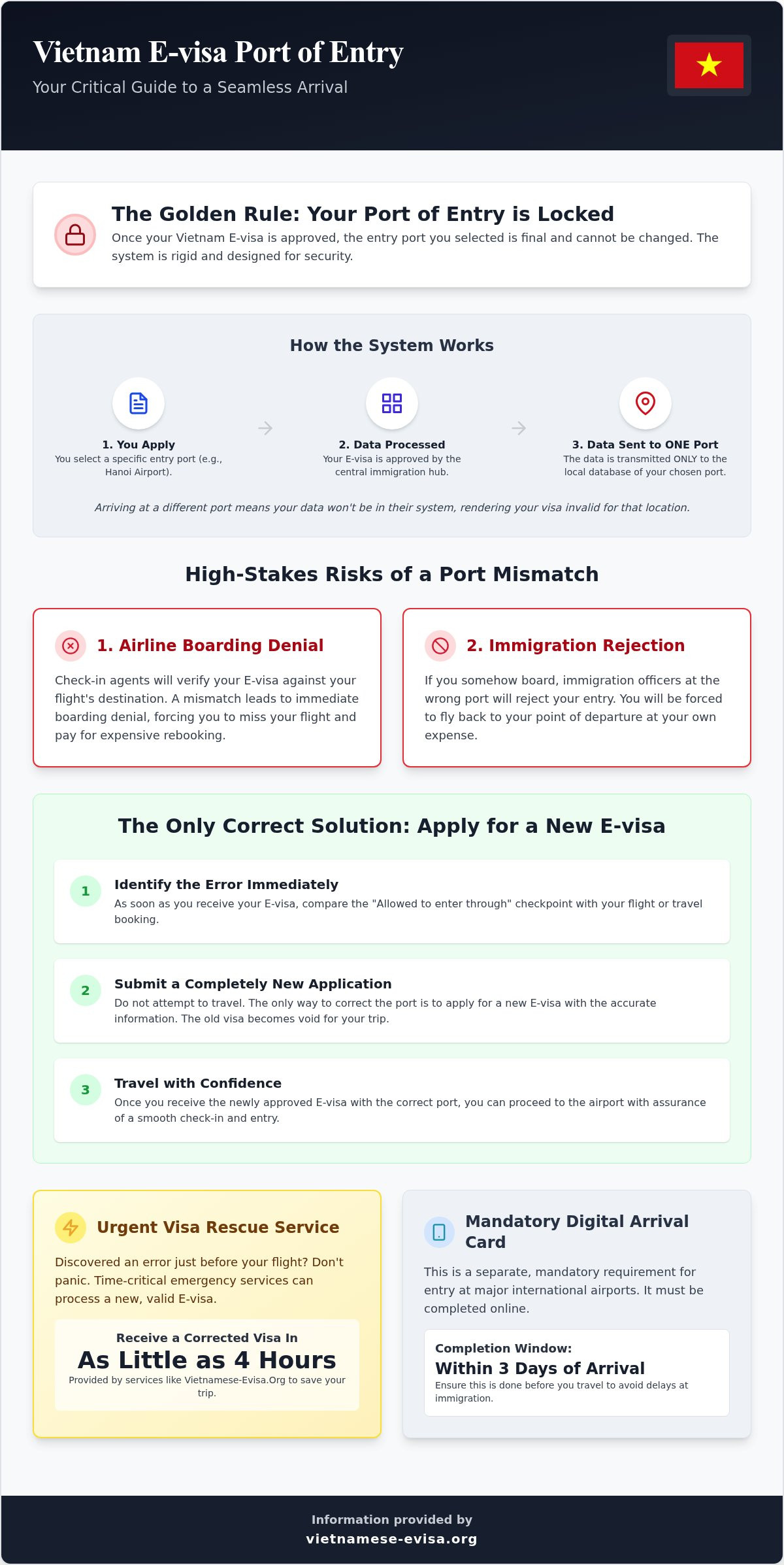
The short answer is no. Once your document is officially issued, a vietnam evisa port of entry change is legally impossible through the standard government portal. The Vietnam Immigration Department treats the electronic visa as a final digital record. This record is electronically transmitted to the specific border checkpoint you selected during the application process. If you arrive at a different gate, the local database won’t contain your pre-cleared information. This mismatch is classified as traveling with an invalid visa, which often results in immediate boarding denial at the airport.
To avoid these complications, it’s vital to consult the Ultimate 2026 Application Guide before submitting your data. Understanding Vietnam’s visa policies is the first step in ensuring your travel plans remain on track. If you’ve already received an approval with the wrong gate listed, don’t attempt to use it; you’ll likely face significant issues at immigration.
Why the Port of Entry is Fixed
The rigidity of the system stems from the high level of digital synchronization between the central immigration hub and individual border checkpoints. When your visa is approved, your data is pushed to the specific terminal’s local server. Security protocols require this pre-verification to maintain national safety standards. Vietnam’s modern automated gate system relies on this specific assignment. The scanners at one airport simply won’t recognize a visa assigned to a different terminal or land border. Because the vietnam evisa port of entry change isn’t an option in the digital system, the record remains locked to the original gate.
Exceptions: Are Any Port Changes Allowed?
Many travelers mistakenly believe that switching between international airports is acceptable since they’re all air terminals. This is a dangerous myth. The immigration rules are equally strict for land borders, seaports, and airports. If you’ve secured a visa for a specific land crossing but decide to fly instead, your current document is void for that journey. The only rare exception occurs during genuine flight emergencies. If your plane is diverted to a different city due to weather or mechanical failure, immigration officials typically coordinate with the airline to facilitate entry. Outside of these extreme scenarios, your only path forward is to secure a corrected document before you depart.
The Risks of Using an E-visa with the Wrong Port
Attempting to enter the country with a mismatched entry gate is a high-stakes gamble that rarely pays off. The official Vietnam e-visa portal clearly states that all submitted data must be 100% accurate. Immigration officers at the border lack the authority to perform a manual override for a port mismatch. Their digital systems are hard-coded to recognize the specific entry gate assigned to your record. If your data isn’t in their local database, you simply don’t exist in their system for that location. The system isn’t designed for flexibility; it’s designed for strict border security.
Airline Boarding Denials
Check-in agents are your first and often most difficult hurdle. They’re legally required to verify that your visa matches your landing destination before issuing a boarding pass. Airlines face heavy financial penalties for transporting passengers with invalid documentation. If your visa specifies a land border and you’re standing at an airport check-in desk, you’ll likely be denied boarding on the spot. This leads to missed flights and the high cost of last-minute rebooking. The risk is absolute. If you find yourself in this situation, you may need an emergency visa solution to save your trip and avoid a total travel collapse. Don’t expect the airline to make an exception for a clerical error.
Immigration Checkpoint Rejection
What happens if you manage to board but land at the wrong port? You’ll face immediate rejection at the immigration desk. The “Turnaround” process is a traveler’s nightmare. You’re forced to fly back to your departure point on the next available flight at your own expense. Beyond the immediate logistical failure, attempting to use invalid documents can lead to administrative delays or even being flagged in the system for future entries. Since a vietnam evisa port of entry change isn’t possible after issuance, the risk of being turned away is nearly certain. Immigration officials take these discrepancies seriously. They view a mismatch as a sign of poorly prepared travel or, in worse cases, an attempt to bypass standard security protocols. Protecting your future travel ability starts with ensuring your current documents are flawless.
How to Correct a Port of Entry Error: Step-by-Step
If you determine that your current documentation doesn’t meet the entry requirements for your new arrival point, you must act quickly. Since a vietnam evisa port of entry change cannot be processed as a simple edit to an existing file, you’ll need to secure a fresh approval. This process ensures your digital record is correctly synchronized with the specific border database where you’ll be appearing. Don’t wait for a rejection at the gate; follow these precise steps to rectify your travel documents.
- Step 1: Confirm the new port. Double-check your flight itinerary or land crossing name. Ensure the checkpoint is one of the 83 eligible international gates.
- Step 2: Submit a new application. Start a fresh request through a secure portal. You must provide all biographical data again to ensure the new record is complete.
- Step 3: Settle the fees. You’ll need to pay the processing costs again. Government and service fees are tied to specific applications and aren’t transferable between files.
- Step 4: Monitor your status. Watch your inbox for the new approval. You must have the updated document in hand before you head to the airport.
Timing Your New Application
Timing is everything when your departure is just days away. Standard government processing typically takes three to five business days, but this is never guaranteed. If your flight is within the next 48 hours, choosing an urgent timeline is the only way to ensure you aren’t left at the check-in desk. There’s a common myth that having two applications will cause a system crash. In reality, it’s safe to have a second application; the most recent approved record is what the immigration officers will use. Don’t waste precious hours waiting for a response from the government helpdesk. They rarely provide manual corrections for port errors.
Avoiding Common Application Mistakes
Precision prevents a second round of stress. When filling out the new form, pay close attention to the “Entry Gate” dropdown menu. It’s easy to click the wrong airport if they have similar names. Also, ensure your passport bio page image is perfectly clear. If the automated system can’t read your passport number or full name, your application will be delayed for manual review. Before you start, verify the current Vietnam Visa Fee to ensure you’ve budgeted for the correction. If you’re already at the airport or your flight is tonight, you can apply for a corrected Vietnam E-visa now to get your plans back on track immediately.
Emergency Solutions for Last-Minute Changes
When you’re standing at the check-in counter and realize your documentation is invalid, every minute counts. The government portal is not designed for these high-stakes moments, as it often takes several business days to process new requests. Private agencies serve as a critical rescue line, offering expedited processing that bypasses standard administrative queues. In many cases, we can facilitate a new approval in as little as four hours, ensuring you don’t miss your flight or forfeit your travel investment. If you’ve just discovered a mismatch, you should Apply for an Emergency Vietnam Visa immediately to initiate the recovery process.
An intermediary acts as a specialized advocate, navigating the complexities of the immigration database on your behalf. While a vietnam evisa port of entry change isn’t a simple button click, our team understands the proprietary approval forms required to secure a fresh record on an accelerated timeline. This service is a strategic investment for travelers who cannot afford the delays of a traditional application. It’s the difference between a ruined vacation and a successful entry. We prioritize your security and speed, ensuring your travel plans remain intact despite the initial error.
When to Use Expedited Processing
You should consider expedited services if your departure is less than 48 hours away. Realizing a port error at the last second is a common travel crisis, and our Emergency Vietnam Visa service is built specifically for these scenarios. We provide 24/7 dedicated support, giving you a direct line to experts who remain calm under pressure. We handle the bureaucratic stress so you can focus on your journey. Our goal is to provide a seamless resolution that gets you through the gate without further complications.
Final Checklist Before You Head to the Airport
Before you leave for the terminal, perform a final audit of your documents. Precision is your best defense against immigration hurdles. Use this checklist to ensure a smooth arrival:
- Print the correct version: Ensure you have the most recent approval that matches your arrival gate. Check the port name one last time.
- Carry a digital backup: Save a PDF copy on your phone and a cloud storage service to ensure accessibility.
- Match the gate: Remember that your entry is only guaranteed when the visa record matches the specific checkpoint where you land.
By following these steps, you can travel with the certainty that your documentation is valid and your entry is secure. A vietnam evisa port of entry change might be a stressful hurdle, but with the right expert support, it’s a problem that can be solved before you even reach the gate.
Secure Your Valid Entry Documents Today
A mismatch between your visa and your landing point is a critical error that standard government portals cannot fix instantly. Since a vietnam evisa port of entry change is legally rigid, your only reliable path forward is a fresh, accurate application. Attempting to enter with an invalid document risks immediate boarding denial or being turned around at the border. We have detailed the risks of airline rejection and the precise steps needed to secure a corrected visa before your departure.
Don’t let a clerical mistake derail your travel plans. Our team specializes in rapid turnaround solutions for travelers facing high-stakes documentation crises. We provide processing in as little as 2 hours, backed by 24/7 expert assistance and a 100% approval guarantee for urgent cases. Fix your Vietnam E-visa port error now with our Emergency Processing service and move toward your destination with total peace of mind. Your journey is too important to leave to chance; take action now to ensure your arrival is seamless and stress-free.
Frequently Asked Questions
Can I enter Vietnam at a different airport than the one on my e-visa?
No, you cannot enter at a checkpoint that doesn’t match your approved document. Vietnamese immigration requires your visa to be synchronized with the specific gateway database listed on your file. If your flight lands at a different airport, the airline will likely deny you boarding because they’re legally required to verify your visa against the flight manifest. A mismatch is viewed as an invalid document, making a new application mandatory for entry.
What happens if my e-visa has the wrong port of entry?
If your e-visa contains the wrong checkpoint, you face significant risks of being denied entry at the border. Immigration databases are synchronized with specific checkpoints; if you arrive at a gate where your record isn’t stored, officers cannot manually override the system. This usually leads to a “turnaround” where you’re forced to fly back to your origin point immediately at your own expense. It’s a stressful and costly situation that requires immediate correction.
How long does it take to get a new Vietnam e-visa if I made a mistake?
A standard application through the government portal usually takes three to five business days. However, this timeline isn’t guaranteed and can take longer during peak travel seasons. If you need a vietnam evisa port of entry change urgently, private agencies can facilitate a new approval in as little as two to four hours. This expedited service is vital for travelers who discover errors just before their flight and need a rescue solution.
Can I edit my Vietnam e-visa after it has been approved?
No, you cannot edit any information on an e-visa once the immigration department has issued the approval. The digital record is locked and cannot be modified by the traveler or a helpdesk agent. Any error, including a wrong entry gate or a misspelling of your name, requires a completely new application. You should always double-check every detail on the application form before submitting your final payment to avoid the need for a re-application.
Is there a way to fast-track a Vietnam e-visa for a port change?
Yes, you can fast-track a new application if you need a vietnam evisa port of entry change on a tight deadline. While the government portal doesn’t offer a rush option, private intermediaries specialize in emergency processing for these specific errors. These services provide 24/7 support and can secure a valid document for a different entry point in a matter of hours. It’s the most reliable method to ensure you don’t miss your upcoming flight.
Do I have to pay the visa fee again for a port of entry correction?
Yes, you must pay the processing fees again for a new application. The Vietnam Immigration Department does not offer refunds or credits for mistakes made during the initial submission. Since each application generates a unique digital record and processing ID, the fees are non-transferable. While losing the initial fee is frustrating, the cost of a new visa is much lower than the price of a missed international flight or a last-minute ticket home.