


Vietnam E-visa: 2026 Land Border Crossing Guide
Imagine standing at the Moc Bai border gate with your bags packed, only to be told your documentation is invalid because you selected the wrong entry point. It’s a high-stakes moment that triggers immediate anxiety, especially when you’re stuck in the “no-man’s land” between countries. Learning exactly how to use vietnam evisa at land border crossings is the only way to avoid being stranded or pressured into paying unofficial fees. You’re right to be cautious; in 2026, border officials allow zero margin for error regarding your digital paperwork or port selection.
This guide provides the exact procedural steps and updated documentation requirements you need to ensure a seamless entry. We’ll examine the 27 land borders currently accepting E-visas, explain the mandatory 2026 Digital Arrival Card for gates like Dong Dang, and show you how to fix urgent visa errors on the spot. You’ll gain the expert knowledge required to navigate the checkpoint quickly and reach your destination without the stress of bureaucratic roadblocks. Prepare your documents correctly now to ensure your travel plans remain on track and secure.
Key Takeaways
- Verify that your E-visa explicitly lists the correct land gate, as 2026 regulations permit entry only through the specific port of entry designated on your document.
- Follow the precise sequence of how to use vietnam evisa at land border checkpoints, including securing your exit stamp from the neighboring country before entering the transit zone.
- Prepare a high-quality physical printout of your E-visa and Digital Arrival Card to satisfy the strict “hard copy” requirements enforced at all 27 approved land borders.
- Maintain passport validity for at least six months and ensure you have two blank pages available for necessary entry and exit stamps.
- Access 24/7 emergency assistance for immediate port-of-entry corrections or last-minute approvals if you encounter critical documentation errors while at the border.
Understanding the Vietnam E-visa Land Border Framework
The 2026 Vietnam E-visa is a digital permit allowing travelers to enter the country for up to 90 days. It’s available for both single and multiple entries, providing a streamlined way to cross from neighboring Cambodia, Laos, or China. Unlike the more flexible “Visa on Arrival” systems often found at major airports, land border entries are governed by rigid electronic logs. This means understanding how to use vietnam evisa at land border checkpoints starts with your initial application form. You must select the specific land gate where you intend to cross. For a broader context, Vietnam’s visa policy outlines which nationalities require these permits versus those with exemption status.
Eligible Land Border Gates for E-visa Entry
By 2026, the number of approved entry points has stabilized at 83, including 27 specific land borders. Major international gates include Moc Bai and Ha Tien from Cambodia, Lao Bao and Nam Can from Laos, and Huu Nghi from China. It’s vital to distinguish between international gates and local gates. Local gates are strictly reserved for residents of border provinces and do not have the equipment to process E-visas. Always verify your specific gate against the official Vietnam E-visa (30 & 90-day) list before submitting your data. If your gate isn’t on that list, you can’t use an E-visa to cross there.
The Consequences of a Port Mismatch
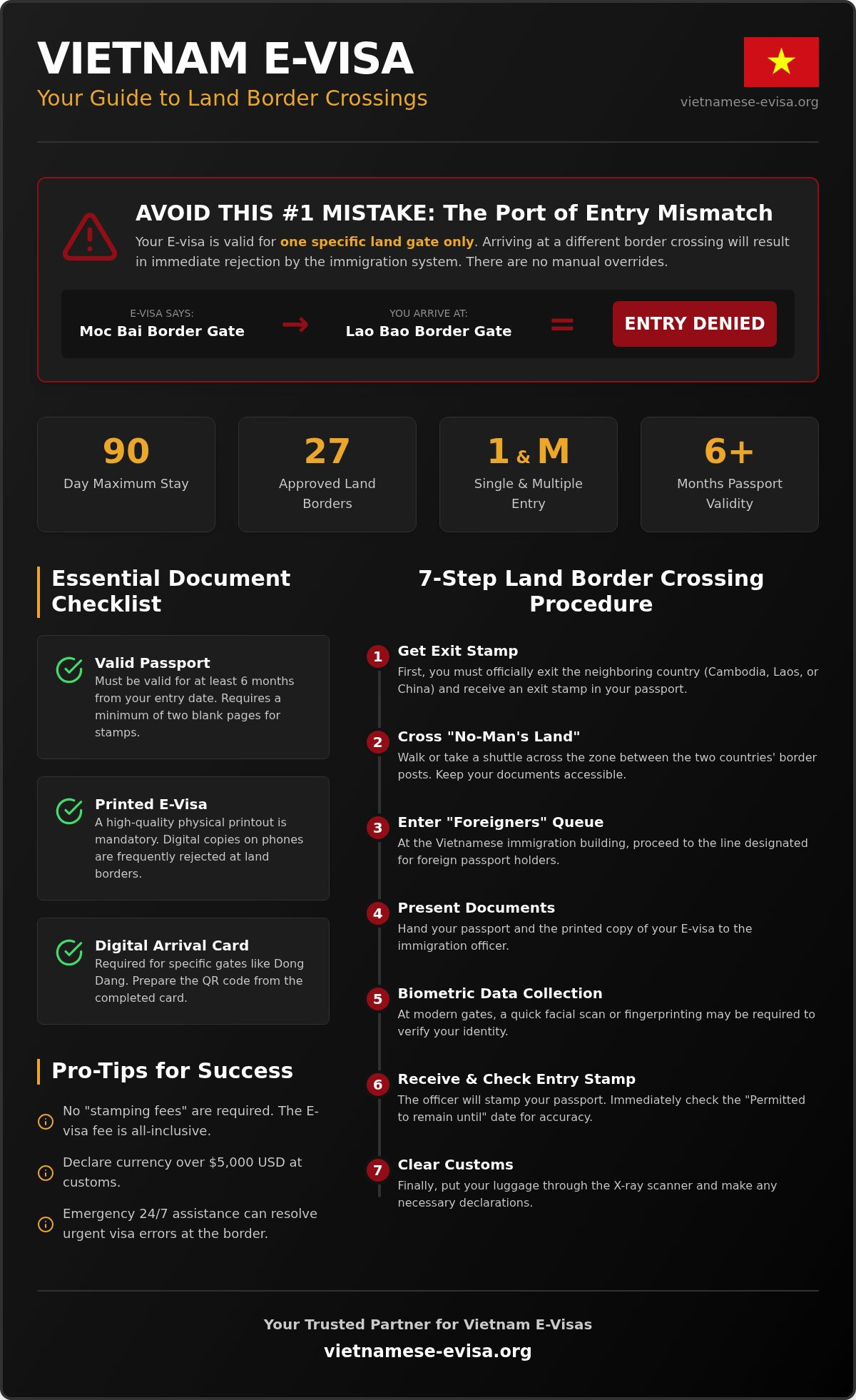
The “Port of Entry” rule is the most common cause of border rejection. If your visa says “Moc Bai” but you arrive at “Lao Bao,” the immigration system will block your entry. Border guards don’t have the authority to manually override this data or change your entry point in the system. You’ll likely be sent back to the departure country immediately. A port correction requires a completely new visa application. This creates a high-stakes situation where you might be stuck in a remote area without valid documentation. Ensure your travel itinerary matches your visa exactly to avoid this bureaucratic nightmare.
Step-by-Step Procedure at the Land Border Checkpoint
Crossing a land border requires a precise sequence of actions that begins before you even touch Vietnamese soil. You must first secure an exit stamp from the neighboring country’s immigration office, whether you’re departing from Cambodia, Laos, or China. Without this exit stamp, Vietnamese officials will refuse your entry, forcing a stressful trek back across the buffer zone. Understanding how to use vietnam evisa at land border gates means recognizing that you are entering a high-security environment where digital records must match physical movements perfectly.
Once you’ve cleared the departure post, you’ll enter “No-Man’s Land.” This is the physical territory between the two border stations. Depending on the specific gate, this could be a short 200-meter walk or a mandatory shuttle ride. Keep your documentation easily accessible during this transition. Vietnamese officers will verify your permit against the national database, which is linked to the Official Vietnam E-visa Portal. Any discrepancies between your passport and the electronic record will trigger an immediate halt to your processing.
At the Vietnamese Immigration Desk
Approach the “Foreigners” queue and present your original passport alongside a high-quality physical printout of your E-visa. Digital copies on smartphones are frequently rejected at land borders due to scanning limitations. In 2026, modern gates like Moc Bai have implemented biometric data collection, so expect a quick facial scan or fingerprinting. Once the officer clears your data, they’ll apply an entry stamp. Check this stamp immediately to ensure the “Permitted to remain until” date matches your 90-day allowance. If you spot a typo, point it out before leaving the window.
Common Land Border Customs Procedures
After immigration, your luggage must pass through an X-ray scanner. You’re required to declare any high-value items or currency exceeding $5,000 USD. As of 2026, health declarations have been digitized; if you’re crossing at the Dong Dang gate, you must present the QR code from your mandatory Digital Arrival Card. Be wary of officials asking for “extra processing fees” or “stamping fees.” E-visas have no additional government fees at the border. If you encounter a documentation crisis or a system rejection, you may need to secure emergency visa assistance to resolve the error without being deported.
Essential Checklist and Pro-Tips for Land Crossings
Mastering how to use vietnam evisa at land border crossings requires more than just a digital approval. While airports are increasingly paperless, land border stations in 2026 maintain a strict “Hard Copy” mandate. Officers frequently reject digital PDFs shown on smartphones because they need a physical document to file alongside their manual logs. If you arrive without a printout, you’ll likely be forced to find a local printing shop, which is often impossible in remote buffer zones. Additionally, verify that your passport remains valid for at least six months and contains two blank pages. Many travelers are turned back because they’ve run out of stamping space, a mistake that’s difficult to rectify once you’ve reached the border.
Preparing Your Physical Documents
Print at least two high-quality copies of your E-visa before you begin your journey. Ensure the QR code is sharp, as smudged or folded codes can’t be read by the scanners at modern checkpoints. Keep one copy in your carry-on and a backup in your main luggage. It’s also wise to carry a black ink pen; while many procedures are digital, some gates still require manual arrival cards or customs declarations. To ensure your paperwork meets every 2026 regulatory standard, you can apply for a verified E-visa through our secure portal to avoid common formatting errors.
Logistics and Scams to Avoid
Timing is critical when planning your arrival. Most land gates operate between 7:00 AM and 7:00 PM, though some smaller posts may close earlier for lunch. Arriving at 6:45 PM is a high-stakes gamble that often results in being stranded overnight in “No-Man’s Land.” Regarding logistics, always carry small denominations of Vietnamese Dong (VND) or US Dollars (USD). You’ll need these for local transport or shuttles between the two border posts. Ignore “helpers” who offer to fast-track your application for a fee; only interact with uniformed personnel behind official desks. Finally, don’t book your onward bus or train until you’ve physically cleared the Vietnamese side, as processing times can vary based on system connectivity.
Handling Visa Emergencies and Expedited Entry
Rejection at the gate is a high-stakes scenario that requires an immediate, professional solution. If an officer identifies a typo in your passport number or a mismatch in your port of entry, they’ll deny your crossing. The official government portal typically requires three to seven working days for processing; this is an impossible timeline when you’re standing in a remote border zone. Learning how to use vietnam evisa at land border checkpoints includes knowing how to react when the system flags an error. This is where an intermediary for Emergency Vietnam Visas becomes your most valuable partner. We specialize in resolving these critical documentation errors in real-time, preventing deportation and ensuring your travel remains on schedule.
Last-Minute Port of Entry Corrections
When you realize your visa lists the wrong land gate, a rush visa is often your only path to avoid being sent back to your departure country. You can initiate this process directly from your mobile device while waiting at the checkpoint. Our experts work around the clock to secure a new approval that reflects your actual location. The Urgent Vietnam Visa service provides 2026 travelers with a reliable method to obtain a corrected approval letter in under two hours. This speed is essential for those facing strict border gate closing times or connecting transportation deadlines.
Confirming Your 2026 Visa Fees
Navigating an emergency requires clarity regarding costs to avoid further delays. You must distinguish between the service fees paid for expedited processing and the standard administrative costs. Consult our Vietnam Visa Fee page to review the current 2026 price structure for emergency requests. Have a secure digital payment method ready, such as a credit card or digital wallet, to authorize the request immediately. Our 24/7 support team remains available to guide you through the payment and application steps, ensuring you receive your new documentation via email as quickly as possible. Don’t let a clerical error end your journey. Take action now to secure a professional resolution and enter Vietnam without further delay.
Secure Your Entry at the Vietnamese Border
Navigating a land crossing in 2026 requires meticulous attention to detail and a proactive approach to your documentation. You now understand that matching your listed port of entry to your actual arrival point is non-negotiable; carrying a high-quality physical printout is equally essential for clearing immigration desks without delays. Learning how to use vietnam evisa at land border checkpoints effectively means being prepared for the rigid electronic verification systems currently in place. If you find yourself facing an immediate rejection or a clerical error while standing at the gate, don’t let it derail your journey.
Our team brings over 15 years of immigration expertise to every case, providing 24/7 dedicated support for border emergencies. We can often secure a new approval in as little as 1-2 hours, ensuring you don’t spend the night in a transit zone. Apply for an Emergency Vietnam Visa now to avoid border delays and move forward with total confidence. Your successful entry into Vietnam is just a few clicks away, and we’re ready to assist you at any hour.
Frequently Asked Questions
Can I use a Vietnam E-visa at any land border gate?
No, you cannot use an E-visa at every checkpoint. As of 2026, there are 27 specific land border gates approved for E-visa entry out of 83 total ports. You must verify that your chosen gate is on the official list and ensure it matches the port of entry printed on your document. Local or border-resident gates generally don’t have the technical infrastructure to process electronic permits for international travelers.
Do I need a physical printout of my E-visa for land entry?
Yes, carrying a high-quality physical printout is mandatory at most land checkpoints. While airports may accept digital versions, land border officers require a hard copy for their manual filing systems and internal audits. Ensure your printout clearly displays the QR code and all personal data. Relying on a smartphone screen is risky due to scanning limitations and potential battery or connectivity issues in remote border areas.
What should I do if my E-visa has the wrong port of entry?
If your document lists the wrong port, you must apply for a new visa immediately. Border guards can’t manually override the system or allow you to enter through a gate not specified on your permit. Entering through a different location will lead to a denial of entry and potential deportation back to the departure country. In such cases, securing an expedited approval is the only way to resolve the mismatch while at the checkpoint.
How long does it take to cross a Vietnam land border with an E-visa?
The crossing time typically ranges from 30 to 60 minutes, depending on queue lengths and system connectivity. This process includes clearing the departure post of the neighboring country, crossing the buffer zone, and completing Vietnamese immigration and customs checks. Learning how to use vietnam evisa at land border gates effectively involves arriving during peak operating hours (usually 7:00 AM to 7:00 PM) to avoid delays caused by shift changes or gate closures.
Are there extra fees to pay at the land border gate?
No, there are no official government fees or stamping fees to pay at the gate when using an E-visa. Your application fee paid online covers the entire administrative cost for the permit. Be wary of unofficial requests for “processing” or “service” fees from individuals at the checkpoint. You should carry small amounts of local currency for transit shuttles or luggage handling services that may operate in the buffer zone between countries.
Can I apply for an emergency visa while at the border checkpoint?
Yes, you can apply for an emergency visa using your mobile device if you encounter a documentation error at the checkpoint. Specialized intermediaries provide 24/7 assistance to help travelers secure a new approval in as little as one to two hours. This is the most efficient way to understand how to use vietnam evisa at land border crossings when your original paperwork is rejected, allowing you to proceed with your travel plans without major disruptions.