


The Ultimate Vietnam Travel Checklist 2026: Essential Prep & Packing
What if the most vital item for your trip isn’t your hiking boots, but a single digital confirmation code? With 2026 bringing new entry protocols like the mandatory pre-arrival declaration for Tan Son Nhat International Airport, your vietnam travel checklist now requires a document-first strategy to avoid costly delays at the border. One small oversight in your paperwork can derail an entire itinerary, making administrative precision your most important travel skill this year.
We understand the anxiety that comes with navigating technical visa requirements or the fear of being denied entry because of a minor clerical mistake. It’s frustrating to balance packing for diverse climates while worrying if your paperwork is truly airtight. This guide provides everything you need to secure your entry and optimize your luggage for Vietnam’s unique terrain. You will learn the specific 2026 digital requirements, discover a suitcase strategy tailored for high humidity, and verify the administrative hurdles you must clear to ensure your journey is seamless and stress-free.
Key Takeaways
- Master the 2026 “Document-First” entry strategy, including the mandatory online pre-arrival declaration required for major international airports.
- Learn how to optimize your suitcase for Vietnam’s three distinct climates using quick-dry fabrics and strategic layering for the North and Central Coast.
- Secure your digital connectivity by choosing the right 2026 eSIM technology and essential local apps for transport and currency conversion.
- Use this comprehensive vietnam travel checklist to verify your six-month passport validity and finalize bank notifications before departure.
- Identify critical administrative backups, such as rush visa options, to resolve unexpected documentation errors or e-visa rejections instantly.
The Document Layer: Entry Requirements and Visa Verification
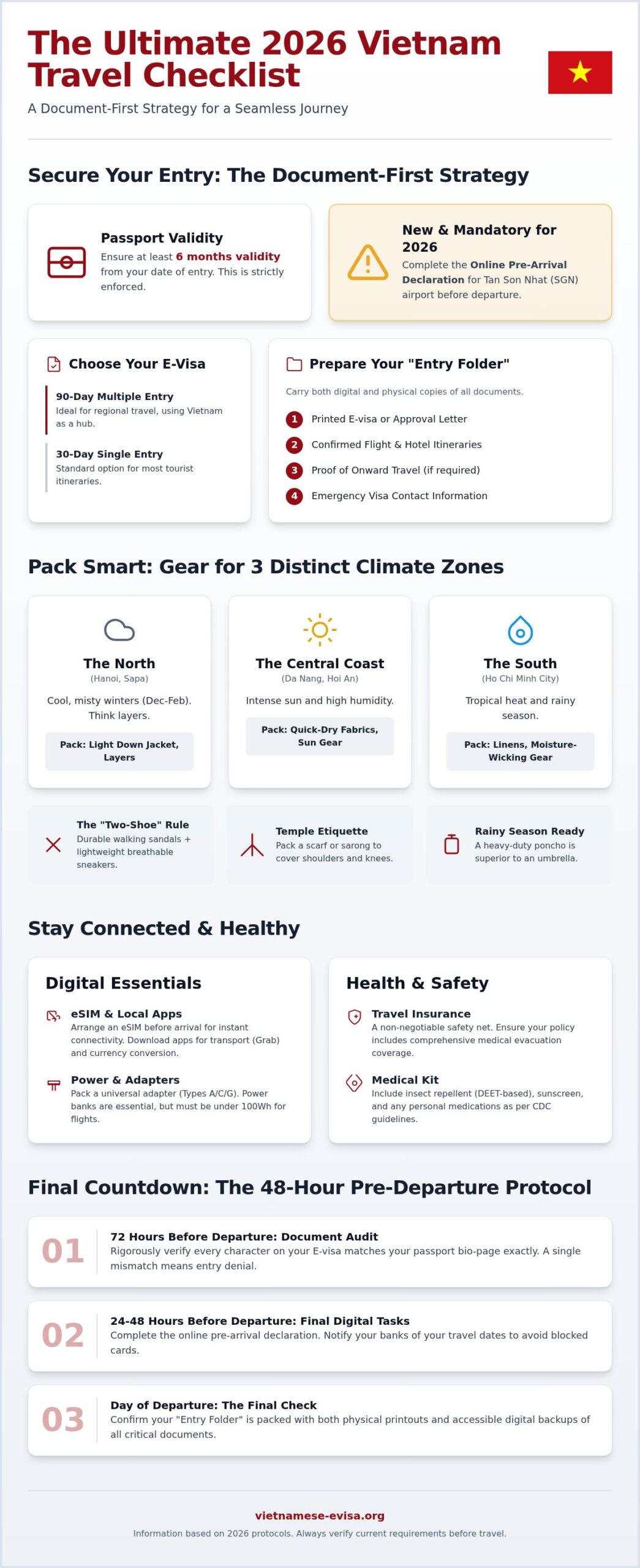
Your vietnam travel checklist begins long before you reach the airport. The most critical administrative hurdle is your passport validity. You must ensure your passport has at least six months of remaining validity from your planned date of entry. Immigration officers strictly enforce this rule; any less, and you’ll be denied boarding at your point of origin. Beyond the passport, understanding the current Vietnam visa policy is essential for a legal entry.
While digital transformation has streamlined the process, you must carry both physical and digital copies of all approvals in 2026. Technology can fail, and having a printed backup ensures you aren’t stranded due to a dead battery or a localized network outage at the border. If you’re using a Visa on Arrival service, your physical “Approval Letter” is the only document that allows you to board your flight and receive your stamp at the airport.
Choosing the Right Visa for Your 2026 Itinerary
Selecting the correct visa type depends entirely on your travel duration and whether you plan to visit neighboring countries like Cambodia or Laos. For most travelers, including US citizens, the E-visa is the primary choice. You can opt for a standard 30-day stay or the more flexible 90-day Multiple Entry E-visa. This 90-day option is ideal if you intend to use Vietnam as a regional hub. To avoid common data entry mistakes that lead to instant rejection, refer to this Vietnam E-visa 30/90-day guide before submitting your application.
The Pre-Flight Document Audit
Perform a rigorous audit 72 hours before departure. Verify that every character on your E-visa matches your passport bio-page exactly. A single transposed digit in your passport number or a misspelled middle name will result in entry denial. Additionally, as of April 15, 2026, all passengers entering through Tan Son Nhat International Airport must complete an online pre-arrival declaration before departure. Integrating this vietnam travel checklist protocol into your prep ensures you won’t face a last-minute crisis at the gate. Prepare a dedicated “Entry Folder” containing:
- Printed copies of your E-visa or Approval Letter.
- Confirmed flight itineraries and hotel bookings.
- Proof of onward travel (required for certain visa types).
- A digital backup and physical printout of your emergency vietnam visa contact details.
Comprehensive travel insurance is a vital safety net. While not always a legal requirement for entry, a policy covering medical evacuation is indispensable. Vietnam’s healthcare landscape varies by region; having verified coverage ensures you receive the highest standard of care without financial strain.
Vietnam Packing List: Gear for Three Distinct Climates
Packing for Vietnam requires a strategic approach because the country spans multiple climate zones. In the North, particularly Sapa and Hanoi, winters are misty and surprisingly cold. You’ll need layers and a light down jacket if visiting between December and February. Conversely, the Central Coast offers intense sun; quick-dry fabrics are essential for the humidity of Da Nang and Hoi An. In the South, Ho Chi Minh City’s tropical heat demands breathable linens and moisture-wicking gear. Don’t forget temple etiquette: always pack a lightweight scarf or sarong to cover your shoulders and knees at sacred sites. This modesty is a non-negotiable addition to your vietnam travel checklist.
Clothing Essentials for High Humidity
Humidity is the primary challenge for your wardrobe. Moisture-wicking synthetics and high-quality linens outperform cotton, which traps sweat and takes days to dry in the high humidity common in the South. Adopt the “Two-Shoe” Rule: one pair of durable walking sandals and one pair of lightweight, breathable sneakers. For the rainy season, a heavy-duty poncho is far superior to an umbrella. It provides better coverage and is much safer if you plan on using motorbikes or walking through narrow, crowded alleys. While focusing on gear, also review the CDC health information for Vietnam to ensure your medical kit includes appropriate insect repellent and sun protection for these specific environments.
Electronics and Power Solutions
Vietnam typically uses Type A and C outlets, though Type G is sometimes found in older colonial-style hotels. A universal adapter is a mandatory tool for your vietnam travel checklist. When packing power banks, remember that most international flights to Vietnam limit battery capacity to 100Wh per person in carry-on luggage. High humidity and salt spray can quickly damage sensitive electronics; use silica gel packets or waterproof dry bags to protect your camera gear, particularly when visiting coastal regions like Ha Long Bay or Nha Trang. If you find yourself in a rush and realize you’ve missed a critical step in your preparation, securing an urgent vietnam visa can resolve last-minute documentation gaps before your departure.
Health, Safety, and the 2026 Digital Checklist
Managing your health and digital presence is just as vital as securing your visa. In 2026, relying on physical SIM cards is no longer the most efficient path. Pre-activating an eSIM before you land ensures instant connectivity, allowing you to bypass long airport queues. This digital-first approach should be a priority on your vietnam travel checklist to ensure you can access maps and transport apps the moment you clear immigration. While connectivity is seamless in urban hubs, rural provinces still require pre-downloaded resources.
The 2026 Digital Nomad & Traveler Tech Stack
Download and set up your Grab account before arriving. Link a credit card to the app to facilitate cashless payments and avoid common airport taxi scams. While major cities like Da Nang and Ho Chi Minh City have robust 5G networks, a VPN is mandatory for secure browsing, especially when accessing home banking or sensitive work files. Always download offline maps and Vietnamese translation packs for rural exploration in areas where signal strength may fluctuate. These tools provide a layer of security that physical maps simply cannot match.
Health and Personal Care Essentials
Your physical health kit must be tailored for the tropics. Include high-quality rehydration salts to combat the intense humidity and specific digestive aids to manage the transition to local street food. Don’t rely on finding your preferred brands of sunscreen or mosquito repellent locally. Many Vietnamese brands contain skin-whitening agents or different active ingredients that may not suit your skin. Bring a sufficient supply from home to ensure you’re protected from the 2026 summer sun and mosquito-borne risks.
Water safety is non-negotiable. Only drink bottled or filtered water, and use it for brushing your teeth in rural provinces. If you plan to rent a motorbike, pack basic first-aid supplies like antiseptic wipes and sterile dressings to treat minor abrasions or “exhaust pipe burns,” which are a common hazard for tourists. Managing your administrative safety is equally important. If you encounter issues with your documentation at the last minute, you can secure an expedited vietnam visa to ensure your travel plans remain on schedule.
Finally, balance your money management. While digital payments and QR codes are ubiquitous in 2026 urban centers, smaller vendors and rural markets still require cash (Vietnamese Dong). Carry a mix of both to ensure you’re never stranded without a payment method. Adding a “money check” to your vietnam travel checklist will prevent the stress of finding an ATM in remote regions.
Pre-Departure Protocol: The Final 48 Hours
The final 48 hours before your flight represent the “critical window” where preparation meets execution. Begin by confirming your flight status and completing online check-in to secure your preferred seating. This is also the time to notify your bank of your 2026 Vietnam travel dates. Without this notification, your first attempt to use an ATM in Hanoi or Ho Chi Minh City could trigger an automatic card block, leaving you without funds in a foreign country. A quick call or app update prevents this administrative headache.
Perform a final document audit. While digital copies are convenient, you must have physical printouts of your visa and travel insurance. If your itinerary coincides with the 2026 Tet holiday, verify specific holiday dates as transportation and services will be limited during this period. This final step in your vietnam travel checklist ensures you aren’t caught off guard by local closures or reduced staffing at service hubs.
The Emergency Visa Safety Net
A visa emergency occurs when you discover a discrepancy, such as a misspelled name or an incorrect passport number, just hours before boarding. If your application status is still “pending” on the official portal, don’t wait at the gate hoping for a miracle. You can utilize Emergency Vietnam Visa services to secure a valid approval in as little as two hours. Our 24/7 support is designed to rescue travel plans at the boarding gate, providing the administrative precision needed to clear immigration when the standard government process fails.
Final Logistics Checklist
Your logistics should be finalized before you leave home. Pre-booking an airport transfer through your hotel or a reputable app is significantly safer and more reliable than negotiating with street taxis after a long-haul flight. Additionally, plan to withdraw or exchange at least 1,000,000 VND (approximately $40 USD) upon arrival. This amount covers your initial transport, a meal, and small expenses before you find a competitive exchange rate in the city center.
Complete a final “Go-Bag” check for your carry-on luggage. Your passport, printed visas, and essential medications must be physically on your person, not in checked baggage. This disciplined approach to your vietnam travel checklist guarantees that even if your main luggage is delayed, your entry into Vietnam remains secure and your journey can begin without hesitation.
Secure Your 2026 Vietnamese Adventure Today
A successful journey through Vietnam requires balancing administrative precision with physical readiness. By following this vietnam travel checklist, you’ve prioritized the essential document layer while preparing for the country’s diverse climates and digital landscape. From the misty mountains of Sapa to the bustling streets of Ho Chi Minh City, your preparation is now your greatest asset. You don’t have to navigate the complexities of 2026 entry requirements alone.
Don’t leave your travel plans to chance or risk a last-minute rejection on the official portal. Our specialists provide an expert application review to identify errors before they cause delays. We offer same-day processing for time-sensitive departures and 24/7 emergency support to resolve any documentation crisis at the boarding gate. Apply for your Vietnam Visa now to ensure a stress-free trip and move forward with total confidence. Vietnam is waiting, and we’re here to make sure you get there without a hitch.
Frequently Asked Questions
Do I need a physical copy of my Vietnam E-visa in 2026?
Yes, you should carry a physical copy of your E-visa. While digital versions are often accepted, many immigration officers and airline staff still require a paper printout for official verification. Technology can fail due to battery depletion or limited connectivity at the border. Including a printed visa in your vietnam travel checklist ensures you avoid unnecessary delays or boarding denials during the entry process.
What happens if I forget to apply for my Vietnam visa before my flight?
If you forget to apply, you must secure an urgent or rush visa immediately. You cannot board a flight to Vietnam without a valid visa or an official approval letter. We provide same-day and rush processing to resolve these high-stakes situations. Our team works around the clock to ensure your documentation is approved before you reach the boarding gate, saving your travel plans.
Is travel insurance mandatory for entry into Vietnam in 2026?
Travel insurance isn’t a mandatory legal requirement for all travelers in 2026, but it remains a critical safety component. Local healthcare providers often require upfront payment or proof of coverage for high-standard care. We strongly recommend a policy that includes medical evacuation. This protection is a vital part of any vietnam travel checklist, providing security against unforeseen tropical illnesses or accidents.
How much cash should I carry on my first day in Vietnam?
Carry approximately 1,000,000 to 2,000,000 VND on your first day. This amount covers airport transfers, initial meals, and small convenience items. While digital wallets and QR payments are ubiquitous in 2026 urban centers, many street food stalls only accept cash. Having a reserve of Dong ensures you can navigate your first few hours without the stress of finding an ATM immediately.
Can I get a Vietnam visa on arrival without prior paperwork?
No, you cannot get a visa on arrival without prior paperwork. You must have a pre-approved Visa Approval Letter to board your flight and receive a stamp at the airport. Arriving without this proprietary document will result in immediate entry denial. Always verify your paperwork status 48 hours before departure to ensure that all administrative hurdles are cleared and your entry is guaranteed.
What is the best month to visit Vietnam based on the 2026 weather forecast?
March and April are the optimal months to visit Vietnam according to 2026 climate trends. During this window, the weather is generally dry and temperate across all three major regions. You’ll experience the misty beauty of the North and the tropical warmth of the South without the extreme summer heat or the heavy monsoon rains that typically begin in the later months.