


The Ultimate Guide to Vietnam e-visa Application
What if a single blurry photo or a minor typo was the only thing standing between you and your flight to Hanoi? The Vietnam e-visa application process is deceptively simple, yet approximately 10% of travelers face delays or outright rejections due to easily avoidable mistakes. Whether you’re applying for a single-entry stay or the 90-day multiple-entry option, the stakes are high because the government fees are strictly non-refundable. It’s a high-stakes digital hurdle that requires absolute precision to clear on the first attempt.
You likely feel the weight of these requirements, especially when navigating confusing passport upload rules or worrying about system glitches during peak travel seasons. This guide will show you how to master the Vietnam e-visa application so you can avoid common pitfalls and secure your travel authorization in record time. We’ll preview the exact document specifications needed for success, explain how to handle processing during Vietnamese holidays, and share expert strategies for those who need an emergency approval. By following these proven steps, you’ll gain the confidence that your documentation is perfect and your trip is secure.
Key Takeaways
- Understand the 2026 updates allowing for 90-day stays and multiple entries for all nationalities to maximize your travel flexibility.
- Follow a precise walkthrough for your Vietnam e-visa application to ensure your portrait photo and passport data meet strict ICAO standards.
- Identify the common technical errors, such as truncated names or low-resolution uploads, that lead to the majority of visa rejections.
- Learn how to bypass the “Black Hole” effect of government system glitches with professional oversight and manual data verification.
- Discover specialized options for same day or rush visa processing to secure your travel authorization when facing tight deadlines.
Vietnam E-visa Application: Requirements and 2026 Updates
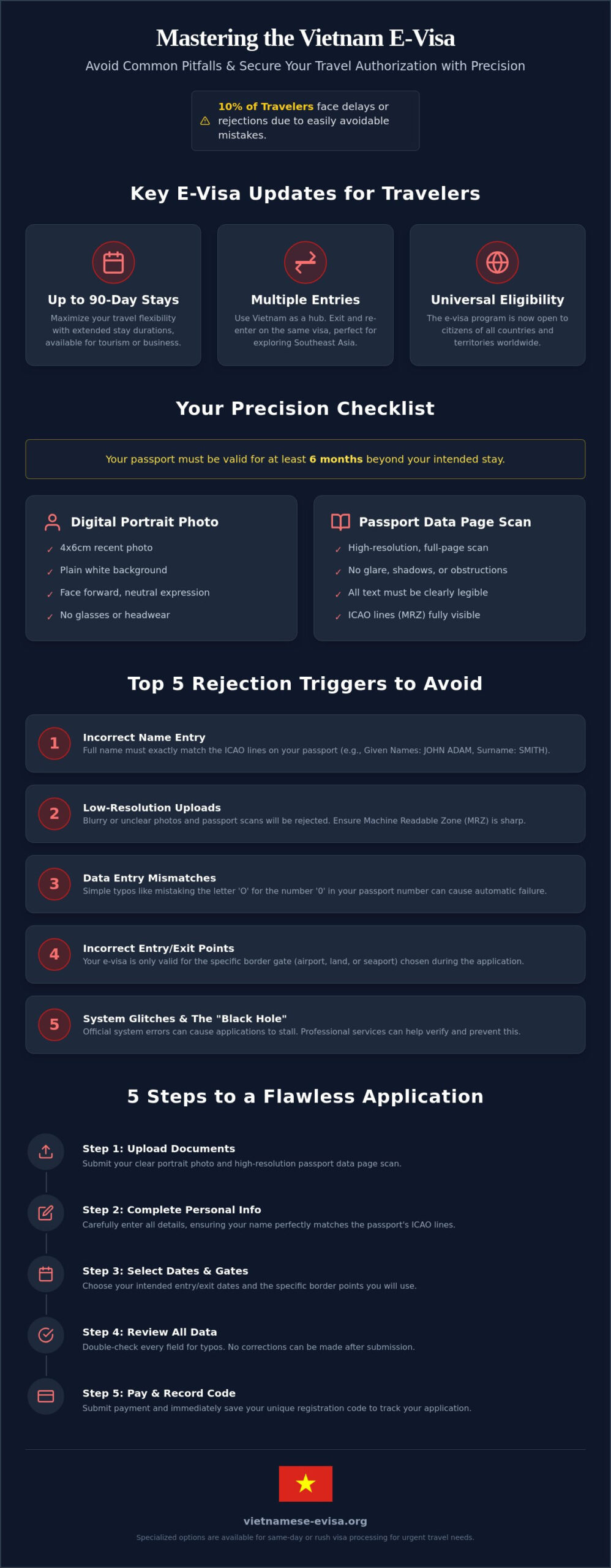
The Vietnam e-visa is a digital authorization that has effectively replaced traditional paper visas for the vast majority of international travelers. It allows you to enter the country for tourism or business purposes for a period of up to 90 days. Since the major policy shifts in 2026, the Vietnam e-visa application process is now open to citizens of all countries and territories. This universal eligibility makes it the primary gateway for visitors, eliminating the need to visit an embassy or wait for physical stamps, provided you meet the strict digital documentation standards.
Understanding Vietnam’s visa policy is essential because your e-visa is only valid at 42 designated international border gates. These specific entry points include major hubs like Noi Bai in Hanoi and Tan Son Nhat in Ho Chi Minh City, along with select land borders and seaports. If you attempt to enter through a gate not on this list, your authorization will be rejected at the border. You must decide at the time of application whether you require a 30-day or a 90-day stay, and whether your plans involve a single entry or multiple entries.
Mandatory Documents for a Successful Application
Precision is your best defense against bureaucratic delays. Your passport must be valid for at least six months beyond your intended stay; applications with shorter validity face immediate rejection. You’ll need to upload two specific digital files to the portal:
- Digital Portrait: This must be a recent 4x6cm photo with a white background. You must face forward with a neutral expression and no glasses.
- Passport Data Page Scan: A high-resolution, full-page scan is required. The Machine Readable Zone (the ICAO lines at the bottom) must be entirely visible, clear, and free from any glare or thumbprints.
The 2026 90-Day Visa Expansion
The introduction of the 90-day multiple-entry e-visa has transformed how travelers approach Southeast Asian itineraries. You can now use Vietnam as a strategic hub, venturing into neighboring countries like Cambodia or Laos and returning without filing a new Vietnam e-visa application for every leg of the journey. It’s vital to distinguish between the “validity period” and the “stay duration” to avoid heavy overstaying fines. If your visa expires on a specific date, you must exit the country by that time, regardless of when you actually arrived. For a deeper dive into these nuances, consult our Vietnam E-visa (30 & 90-day): The Ultimate 2026 Application Guide.
Step-by-Step Walkthrough of the Vietnam E-visa Application
Completing your Vietnam e-visa application requires a methodical approach because the official system offers no room for post-submission corrections. If you submit an error, you’ll likely have to pay again and start from scratch. Follow these five steps to ensure your submission is processed without delay.
- Step 1: Upload your passport data page and portrait photo to the secure portal. The system uses automated character recognition, so any glare or obstruction on the Machine Readable Zone (MRZ) will trigger an immediate failure.
- Step 2: Complete the personal information form. You must ensure your names match the passport ICAO lines exactly. Don’t rely on the visual data page; look at the chevron-separated lines at the bottom of your passport.
- Step 3: Select your entry/exit dates and specific border gates. This is a critical legal choice. Your visa is only valid for the specific airport, land border, or seaport you designate here. You cannot change this after the visa is issued.
- Step 4: Review all data for typos. Even a minor middle name omission or a switched digit in your passport number can cause entry denial at the border.
- Step 5: Submit payment and record your registration code immediately. This alphanumeric string is the only way to track your progress or download your final document.
Critical Data Fields You Cannot Get Wrong
The #1 cause of rejection is the “Full Name” field. Many travelers confuse the placement of “Given Name” and “Surname.” If your passport lists “John Adam Smith,” ensure “Smith” is in the surname field and “John Adam” is in the given name field. Additionally, watch for character confusion; the system often flags errors when applicants mistake the letter “O” for the number “0” in passport numbers. Precision here is mandatory to avoid the “Black Hole” effect where applications are ignored by the system.
Payment and Status Tracking
The official government payment gateway is known to fail during high-traffic periods or with certain international credit cards. If your payment doesn’t go through, don’t keep resubmitting; wait 20 minutes and try a different card. Once paid, you can check your Vietnam e-visa application status using your registration code. If the status remains “In Processing” for more than five working days, it often indicates a backlog or a minor data mismatch that requires manual intervention. To ensure your data is perfect before it hits the government server, you might consider having an emergency vietnam visa specialist review your file.
Avoiding Rejections and Handling Emergency Visa Needs
A failed Vietnam e-visa application is more than a minor inconvenience; it’s a financial and logistical setback. The government portal operates on a strict non-refundable policy. If your application is denied because of a blurry portrait or a name that doesn’t match your passport’s machine-readable zone, your fee is lost. You’re then forced to start the multi-day waiting period all over again, which is a luxury many travelers don’t have when their departure date is looming.
Many applicants encounter what we call the “Black Hole” effect. This occurs when a submission remains “In Processing” for well beyond the standard five working days without any status update or request for correction. This often happens during peak travel seasons or Vietnamese public holidays, such as the National Day break in late August. Without a direct support line to the Immigration Department, you’re left in a state of uncertainty that can jeopardize your entire itinerary. System glitches on the official site frequently leave travelers stranded without recourse.
What to Do if Your Visa is Rejected
If you receive a rejection, analyze the specific feedback provided. A note citing “Document quality” usually refers to your photo or passport scan, while “Incorrect information” points to data entry errors. Re-applying on your own carries a high risk of repeating the same mistake because the portal doesn’t always specify which field was wrong. For those who need an immediate resolution to a denied claim, our Urgent Vietnam Visa: How to Get Your Approval in Under 2 Hours (2026 Guide) provides a roadmap for salvaging your trip.
The Emergency Processing Advantage
When you’re standing at the airport check-in counter and realize your visa hasn’t arrived, standard bureaucratic channels won’t help you. This is where emergency Vietnam visa services become essential. These expedited pathways bypass the standard queue through direct coordination with immigration authorities. We specialize in sub-2-hour approvals, providing a human intermediary to resolve glitches that automated systems simply cannot handle. Our 24/7 support ensures that even if a problem arises at midnight, you have an expert working to secure your entry. Don’t let a system glitch stop your travel; secure your urgent Vietnam visa now to guarantee your departure.
Why Apply Through Vietnamese-Evisa.Org?
Interacting with the official government portal often feels like a gamble. When your departure is only hours away, you can’t afford a system glitch or a silent rejection. At Vietnamese-Evisa.Org, we function as your dedicated intermediary, bridging the gap between your travel needs and the strict requirements of the Immigration Department. Our primary goal is to eliminate the uncertainty that leads to travel anxiety. As a private agency with nearly two decades of experience, we provide the vigilance and speed that public portals lack.
Every Vietnam e-visa application submitted through our platform undergoes a rigorous manual review by our immigration specialists before it ever reaches the government server. This human oversight catches the subtle errors that automated systems miss, such as inverted names or low-resolution passport scans that trigger the “Black Hole” effect. While the public portal offers a standard 3 to 5 day window, we provide guaranteed speed options for rush, same-day, and expedited processing that the government site simply cannot match. You’ll receive total transparency regarding Vietnam visa fees and realistic processing timelines from the moment you begin.
The Intermediary Benefit: Peace of Mind
We act as your advocate, maintaining direct communication with the Vietnam Immigration Department to resolve stalled applications or technical glitches. This level of support is vital for travelers with complex requirements, such as those entering via cruise ships or specific land border crossings where documentation rules can be exceptionally rigid. Since our team operates 24/7, we’re available to assist you regardless of your time zone. This ensures that your travel plans remain on track even during Vietnamese public holidays when the official portal is unmonitored.
How to Start Your Application Today
Securing your travel authorization shouldn’t be a day-long project. We’ve developed a simplified 3-minute form designed to prevent common user errors and streamline the data entry process. After providing your basic details and uploading your documents, you’ll benefit from secure payment options and receive an instant confirmation email. We handle the bureaucratic heavy lifting so you can focus on your itinerary. Don’t leave your entry to chance; Start your Vietnam e-visa application now and experience the security of professional visa management.
Secure Your Entry to Vietnam Today
Success with your Vietnam e-visa application depends on absolute precision. As we’ve detailed, meeting the strict ICAO photo standards and correctly identifying your specific entry gate are the only ways to avoid non-refundable rejections. With the 2026 expansion of the 90-day multiple-entry visa, the opportunities for regional travel are greater than ever, but so is the complexity of the digital submission process. Don’t leave your travel plans to an automated system that offers no support when glitches occur. A single data entry error shouldn’t be the reason you miss your flight.
Since 2007, we’ve specialized in processing emergency visas and providing the human oversight necessary for a stress-free experience. Our team offers 24/7 global support and a guarantee of either approval or expert correction before your data reaches immigration authorities. We handle the bureaucratic hurdles so you can focus on your journey. Apply for your Vietnam E-visa with Expert Review now to ensure your documentation is handled with the professionalism it deserves. Your adventure in Vietnam is waiting, and we’re here to make sure you get there on time.
Frequently Asked Questions
How long does the Vietnam e-visa application take to process in 2026?
Standard processing typically takes 3 to 5 working days, excluding weekends and Vietnamese public holidays. During peak travel seasons or major national breaks, such as the National Day holiday in late August, timelines often extend to 7 working days or more. If you’re on a tight deadline, the official portal’s lack of a guaranteed timeframe can be risky, making expedited options a safer choice for time-critical trips.
What is the difference between the 30-day and 90-day Vietnam e-visa?
The primary difference lies in the duration of stay and the entry flexibility provided to the traveler. A 30-day e-visa is limited to a single entry, whereas the 90-day option allows for both single and multiple entries over a three-month period. You must select the correct version during your initial Vietnam e-visa application because you cannot extend these authorizations or switch from single to multiple entry after the document is issued.
Can I change my entry port after my Vietnam e-visa has been issued?
No, you cannot change your entry port once the visa is finalized and printed. Your authorization is legally tied to the specific airport, land border, or seaport you designated during the application process. If you arrive at a checkpoint that doesn’t match your visa, such as attempting a land crossing when you’ve selected an airport, immigration officers will deny your entry. You’ll be forced to apply for a new visa immediately.
What should I do if my Vietnam e-visa application is denied?
You must first review the rejection note to determine if the issue was “Document quality” or “Incorrect information.” Since government fees are non-refundable, simply re-applying with the same data often leads to a second rejection. It’s best to have a professional specialist review your passport scan and data entry to ensure everything aligns with ICAO standards before you submit a new request. This prevents the “Black Hole” effect where applications stall indefinitely.
Is there an emergency Vietnam visa option for same-day travel?
Yes, same-day and rush processing options are available through specialized intermediary services for travelers in urgent situations. While the government’s public portal doesn’t offer a fast-track feature, we can secure approvals in as little as 2 hours. This is an essential safety net if you’ve forgotten your visa or discovered a typo while at the airport check-in counter. These emergency services operate 24/7 to handle time-sensitive documentation crises.
Do I need to print my Vietnam e-visa or can I show it on my phone?
You should always carry a physical, printed copy of your e-visa to present at the border. While some international airports might allow you to show a digital version on your mobile device, many of the 42 designated border gates require a hard copy for their records. Printing two copies ensures you have a backup if one is lost or if your phone battery fails during a long transit. It’s a simple step that prevents unnecessary delays at immigration.