


How to Master do Americans need a visa for Vietnam for Better Results
Your dream trip to Southeast Asia could end at the boarding gate before it even begins if you haven’t secured the right paperwork. Do americans need a visa for vietnam in 2026? The answer is a definitive yes. Whether you’re planning a quick 30-day tour or a 90-day deep dive into the country, having your documentation approved and ready is the only way to avoid the stress of a denied entry or a missed flight.
We understand the anxiety that comes with using government portals and the fear of a technical glitch ruining your itinerary. It’s frustrating to wait days for a confirmation while your departure date looms closer. This guide shows you exactly why US citizens require a visa for Vietnam in 2026 and how you can secure your approval in as little as 2 hours.
You’ll learn the critical differences between single and multiple-entry options, how to bypass common application errors, and the most efficient path to total peace of mind for your 2026 journey.
Key Takeaways
- Confirm the mandatory entry requirements and learn exactly why do americans need a visa for vietnam to avoid boarding denial at the gate.
- Navigate the selection process between 30-day and 90-day e-visa options to ensure your 2026 travel itinerary remains flexible and legal.
- Master the specific digital photo standards and documentation checklist required to prevent common government website processing delays or rejections.
- Secure a reliable safety net for last-minute travel emergencies by understanding how to access rush visa services with turnaround times as fast as 2 hours.
Mandatory Vietnam Entry Requirements for Americans in 2026
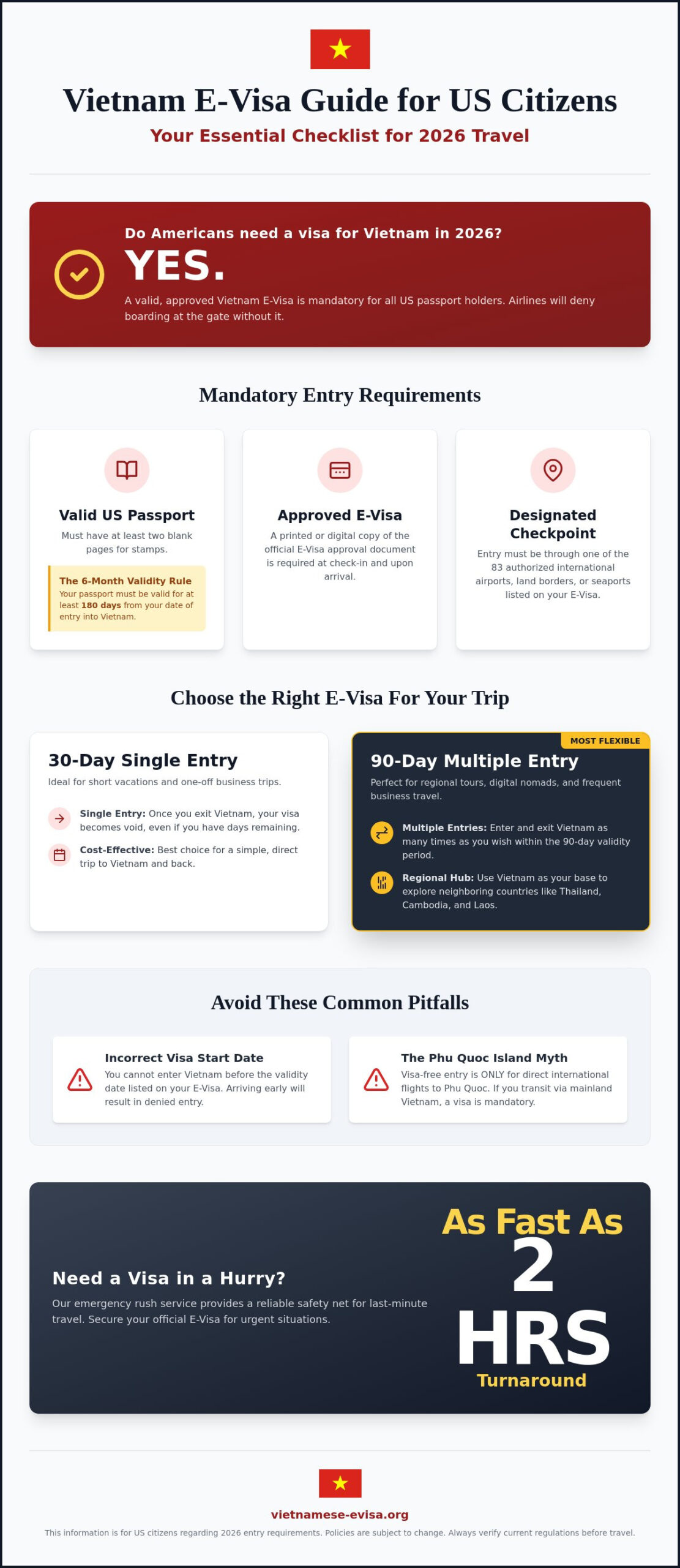
Securing entry into Vietnam requires more than just a plane ticket. Many travelers ask, do americans need a visa for vietnam before booking their flights to Hanoi or Saigon. The answer is a definitive yes. All US passport holders must possess a valid visa to enter the country in 2026. This rule applies to tourists, business travelers, and those visiting family alike. Failing to present an approved visa at the check-in counter will result in immediate boarding denial, as airlines are strictly liable for transporting undocumented passengers.
The landscape of Vietnam’s visa policy has shifted significantly toward a digital-first approach. The traditional “Visa on Arrival” process, which previously required a physical approval letter and long queues for a stamp, has been largely replaced by the electronic visa (E-visa) system. This digital document is now the standard requirement for 2026. To ensure a successful entry, your documentation must meet these specific criteria:
- Valid US Passport: Must have at least two blank pages for entry and exit stamps.
- Approved E-visa: A digital or printed copy of your official approval.
- Designated Checkpoint: Your entry must occur at one of the 83 authorized international checkpoints.
The 6-Month Passport Rule Explained
Vietnam immigration strictly enforces a policy where US passports must remain valid for at least 180 days from the date of entry to ensure legal stay and exit. If your passport expires in less than six months, you won’t even make it past the airport security in the United States. Airlines use automated systems to check these dates during check-in. If you realize your passport is nearing its expiration, renew it immediately before you apply for a visa. Attempting to apply with a passport that doesn’t meet this duration will lead to an automatic rejection of your visa application.
Visa-Free Entry Myths vs. Reality
It’s a common misconception that US citizens enjoy the same visa-free privileges as travelers from certain European or ASEAN nations. While travelers often wonder, do americans need a visa for vietnam when visiting Phu Quoc Island, the reality is complex. You can visit Phu Quoc for up to 30 days without a visa only if you fly directly to the island from an international location. If your flight transits through Ho Chi Minh City, Da Nang, or Hanoi, you must have a valid visa. For the vast majority of American itineraries, following the complete 2026 entry requirements guide is the only way to guarantee a stress-free arrival.
Choosing the Right Visa: 30-Day vs. 90-Day E-visa Options
We’ve established that the answer to do americans need a visa for vietnam is a clear yes. However, the decision isn’t just about getting “a” visa; it’s about selecting the right one for your 2026 travel goals. Since the landscape changed in late 2023, travelers now enjoy much more flexibility than the old 30-day limit allowed. You must choose between a short-term stay and a longer-term hub strategy based on your regional itinerary.
One critical detail often overlooked is the validity window. Your visa is valid starting from the specific date you provide on your application form. You cannot enter the country before this date. If you arrive early, immigration will not let you through. Conversely, if you arrive late, you don’t get those lost days back. Your stay must end by the expiration date printed on the document. If your plans are still fluid, you should apply for your visa online with a start date that accounts for your earliest possible arrival.
The 30-Day Single Entry E-visa
This is the most common choice for short vacations or single-city business trips. It’s designed for travelers who enter Vietnam, explore, and then fly home directly. The primary limitation is the “single entry” status. Once you pass through immigration to exit the country, the visa becomes void instantly. Even if you only used five days of your 30-day allowance, you cannot re-enter without a new application. This is a cost-effective solution for simple trips, but it lacks the flexibility needed for multi-country Southeast Asian tours.
The 90-Day Multiple Entry E-visa
For digital nomads or those on an extensive tour, this is the superior choice. It allows you to use Vietnam as a hub for the region. You can travel to Thailand, Laos, or Cambodia and re-enter Vietnam as many times as you like within the 90-day window. This flexibility is invaluable for travelers who want to follow the weather or change plans on the fly. It’s also the preferred premium option for business travelers who may need to fly out for meetings and return to their Vietnam base. For a deeper look at these options, check out our Vietnam E-visa (30 & 90-day): The Ultimate 2026 Application Guide. While the initial cost is higher, it removes the bureaucratic stress of reapplying every time you cross a border.
How to Apply for a Vietnam Visa from the USA
Applying from the United States requires administrative precision. While we’ve confirmed the answer to do americans need a visa for vietnam, the actual execution of the application determines whether you’ll be cleared for boarding. You must treat this process with the same attention to detail as a legal filing to avoid unnecessary delays. Before you begin, ensure you have a high-quality digital scan of your passport bio page and a professional portrait. The system is sensitive; even a slight glare on your passport photo or a shadowed face in your portrait can trigger an automatic rejection.
One critical step often overlooked is the selection of entry and exit points. You must decide your arrival airport or land border before submitting the form. Once your visa is issued, it’s tied to those specific locations. If you list Hanoi but decide to fly into Ho Chi Minh City instead, you may face significant hurdles at immigration. Additionally, navigating international payment portals with US credit cards can be difficult, as many banks flag these transactions as fraudulent. Using a dedicated service ensures your payment is processed securely and your application is submitted without technical glitches.
Step-by-Step Application Roadmap
- Step 1: Prepare a high-resolution scan of your passport bio page in JPEG format. Ensure no information is cut off.
- Step 2: Take a professional-style digital portrait. This must be on a plain white background with no glasses or headwear.
- Step 3: Complete the online application form accurately at apply visa.
- Step 4: Receive your E-visa PDF via email. Print at least two physical copies to keep in your carry-on luggage.
Common Mistakes That Lead to Rejections
- Typing Errors: Reversing digits or confusing the letter “O” with the number “0” in your passport number will invalidate your document.
- Date Formats: Many US travelers accidentally use the MM/DD/YYYY format. Most international forms require DD/MM/YYYY. Always double-check the field labels.
- Poor Timing: While the official window is often cited as three days, the reality is that government processing can take seven days or longer during peak seasons like Tet.
To avoid the stress of a pending application as your departure date approaches, you should start your expedited visa application now to guarantee your travel documents are ready in time.
Emergency & Last-Minute Solutions for Americans
Standing at the check-in counter at LAX or JFK only to be told you cannot board is a traveler’s worst nightmare. If you find yourself in this position, you’re likely frantically asking, do americans need a visa for vietnam right now? The answer remains a firm yes, but the standard 3 to 7 day government processing window is no longer an option for you. In these high-stakes moments, you need a specialized intermediary to bypass the standard queue and secure a legal entry document immediately.
The emergency process differs from the standard digital e-visa you might apply for weeks in advance. For ultra-fast turnarounds, we often utilize a proprietary approval letter system that allows you to board your flight and receive your entry stamp upon arrival. We offer several expedited tiers to match your specific departure time: 1-day processing for those leaving tomorrow, 4-hour windows for mid-day crises, and a 2-hour emergency service for those currently at the airport. This safety net ensures that a simple paperwork oversight doesn’t result in thousands of dollars in lost flight and hotel costs.
How to Get a Rush Visa in Under 2 Hours
If your flight departs in a few hours, you must act with precision. Follow these steps to secure your documentation:
- Step 1: Access the application form and select the “Emergency” processing option to trigger our priority alert system.
- Step 2: Provide your specific flight number and departure time so our team can coordinate with the immigration department.
- Step 3: Keep your mobile device active and monitor your email for the expedited approval document.
For a detailed breakdown of this protocol, consult our Urgent Vietnam Visa: How to Get Your Approval in Under 2 Hours (2026 Guide).
Holiday Closures and Processing Delays
Timing is everything when planning for 2026. The most significant disruption occurs during Tet, the Vietnamese Lunar New Year. In 2026, Tet is expected to fall on February 17. The Immigration Department typically closes for a full week surrounding this date, meaning standard e-visa processing stops entirely. If you’re traveling in February 2026, you must submit your application at least two weeks early to avoid being caught in the holiday backlog. Travelers facing weekend departures can utilize emergency Vietnam visa services to bypass standard government office closures. Our team remains vigilant 24/7 to handle these time-critical requests even when official channels are offline.
Secure Your 2026 Vietnam Entry Today
Your journey through Vietnam’s vibrant landscapes begins with a single, non-negotiable requirement. We’ve established that the answer to do americans need a visa for vietnam is a definitive yes. By selecting the correct 30 or 90-day e-visa and ensuring your passport meets the 6-month rule, you’ve already cleared the most significant hurdles to entry. Success now depends on precise execution and timing.
Since 2007, our team has acted as a vital safety net for international travelers. We provide 2-hour emergency processing for high-stakes airport situations and maintain a 24/7 dedicated US support line to resolve any concerns. Whether you’re navigating the holiday closures of Tet 2026 or simply seeking a streamlined application, we’re here to ensure your approval is fast and secure.
Take the final step toward your Southeast Asian adventure with total peace of mind. Apply for your 2026 Vietnam Visa Now and let us handle the administrative complexities while you focus on your itinerary. We’re ready to help you make your 2026 trip a reality.
Frequently Asked Questions
Can I get a Vietnam visa on arrival at the airport in 2026?
You cannot obtain a traditional visa on arrival without prior documentation. In 2026, the digital e-visa is the mandatory standard for American tourists. If you arrive at an international checkpoint without an approved e-visa or a specific emergency approval letter, immigration will deny your entry and require you to return to your point of origin.
How long does it take for a US citizen to get a Vietnam E-visa?
Standard processing typically requires three to seven business days through official government channels. If you’re on a tight deadline, expedited services can secure your approval in as little as two hours. It’s best to apply at least two weeks before your departure to account for potential technical glitches or holiday closures like Tet.
Is there a 5-year visa for Vietnamese-Americans?
Yes, Vietnamese-Americans and their immediate family members are eligible for a 5-year visa exemption certificate. This document allows for multiple entries with stays of up to 180 days per visit. You must provide legal proof of heritage, such as a birth certificate or marriage license, to qualify for this specific administrative category.
What is the cost of a Vietnam visa for Americans?
The total cost depends on your chosen entry type and the urgency of your request. Single-entry and multiple-entry e-visas have different baseline government fees. When you utilize an expedited service to secure your documents quickly, additional processing charges apply to ensure your file is prioritized by the immigration department.
Can I extend my Vietnam visa while I am in the country?
E-visa extensions are currently not permitted within Vietnam’s borders. If you wish to stay longer than your original 30 or 90-day allowance, you must perform a visa run by exiting to a neighboring country like Cambodia or Thailand and re-entering with a new approval document. This process requires careful planning to avoid overstay penalties.
Do children from the US need their own visa for Vietnam?
Yes, every US citizen, regardless of age, must possess their own visa to enter the country. If the child has their own US passport, you must submit a separate application and provide a digital photo that meets official standards. When travelers ask do americans need a visa for vietnam, it’s vital to remember that this requirement applies to infants and minors just as strictly as it does to adults.