


Complete Vietnam Work Permit Application Guide for Success
What if your 2026 career move to Vietnam depended on a single document that most professionals get wrong before they even land? It’s a common reality for many expats. You’re likely feeling the pressure of distinguishing between a DN business visa and a formal LD work permit, all while worrying about the time-consuming legalization of foreign documents. The fear of facing deportation or heavy fines for unauthorized work is a valid concern that can cast a shadow over your professional transition.
We understand that you need a seamless transition from entry to employment. This guide provides an expert roadmap to master the 2026 Vietnam work permit application process under the latest Decree 219/2025/ND-CP regulations. You’ll learn how to navigate the merged labor demand approval system and secure a valid two-year permit. We also cover strategies for obtaining a Temporary Residence Card (TRC) to ensure your family can join you legally and securely.
We will preview the essential documentation you need, including the 10-day DOLISA processing timeline and mandatory job posting requirements. By following this roadmap, you can replace bureaucratic stress with the security of a fully compliant residency status. Our goal is to move you from inquiry to action as quickly as possible.
Key Takeaways
- Understand the critical distinction between a DN business visa for entry and an LD permit for legal employment and salary collection.
- Learn how to navigate the 2026 labor market testing rules that require employers to prioritize local recruitment before hiring foreign experts.
- Master the two-phase Vietnam work permit application sequence, beginning with the mandatory labor demand approval 30 days before your start date.
- Identify the specific documentation requirements for consular legalization of degrees and criminal records to avoid common processing delays.
- Discover strategic entry methods to manage the 45 to 60-day timeline, allowing you to finalize residency paperwork securely while on the ground.
Understanding the Vietnam Work Permit (LD) vs. Business Visa (DN) in 2026
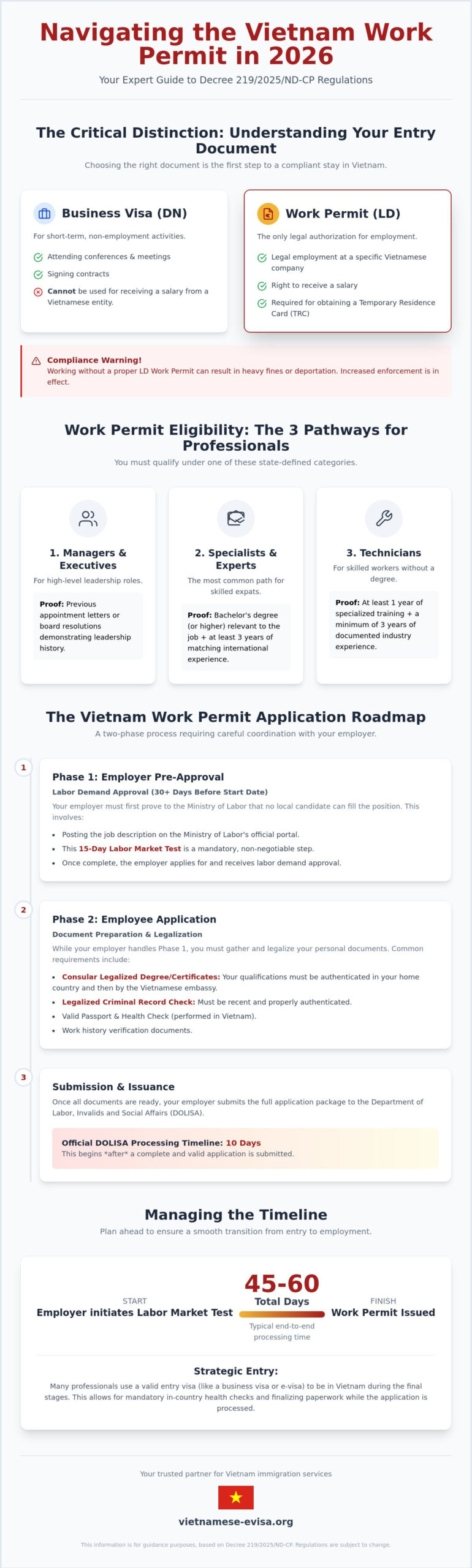
The distinction between a Work Permit (Giấy phép lao động) and a Business Visa (DN) is the most frequent point of confusion for new arrivals. In 2026, the Vietnamese government has sharpened the lines between these two documents to ensure labor market integrity. A Business Visa (DN) is strictly for short-term activities like attending conferences, signing contracts, or scouting locations. It doesn’t grant you the right to receive a salary from a Vietnamese entity. For that, you must complete a formal Vietnam work permit application. This permit is the only legal authorization that allows you to be employed by a specific company in Vietnam.
Following the implementation of Decree 219/2025/ND-CP, authorities have increased enforcement against foreigners attempting to work on 90-day E-visas or tourist visas. Working without the correct LD (Labor) designation can lead to immediate fines or deportation. Because the full permit process typically takes 45 to 60 days from start to finish, many professionals utilize an urgent Vietnam visa to enter the country legally. This “entry strategy” allows you to be physically present to finalize health checks and document legalization while your employer manages the administrative filings. Understanding the nuances of Vietnam work permit regulations is essential for long-term compliance and securing a Temporary Residence Card (TRC).
Who Needs a Work Permit in 2026?
If you plan to work for more than three months at any Vietnamese-registered firm, you need a permit. This requirement applies to intra-company transferees, experts, and technical workers. New 2026 clarifications also specify that even interns and volunteer workers in specific sectors must now hold valid work authorization. Don’t assume your role is too small for scrutiny; the Department of Labor, Invalids and Social Affairs (DOLISA) requires specific documentation for any foreign national contributing labor to a local entity.
Work Permit Exemptions: Do You Qualify?
Not everyone requires a full permit. You might be exempt if you’re a lawyer with a professional practice license issued by the Ministry of Justice or an owner of a company meeting specific capital thresholds. Additionally, foreigners married to Vietnamese citizens benefit from special 2026 residency rules that simplify their path to legal employment. Even if you qualify for an exemption, you must still apply for an official “Exemption Certificate.” This document serves as your legal proof of work rights and is a prerequisite for your family’s residency applications.
The 3 Critical Categories for Work Permit Eligibility
Vietnam’s current labor laws place a heavy emphasis on protecting the domestic workforce. For a Vietnam work permit application to succeed, the sponsoring company must demonstrate that no local citizen can fulfill the requirements of the role. This verification process has become highly digitalized in 2026, leaving no room for administrative shortcuts. To qualify, you must fit into one of three specific professional categories, each with its own rigid set of documentation requirements.
- Category 1: Managers and Executives. This group includes heads of representative offices or those holding high-level leadership positions. You’ll need to provide previous appointment letters or board resolutions that prove your leadership history in prior firms.
- Category 2: Specialists and Experts. This is the most common path for skilled expats. It requires a bachelor’s degree or higher that’s directly relevant to the job, paired with at least three years of international experience in the same field.
- Category 3: Technicians. If you don’t have a degree, you can qualify as a technician. This requires at least one year of specialized training and a minimum of three years of documented experience in your specific industry.
Before you begin gathering your personal papers, your employer must satisfy the official Vietnam work permit conditions regarding local recruitment. If you’re currently outside the country, it’s wise to coordinate with your HR department to ensure they’ve initiated the mandatory digital postings on the Ministry of Labor’s portal.
The 15-Day Labor Market Test Rule
Employers must post the job vacancy on the Ministry of Labor’s official portal at least 15 days before they can even apply for your permit. This window allows local candidates to apply first. The 2026 digital tracking system logs every local applicant, and the company must provide a detailed report explaining why no suitable Vietnamese candidate was found. This step is non-negotiable for approval. If you need to arrive in the country to assist with interviews or finalize your contract during this 15-day window, you can secure an urgent Vietnam visa to bridge the gap legally.
Proving Your Expertise: The 2026 Standard
The standard for proving your background has tightened significantly. Experience certificates must now be notarized and legalized in your home country to be accepted by the Department of Labor. If your diploma is from a non-English speaking country, it requires a certified translation into Vietnamese alongside the standard legalization stamps. According to the 2026 updates to Decree 219/2025/ND-CP, a Specialist is officially defined as a foreign worker who has graduated with at least a bachelor’s degree or equivalent and possesses at least three years of professional experience appropriate to the proposed job position in Vietnam. Ensuring your documents match this exact definition is the key to a successful Vietnam work permit application.
Step-by-Step Vietnam Work Permit Application Process
Succeeding with your Vietnam work permit application in 2026 requires a methodical approach to four distinct phases. While recent regulations have merged several administrative steps into a single submission, the logic of the process remains unchanged. You must initiate the workflow at least 30 days before your intended start date. This timeline allows for the mandatory job posting period and the subsequent internal review by your employer. Once the 15-day local recruitment window closes, your employer submits the unified dossier to the Department of Labor, Invalids and Social Affairs (DOLISA). Official processing for the combined labor demand and permit issuance takes 10 working days. After receiving your physical permit, you can finalize your long-term residency by applying for a Temporary Residence Card (TRC), which the Immigration Department typically issues within 5 to 7 working days.
Essential Document Checklist for 2026
Don’t let a single missing stamp derail your timeline. Your dossier must be complete and accurate before submission to DOLISA. Ensure you have the following:
- Health check certificate: This must be issued by a designated Vietnamese hospital and is valid for 12 months.
- Criminal record certificate: Also known as a Police Clearance, this must be issued within 6 months of your application. You’ll need one from your home country and one from Vietnam if you’ve resided here for more than 6 months.
- Original passport: Your passport must contain a valid Vietnam entry visa that matches your employment purpose.
- Photos: Provide two color photos (4x6cm) with a white background, taken without glasses.
The Legalization Workflow: Home Country to Hanoi
Document preparation is often the most time-consuming part of the Vietnam work permit application. Because Vietnamese authorities only accept foreign documents that have been officially recognized, you must follow a strict three-step legalization path. First, have your degrees and criminal records notarized in your country of origin. Second, obtain consular legalization from the Vietnamese Embassy or Consulate abroad. Finally, once you arrive in Vietnam, have these documents processed for certified Vietnamese translation by a licensed agency. It’s a complex chain, but skipping any step will result in immediate rejection. If you’re still in the planning stages, you can review the current Vietnam visa fee structures to budget for your initial entry and document processing costs.
If you’re facing an immediate job start and need to land in Vietnam while your home country documents are still in transit, we can help you secure an urgent Vietnam visa to ensure you’re on the ground and ready to work as soon as your permit is approved.
Timeline Management: Expediting Your Entry and Approval
Managing expectations is the first step toward a successful relocation. While the official government review takes 10 working days, the total end to end timeline for a Vietnam work permit application is realistically 45 to 60 days. This duration accounts for the mandatory 15 day labor market test and the often unpredictable time required for document legalization in your home country. Common causes for delays include health check failures at non approved hospitals or minor clerical errors in notarized papers. Perhaps the most critical error is a visa mismatch. Entering on a tourist visa for a long term position is a mistake that can’t always be fixed in country; it often requires a full exit and re-entry to change your status to labor (LD).
If your job offer is finalized at the last minute, you can utilize a rush Vietnam visa to secure your entry immediately. This allows you to begin your on the ground requirements while your employer manages the administrative filings. To remain in the country legally while waiting for approval, you may need to utilize DN1 or DN2 business visa extensions. These act as a legal bridge, ensuring you don’t fall out of status before your LD permit is issued and your residency is secured.
What to Do if Your Visa is Expiring Before the Permit is Ready
If your initial 90 day E-visa is nearing its end and the permit isn’t ready, you have two primary options: a visa run to a neighboring country or an in country extension. In 2026, extensions are subject to strict scrutiny, making the visa run a more predictable choice for many. It’s vital to have a professional agency handle your initial entry to avoid entry port errors that could complicate your transition to a 2 year Temporary Residence Card (TRC). A single mistake at the border can reset your entire Vietnam work permit application timeline.
The Role of Vietnamese-Evisa.Org in Your Career Move
We specialize in the high stakes period between your job offer and your first day of work. Our team provides the emergency entry documentation required to get you on the ground fast, often within hours of your request. We offer 24/7 assistance for professionals facing immediate deadlines or complex border complications. By ensuring your initial entry visa is compatible with future work permit requirements, we remove the bureaucratic stress from your transition. We act as your vigilant intermediary, keeping your career plans on track even when government portals or standard processing times fail to meet your urgent needs.
Secure Your Professional Future in Vietnam Today
Success in the Vietnamese labor market starts with understanding that compliance isn’t optional; it’s your foundation for residency. You now know the critical differences between a temporary business entry and a long-term labor permit. By preparing your legalized documents early and accounting for the 60-day processing window, you avoid the common pitfalls that stall most expat careers. Your Vietnam work permit application is the final piece of a strategic puzzle that includes mandatory labor market testing and medical clearances.
Don’t let a looming start date or bureaucratic delays compromise your professional standing. Whether you need to land tomorrow to finalize your contract or require expert guidance on 2026 regulatory compliance, we’re ready to assist. We provide same-day urgent approvals and 24/7 expert support to ensure your entry is seamless and secure. Secure your Emergency Business Visa for Vietnam now and take the first step toward your new life. Your career in Vietnam is waiting, and we’re here to make sure you get there on time.
Frequently Asked Questions
Can I apply for a Vietnam work permit while on a tourist visa in 2026?
You cannot legally apply for a work permit while holding a tourist visa. Vietnamese law requires you to enter the country on a business (DN) or labor (LD) visa to begin the formal filing process. If you arrive as a tourist, you’ll likely need to exit and re-enter on the correct visa type before your employer can submit any paperwork. This ensures your entry purpose matches your eventual residency status.
How much does a Vietnam work permit cost including all fees?
The government issuance fee for a new permit is 400,000 VND in Hanoi and 600,000 VND in Ho Chi Minh City. Total expenses vary because you must also pay for a health check at a designated hospital, which costs around 2,000,000 VND, and criminal record certificates. Consular legalization fees for your degrees and background checks typically cost $10 per stamp at the Vietnamese embassy or consulate.
What happens if I work in Vietnam without a valid work permit?
Foreigners working without a permit face severe penalties including fines of up to 25,000,000 VND and immediate deportation. The government has increased enforcement in 2026, specifically targeting those on 90-day E-visas who perform unauthorized labor. Your employer also faces fines up to 75,000,000 VND and the potential suspension of their foreign hiring licenses. It’s a high-stakes risk that isn’t worth taking for your career.
How long is a Vietnam work permit valid for under the current 2026 laws?
A work permit is valid for a maximum of 2 years and allows for a single extension of another 2 years. Under the current 2026 laws, once this 4-year period ends, your employer must restart the Vietnam work permit application from the beginning. This includes the mandatory 15-day labor market testing phase to prove that no local candidate can fill your specific role.
Do I need a work permit if I am a digital nomad working for a foreign company?
Digital nomads working for foreign entities and receiving salaries abroad don’t technically require a work permit. You can legally reside in Vietnam using a standard E-visa or business visa for these purposes. However, if you sign a contract with a local firm or receive a Vietnamese-sourced income, you must immediately obtain a permit. Failing to do so can result in legal complications and potential fines during visa renewals.
Can my employer sponsor my family for a visa if I have a work permit?
Your employer can sponsor your spouse and children for Dependent Temporary Residence Cards (TRC) once your permit is approved. This TRC is tied to the validity of your work permit and removes the need for your family to manage constant visa renewals. You must provide legalized marriage and birth certificates to prove the relationship during the filing. This process provides long-term security for your family’s stay in Vietnam.