


Complete Vietnam Evisa Photo Requirements Rejected Guide for Success
You’ve spent months perfecting your 2026 itinerary, but a single email just put everything at risk because your Vietnam evisa photo requirements rejected your application. It is a common, high-stakes hurdle that leaves many travelers staring at a vague “unqualified photo” status while their departure date looms. We understand the anxiety of potentially missing a flight due to a technicality that the official portal doesn’t clearly explain.
It’s natural to feel confused when you aren’t sure if the issue was a subtle shadow, the file resolution, or a simple mix-up between your portrait and your passport scan. This guide is designed to remove that bureaucratic stress by providing you with the exact visual-standard checklist and digital file fixes you need right now. You will discover the precise reasons for rejection and how to correct them to ensure your next submission is successful.
We are going to break down the latest 2026 requirements, offer a step-by-step fix for your digital images, and explain how to fast-track your processing so you don’t lose another day of your trip. By the end of this article, you’ll have the expert guidance needed to move from a rejected status to a confirmed approval.
Key Takeaways
- Understand the automated AI triggers that lead to your Vietnam evisa photo requirements rejected status and how to interpret vague government error messages.
- Master the technical distinctions between the portrait photo and passport biodata page to prevent common upload errors regarding file size and clarity.
- Access a practical guide to fixing lighting, background, and resolution issues using accessible digital tools without needing a professional photographer.
- Evaluate the risks of the standard amendment process and learn how urgent or expedited services can secure your travel plans when your flight is approaching fast.
- Implement a final verification checklist to ensure your resubmission meets every official 2026 requirement for immediate approval.
Why Your Vietnam E-visa Photo Was Rejected: Official 2026 Standards
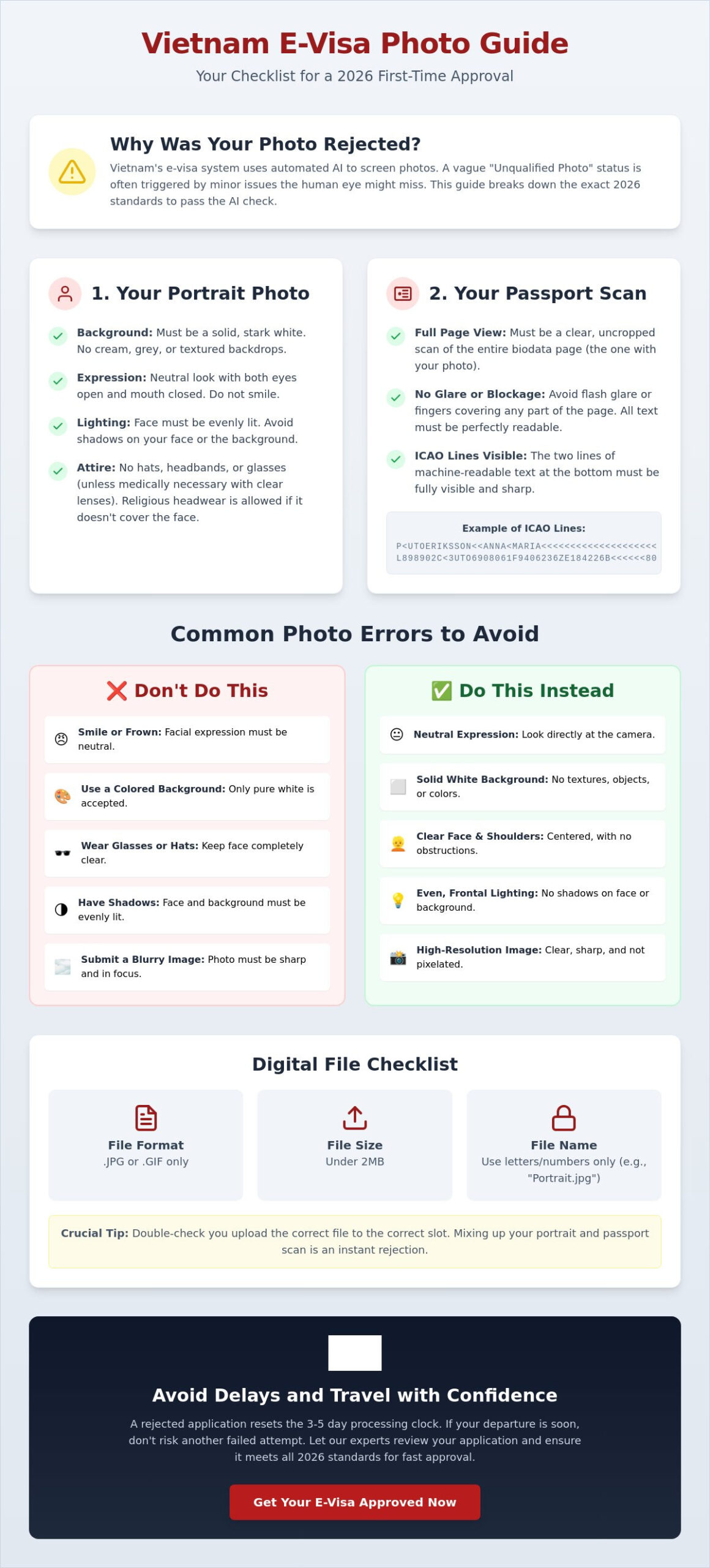
The 2026 Vietnam Immigration Department uses automated AI screening for initial photo compliance. This machine-led process is unforgiving. If your submission triggers a red flag, you’ll likely receive a generic message: “Unqualified photo (incorrect size, blurry, or background not white).” This lack of specificity is exactly why your Vietnam evisa photo requirements rejected status feels so frustrating. The system doesn’t provide a critique; it simply halts your application.
Understanding Vietnam’s visa policy is the first step in recognizing that these digital standards are just as strict as physical border checks. A photo that looks perfectly acceptable in your physical passport might fail the portal’s pixel-by-pixel analysis. The machine doesn’t care about your holiday excitement. It scans for specific pixel coordinates and color values to ensure every visitor profile matches the strict security standards required for entry.
The cost of a mistake is high. Rejection results in a total loss of application fees and resets the 3 to 5 day processing clock. For travelers on a tight deadline, this reset can be catastrophic. If you’ve already faced a delay, reviewing our ultimate 2026 application guide can help you align with the current digital expectations before you try again.
The Core 2026 Portrait Photo Checklist
- Size and Format: Files must be in .jpg or .gif format and stay under the 2MB limit. Aim for a 4×6 cm proportion to avoid stretching.
- Background: The backdrop must be stark white. Off-white, cream, or light grey tones will trigger an immediate rejection.
- Facial Expression: Maintain a neutral expression. Don’t smile, keep your mouth closed, and ensure both eyes are wide open.
- Headgear and Glasses: Remove all hats and headbands. Tinted glasses or heavy frames are prohibited. Religious headwear is only permitted if the entire face remains visible.
The ‘Hidden’ Rules: Lighting and Shadows
Shadows on the face or the background are the primary cause of an “unqualified” status in 2026. Even lighting is the absence of hot spots or dark patches on the skin. You must avoid ‘red-eye’ effects and flash glare on your forehead or glasses frames. If the AI detects a shadow behind your ears or a dark side of your face, it cannot verify your features, leading to an automatic Vietnam evisa photo requirements rejected notification. Ensure your light source is directly in front of you to wash out any potential depth markers that the system might misinterpret.
Technical Specs: Mastering the Portrait and Passport Data Page Uploads
One of the most frequent reasons applications fail is a simple mix-up between the two required upload fields. The “Portrait Photo” slot is reserved exclusively for a headshot, while the “Passport Data Page” field requires a clear scan of your identity page. If you upload a photo of your passport cover or swap these files, your Vietnam evisa photo requirements rejected status will be triggered by the system’s automated verification tools. Accuracy at this stage is non-negotiable for a successful 2026 application.
Resolution is a delicate balancing act. Your files must be sharp enough for the ICAO lines to be legible, yet small enough to stay under the 2MB limit. We recommend saving your files with simple names like “Taylor_Smith_Portrait.jpg” to avoid system errors. Never use special characters or symbols in file names. Additionally, avoid over-cropping your portrait. If you zoom in too far, the image becomes pixelated, leading to a “blurry” rejection tag that forces you to restart the entire process.
To avoid these technical pitfalls, many travelers choose to apply for a Vietnam visa through a streamlined interface that pre-checks these specifications before submission.
Scanning the Passport Data Page Correctly
You must upload the full data page, including the two lines of machine-readable text and numbers at the bottom known as ICAO lines. According to the U.S. Department of State travel advisory, your passport must also be valid for at least six months beyond your arrival. Ensure no fingers are covering any text or the holographic emblems while you hold the document. If you encounter glare on the laminated surface, tilt the passport slightly away from your light source to prevent “white-out” on your name or birthdate.
Digital Portrait: Professional vs. DIY
While a smartphone selfie might seem convenient, using a dedicated passport photo app or a professional service like CVS or AAA is significantly safer. These services ensure your head occupies the required 70-80% of the frame. You must avoid using “beauty filters” or AI enhancers that alter your facial features or skin tone. The Immigration Department’s AI compares your upload against your passport scan; any artificial discrepancy will lead to your Vietnam evisa photo requirements rejected and potentially delay your travel plans for several days.
How to Fix Common Photo Errors and Avoid Further Delays
Receiving notification that your Vietnam evisa photo requirements rejected your application is a setback, but it’s one you can resolve immediately. You don’t need a professional studio to create a compliant file. Most rejections stem from lighting inconsistencies or file compression issues that are easily corrected with a structured approach. Before you resubmit, it’s vital to follow a strict “Double-Check” Protocol by comparing your new file against the Vietnam E-visa ultimate guide to ensure every 2026 standard is met.
Verifying the metadata of your image is a technical step many travelers overlook. Ensure the file isn’t corrupted and that it’s saved in a standard .jpg format. If your previous attempt was rejected for “unqualified” reasons, the system may have struggled to read the file’s header information. Start fresh with a new capture rather than trying to “fix” a file that has already been compressed multiple times. If you’re racing against a deadline, you can apply for an emergency Vietnam visa to have our specialists handle the technical compliance for you.
Fixing Background and Shadow Issues
Shadows are the most frequent trigger for AI rejection. The most effective way to eliminate them is by using natural light; stand facing a large window during the day so the light washes over your face evenly. If you must take the photo at night, use the “Two-Lamp” method by placing two desk lamps at 45-degree angles in front of you to wash out shadows behind the ears and neck. To correct a background that appears slightly grey, use a basic image editor to increase the “Exposure” until the backdrop is stark white without washing out your facial features.
Resolving ‘Blurry’ or ‘Low Resolution’ Errors
Never take a screenshot of an existing photo. Screenshots strip away essential resolution and often lead to “blurry” rejection tags. Always use the original digital file or a high-quality scan of a physical print. When scanning, set your device to a minimum of 300 DPI to ensure the clearest result possible. Before hitting “Submit,” check the file size on your mobile or desktop device; it must be under 2MB but large enough to remain crisp when viewed at 100% zoom. If the image looks grainy on your screen, the Immigration Department’s system will almost certainly reject it.
Emergency Solutions: Saving Your Trip After a Photo Rejection
If your flight is scheduled within the next 24 to 48 hours and you’ve just seen your Vietnam evisa photo requirements rejected, you are likely facing a travel crisis. The natural instinct is to log back into the government portal and upload a new photo immediately. However, travelers often fall into the “Amendment” trap. Once you submit a correction through the official site, the processing clock often resets; it can take another 3 to 5 working days for an officer to review your update. When your departure is tomorrow, you simply don’t have that much time to wait for a bureaucratic queue.
A professional agency provides a vital bypass to this standard delay. We specialize in securing an emergency Vietnam visa by leveraging established channels to move your application to the front of the line. Instead of hoping for a system update, you get a definitive resolution. For those in extreme time crunches, read our guide on Urgent Vietnam Visa for sub-2-hour processing. We understand the high stakes involved and are prepared to act as your knowledgeable intermediary.
The Fast-Track Re-application Process
Our experts perform a manual, secondary review of your documentation before any data hits the immigration system. This human oversight ensures your new files meet every technical specification, from pixel dimensions to background hex codes, guaranteeing 100% acceptance. We facilitate direct communication with the Immigration Department to resolve “amendment” flags in record time. Travelers already at the airport often rely on our expedited visa services to prevent a total loss of their flight and accommodation investments.
Avoiding Future Rejections: Expert Tips
The safest way to avoid another Vietnam evisa photo requirements rejected notification is to use a “Scan-and-Send” service. You provide the raw images; we handle the technical formatting, cropping, and compression to ensure the file is optimized for the Immigration Department’s AI scanners. We offer constant support to manage last-minute travel crises, even during peak periods like the Tet holiday or National Day. Don’t let a photo technicality ruin your trip. Apply for your Emergency Visa now and secure your entry into Vietnam today.
Secure Your Vietnam Entry Today
A Vietnam evisa photo requirements rejected notice is a technical setback, not a permanent barrier. You now understand that shadows, lighting, and the precise distinction between your portrait and passport scans are the keys to a successful 2026 application. While these technical fixes are essential for standard processing, they can’t always overcome the time lost during the official amendment process when your departure is imminent. Relying on the government portal’s standard timeline after a rejection often puts your entire trip at risk.
Our team serves as your tireless intermediary, providing the expert guidance needed to navigate these high-stakes situations. With a track record of 10,000+ successful applications and 24/7 expert review, we ensure your photos meet every administrative requirement before submission. We specialize in rapid resolutions, offering approval in as little as 2 hours to keep your travel plans on track. You don’t have to face bureaucratic stress alone when a seasoned specialist is ready to assist you around the clock.
Get your Emergency Vietnam Visa Approval in hours—Photo Guaranteed!
Move forward with the confidence that your documentation is in capable hands. Vietnam is ready for your arrival, and we’re here to ensure you get there without any further delay.
Frequently Asked Questions
Can I use my phone’s camera for the Vietnam E-visa photo?
Yes, you can use a modern smartphone camera as long as the resulting image meets the 300 DPI resolution and stark white background requirements. Ensure you use the rear camera for higher quality and have someone else take the photo to avoid the distortion common with front facing lenses. The final file must be saved in .jpg or .jpeg format and remain under the 2MB limit to be accepted by the portal.
What happens if my Vietnam E-visa is rejected due to a photo error?
When your application is flagged, you will receive an “unqualified photo” notification and your government fee is typically non refundable. Your processing timeline resets, meaning you must wait another 3 to 5 working days after submitting a corrected image through the official portal. If your Vietnam evisa photo requirements rejected status occurs close to your flight, you will likely need to seek expedited assistance to avoid missing your departure.
Do I need to wear specific clothes for the visa photo?
You should wear casual or professional clothing that contrasts clearly with the mandatory white background. Avoid wearing white or very light colored shirts, as they can blend into the backdrop and cause the AI screening to fail. Uniforms of any kind are prohibited; stick to plain, dark colored attire to ensure your shoulders and head are clearly defined in the digital frame.
Can I wear my glasses in the Vietnam visa photo in 2026?
No, you must remove all eyewear, including prescription glasses and sunglasses, for your 2026 application. Even non reflective lenses can cause glare or obscure your eye shape, which triggers an automatic rejection from the Immigration Department’s automated system. Ensure your eyes are wide open and clearly visible to maintain compliance with the latest security standards.
How long does it take for the E-visa to be approved after I fix the photo?
Standard amendment processing usually takes an additional 3 to 5 working days after you upload the corrected file. This delay can be longer during peak travel seasons or public holidays like the Tet festival. If you cannot afford this wait, our emergency services can bypass the standard queue to secure your approval in as little as 2 to 4 hours, resolving a Vietnam evisa photo requirements rejected crisis immediately.
Is a selfie acceptable for the Vietnam E-visa application?
A traditional handheld selfie is almost never acceptable because it creates facial distortion and often includes visible shadows or an incorrect background. The AI scanners require a perfectly centered, level portrait where your head fills 70% to 80% of the frame. It’s much safer to have another person take the photo or use a tripod to ensure your shoulders are square and the lighting is even across your entire face.