


Complete Happy New Year in Vietnamese Guide for Success
Wishing someone a “Happy New Year” in Vietnam is the fastest way to build a genuine cultural connection, but if you don’t secure your documentation before the country effectively stops for Tet, you won’t even make it past the airport gate. You likely want to show respect by learning the most authentic way to say happy new year in vietnamese, yet you’re probably feeling anxious about the complex tones or the logistical nightmare of traveling during the nation’s biggest holiday. We understand that the pressure to be both culturally respectful and administratively prepared is high when government offices are about to close.
This guide provides the exact phrases you need to speak confidently and a critical roadmap to handle the 2026 holiday closures. You’ll learn the core greetings for the Year of the Horse, essential etiquette for visiting local homes, and the specific steps to ensure your visa is approved before the nine day public holiday begins on February 14, 2026. We’ll break down the traditional “Chuc Mung Nam Moi” and explain why your entry permit must be finalized before the U.S. Embassy and local immigration offices shut down for the week starting February 16, 2026.
Key Takeaways
- Master the correct pronunciation of happy new year in vietnamese to build immediate rapport and show cultural respect during your travels.
- Discover specialized greetings for elders and business partners that go beyond basic phrases to convey prosperity and longevity.
- Understand the spiritual significance of the first day of Tet and why your initial interactions are believed to set the tone for the entire year.
- Navigate the 2026 holiday schedule to avoid being stranded during the nine day administrative shutdown that begins in mid-February.
- Learn why the “Tet Rush” can extend standard visa processing times and how to secure your entry documents before government offices close.
How to Say Happy New Year in Vietnamese: The Core Phrases
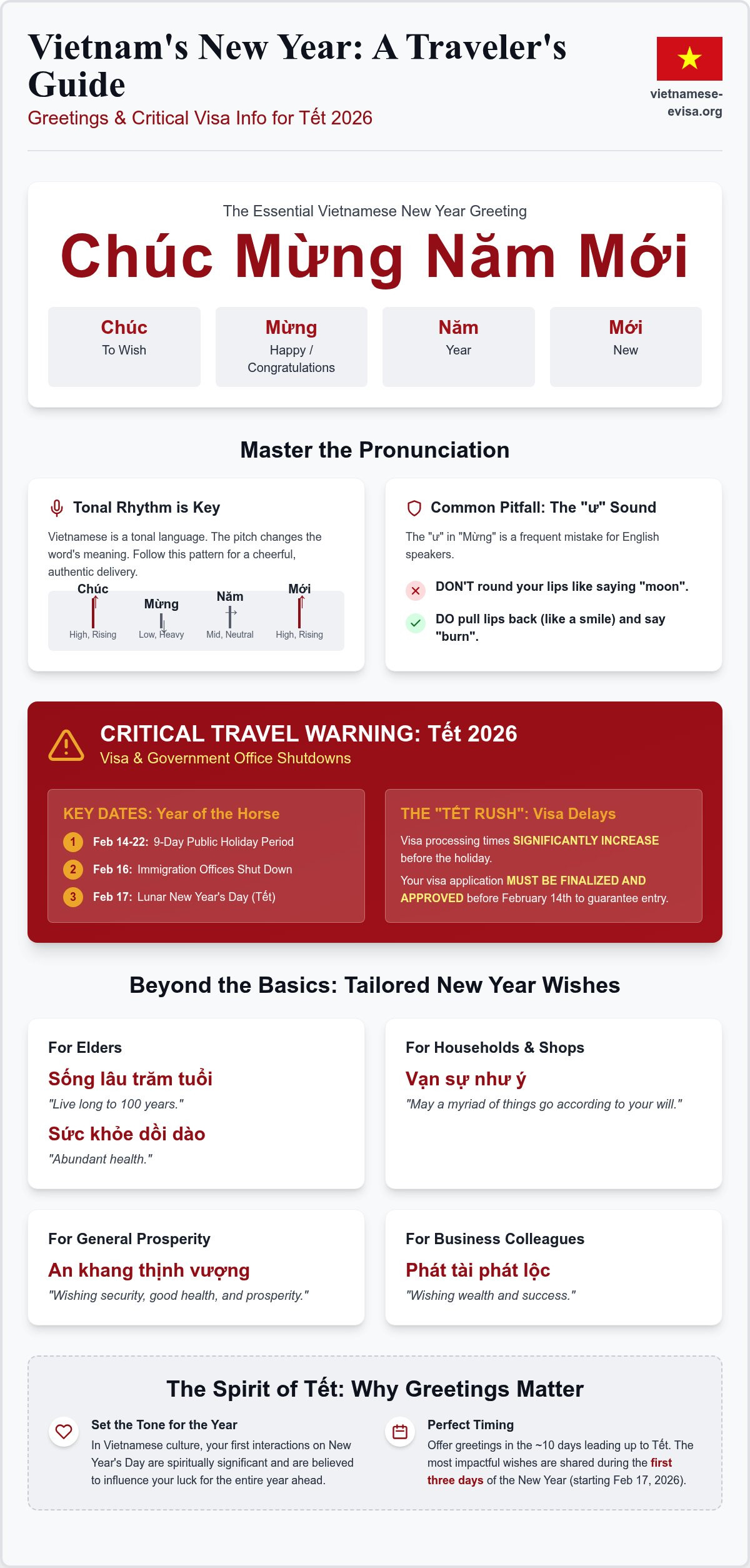
“Chúc Mừng Năm Mới” is the primary festive greeting used across all of Vietnam. While it’s used during the Gregorian New Year on January 1st, its cultural weight is most significant during the lead-up to Tet, the Lunar New Year. The phrase functions as a comprehensive wish for happiness and success. If you break it down literally, the components are simple yet powerful: “Chúc” means to wish, “Mừng” translates to congratulations or happy, “Năm” is year, and “Mới” means new. Learning how to say happy new year in vietnamese correctly is your first step toward meaningful cultural immersion.
You’ll encounter this phrase on red banners, gold stickers, and in every storefront from Hanoi to Ho Chi Minh City. It’s the universal key to opening conversations during the festive season. However, simply knowing the words isn’t enough. You need to understand the mechanics of the language to ensure your message is received with the respect you intend.
Pronunciation Tips for Beginners
Vietnamese is a tonal language, which means the pitch of your voice changes the meaning of the word. “Chúc” uses a sharp rising tone; think of it as the upward inflection at the end of a question. “Mừng” requires a low, heavy tone that stays at the bottom of your vocal range. Finally, “Mới” returns to that high, rising pitch. A frequent mistake for English speakers is the “ư” sound in “Mừng.” Don’t round your lips like you’re saying “moon.” Instead, pull your lips back as if you’re smiling and make a sound closer to the “u” in “burn.” Practice the phrase as a rhythmic sequence: high, low, mid, high. Keep your delivery enthusiastic. A cheerful, energetic greeting often compensates for minor phonetic errors.
Tết 2026: Timing Your Greetings
The 2026 Lunar New Year falls on Tuesday, February 17. This marks the start of the Year of the Horse. Because the official public holiday period runs from February 14 to February 22, you should begin offering your well-wishes roughly ten days before the main event. In Vietnamese culture, the preparation phase is just as vital as the holiday itself. Offering a happy new year in vietnamese greeting during the final days of the outgoing year shows you’re attuned to the local rhythm. Don’t wait until the holiday is over; the most impactful wishes are shared during the first three days of the New Year. Since this period involves a total shutdown of government offices, ensure you’ve reviewed the ultimate 2026 application guide to confirm your entry documents are processed before the February 14 deadline.
Beyond the Basics: Meaningful Wishes for Different People
While the standard “Chúc Mừng Năm Mới” is effective, mastering specific idioms demonstrates a deeper understanding of the cultural traditions of Tet. Vietnamese culture places heavy emphasis on the power of words during the first days of the year. If you wish to truly impress your hosts, you must tailor your happy new year in vietnamese to the recipient’s life stage and goals. For elders, the phrase “Sống lâu trăm tuổi” (Live long to 100 years) is the gold standard, often paired with “Sức khỏe dồi dào” to wish them abundant health. These expressions prioritize longevity and physical well-being, which are highly valued in family-centric circles.
If you’re visiting a household or a shop, “Vạn sự như ý” is a versatile and powerful choice. It translates to “may myriad things go according to your will,” essentially wishing the recipient success in every endeavor they undertake. For those focused on financial stability, “An khang thịnh vượng” combines wishes for security, good health, and prosperity into one elegant phrase. Using these specific terms shows you aren’t just reciting a script, but actually wishing for their specific success.
Greetings for Business Colleagues and Clients
Professional relationships in Vietnam require a careful balance of respect and ambition. When addressing a boss or partner, always use formal pronouns such as “Ông” for an older gentleman, “Bà” for an older lady, or “Anh” and “Chị” for those closer to your age. A highly effective professional wish is “Phát tài phát lộc,” which specifically targets wealth and success. This demonstrates that you value their business growth as much as they do. If your business travel plans are approaching the holiday deadline, consider securing an emergency vietnam visa to ensure you arrive in time for these critical networking opportunities.
Etiquette: The Art of Giving Well-Wishes
The delivery of a happy new year in vietnamese greeting is often accompanied by “Lì Xì,” the tradition of giving red envelopes containing lucky money. Hierarchy governs this process; elders give to children, and adults often give to their parents or younger siblings. When you offer a wish, maintain steady eye contact and a warm smile. This isn’t just a social formality. It’s a spiritual exchange. Standing tall and speaking clearly shows confidence and sincerity, which are vital when setting the tone for the coming year. Remember that your posture and tone of voice are just as important as the words you choose.
The Spirit of Tết: Why These Greetings Matter
Tết is far more than a simple holiday; it represents a profound spiritual reset for the Vietnamese people. There is a deep-seated belief that every action and word spoken on the first day of the Lunar New Year dictates the trajectory of the next twelve months. When you offer a happy new year in vietnamese, you aren’t just being polite. You are actively participating in a ritual designed to invite good fortune. This is why residents spend weeks cleaning their homes and settling debts before the February 17, 2026, start date. They want to enter the Year of the Horse with a clean slate and positive energy.
Foreigners are often invited to participate in the “Xông đất” or “first footing” ceremony. This is a high honor where the first person to enter a home after midnight on New Year’s Eve is believed to bring their own luck to the family. If you’re invited, your presence is a testament to the host’s respect for you. However, you must be mindful of cultural taboos. Avoid any mention of death, illness, or financial loss. Even if you’re feeling the stress of travel, keep your conversation focused on growth and renewal to ensure you don’t inadvertently “spoil” the family’s luck for the year.
Traditional Symbols: Peach Blossoms and Ochna
Visual cues are essential for understanding the seasonal atmosphere. In Northern Vietnam, you’ll see the vibrant pink of Peach Blossoms (Hoa Đào), while the South is dominated by the bright yellow Ochna (Hoa Mai). Both symbolize the arrival of Spring and the resilience of life. You can compliment a host’s decorations by saying “Hoa đẹp quá” (The flowers are so beautiful). This simple acknowledgment, combined with your happy new year in vietnamese greeting, bridges the gap between being a tourist and a welcomed guest. For those still planning their journey, checking the Vietnam Visitor Visa: Essential Tips for Your Stay is vital to ensure you don’t miss these displays due to document delays.
Tet Food: A Vocabulary of Flavor
Food is the heart of the celebration. You’ll likely be offered Bánh Chưng, a square sticky rice cake from the North, or Bánh Tét, its cylindrical counterpart from the South. These dishes are rich in history and represent the earth and sky. To show your appreciation, you can tell your host the food is “ngon” (delicious). Wishing someone a “delicious” New Year is a common way to celebrate the abundance of the season. To avoid the stress of holiday closures, you should apply for your expedited visa now before the February administrative shutdown begins.
Critical Travel Warning: Visa Planning for Tet 2026
While you’ve mastered the cultural nuances of the holiday, you cannot overlook the bureaucratic reality of traveling during this period. The Vietnam Immigration Department undergoes a total shutdown for 5 to 7 days in February 2026. Official public holiday dates are confirmed for February 14 through February 22. During this window, standard e-visa processing, which usually takes 3 business days, can easily stretch into 2 weeks due to the “Tet Rush.” If your approval isn’t secured before the shutdown begins, you risk being denied boarding at your point of departure.
If you find yourself flying during the holiday without a valid permit, you must pivot to expedited options immediately. Review the Urgent Vietnam Visa: How to Get Your Approval in Under 2 Hours guide to understand the specialized protocols required for last minute entry. Don’t assume that standard government portals will be monitored while the country celebrates the Year of the Horse.
How to Secure an Emergency Vietnam Visa During Tet
When public portals are unresponsive, specialized services like Vietnamese-Evisa.Org become essential for navigating last minute travel. Emergency holiday processing differs from standard e-visas because it utilizes proprietary approval channels that remain operational even when the main Immigration Department is closed. To ensure a successful application, prepare a digital checklist including a high resolution passport scan, a recent passport style photo, and your confirmed flight details. This readiness allows for rapid processing when every hour counts.
Airport Logistics During the New Year
Expect significant congestion at “Visa on Arrival” counters in Hanoi, Da Nang, and Ho Chi Minh City. Having your physical approval letter in hand is non-negotiable; without this document, you won’t be allowed to board your flight. Once you arrive, use your knowledge of how to say happy new year in vietnamese to greet the immigration officer. A respectful “Chúc Mừng Năm Mới” can facilitate a smoother interaction during a high stress travel day. However, cultural respect is a supplement to, not a replacement for, valid legal documentation. Ensure your paperwork is finalized at least 10 days before the February 14 holiday start date to avoid the administrative gridlock.
Finalize Your Tet 2026 Travel Strategy
You now possess the linguistic tools to offer a respectful happy new year in vietnamese and understand the intricate social hierarchies of a Tet celebration. From the universal “Chúc Mừng Năm Mới” to specialized wishes for prosperity and longevity, these phrases ensure you build genuine connections with your hosts. However, cultural competence is only half the battle. Your ability to enjoy the Year of the Horse depends on overcoming the administrative hurdle of the nine day government shutdown starting February 14, 2026.
Don’t let bureaucratic closures derail your holiday plans. We provide 24/7 holiday support and can secure your approval in as little as 2 hours; it’s a service trusted by thousands of Tet travelers. Apply for your Emergency Vietnam Visa now to beat the Tet 2026 shutdown and ensure your entry documents are finalized before immigration offices close. Vietnam is ready to welcome you with vibrant traditions and unmatched hospitality. With your paperwork secured and your greetings practiced, you’re prepared for a successful and culturally rich journey.
Frequently Asked Questions
When is the best time to say Happy New Year in Vietnamese?
You should begin using New Year greetings approximately one week before the official start of Tet and continue through the first three days of the new year. For the 2026 season, this means starting around February 10 and continuing through February 20. Offering a happy new year in vietnamese during this window is the most effective way to build rapport with locals before the nine day public holiday begins.
Does the Vietnam visa office close for the Lunar New Year?
Yes, the Vietnam Immigration Department and all government embassies close for five to seven days during the holiday. For 2026, expect a total administrative shutdown from February 14 through February 22. Standard e-visa processing will stop entirely during this period. You must secure your approval documentation before the holiday starts to avoid being denied boarding at the airport due to lack of a valid entry permit.
Can I get a same-day visa if I travel during Tet 2026?
You can only obtain a same-day visa during the Tet holiday through specialized emergency services that operate 24/7. While public immigration portals are inactive during the 2026 Year of the Horse celebrations, private facilitators use proprietary channels to process urgent approvals in as little as 2 hours. This is the only reliable method for travelers who discover documentation errors after the government offices have officially closed for the week.
What is the most polite way to wish an elder Happy New Year in Vietnam?
The most respectful phrase for elders is “Sống lâu trăm tuổi,” which translates to “Live long to 100 years.” You should precede this with the word “Chúc” and the appropriate formal pronoun, such as “Ông” for a grandfather or “Bà” for a grandmother. Using these specific well-wishes demonstrates a deep understanding of Vietnamese hierarchy and a sincere respect for longevity, which is highly valued during family gatherings.
Is ‘Chúc Mừng Năm Mới’ the same as ‘Happy Tet’?
“Chúc Mừng Năm Mới” is the literal translation of “Happy New Year” and is the standard phrase used throughout the country. While “Happy Tet” is a common English simplification, using the native phrase is the most authentic way to say happy new year in vietnamese. It is appropriate for both the solar New Year on January 1st and the Lunar New Year, though its spiritual significance is much higher during Tet.
What should I do if my Vietnam E-visa is delayed during the holiday season?
If your e-visa is delayed as the holiday approaches, you must immediately apply for an expedited or rush visa service. The “Tet Rush” often causes standard three day processing times to stretch into two weeks, and applications won’t move once the February 14 shutdown begins. Contact a specialized provider that offers holiday support to ensure your approval is finalized through emergency channels before you reach the departure gate.