


Common Vietnam E-visa Mistakes: The Essential 2026 Post-Approval Checklist
What if the approval PDF sitting in your inbox isn’t actually a guaranteed ticket to entry, but a document that could see you denied boarding at the airport? It’s a stressful reality that many travelers face when they discover their documentation contains a single, fatal error. You’ve likely spent months dreaming of your 2026 trip, and the last thing you want is for a simple administrative oversight to halt your journey at the check-in desk. We understand the anxiety that comes with navigating complex immigration rules, especially when the stakes for your vacation or business trip are so high.
By following this expert checklist, you’ll learn how to identify common vietnam evisa mistakes that often slip through the cracks during the initial application. We’ll show you exactly how to verify your personal data against your passport’s ICAO line, explain the specific 2026 printing requirements, and clarify the rules regarding your designated port of entry. This guide provides the professional clarity you need to ensure your paperwork is flawless, giving you total confidence as you head to the border. We’ve compiled the most critical steps to verify, print, and use your visa correctly so you can focus on your travels instead of bureaucratic stress.
Key Takeaways
- Cross-reference your E-visa PDF against your passport’s machine-readable zone to catch subtle data errors that trigger boarding denials.
- Understand the 2026 physical documentation requirements, including the necessity of printed copies and specific passport validity rules.
- Streamline your arrival by identifying the correct immigration queues and avoiding the common pitfall of waiting at the wrong service counters.
- Learn how to quickly rectify common vietnam evisa mistakes such as incorrect port-of-entry designations or name formatting issues.
- Ensure your stay remains legally compliant by following the mandatory post-arrival registration steps required for all 2026 international travelers.
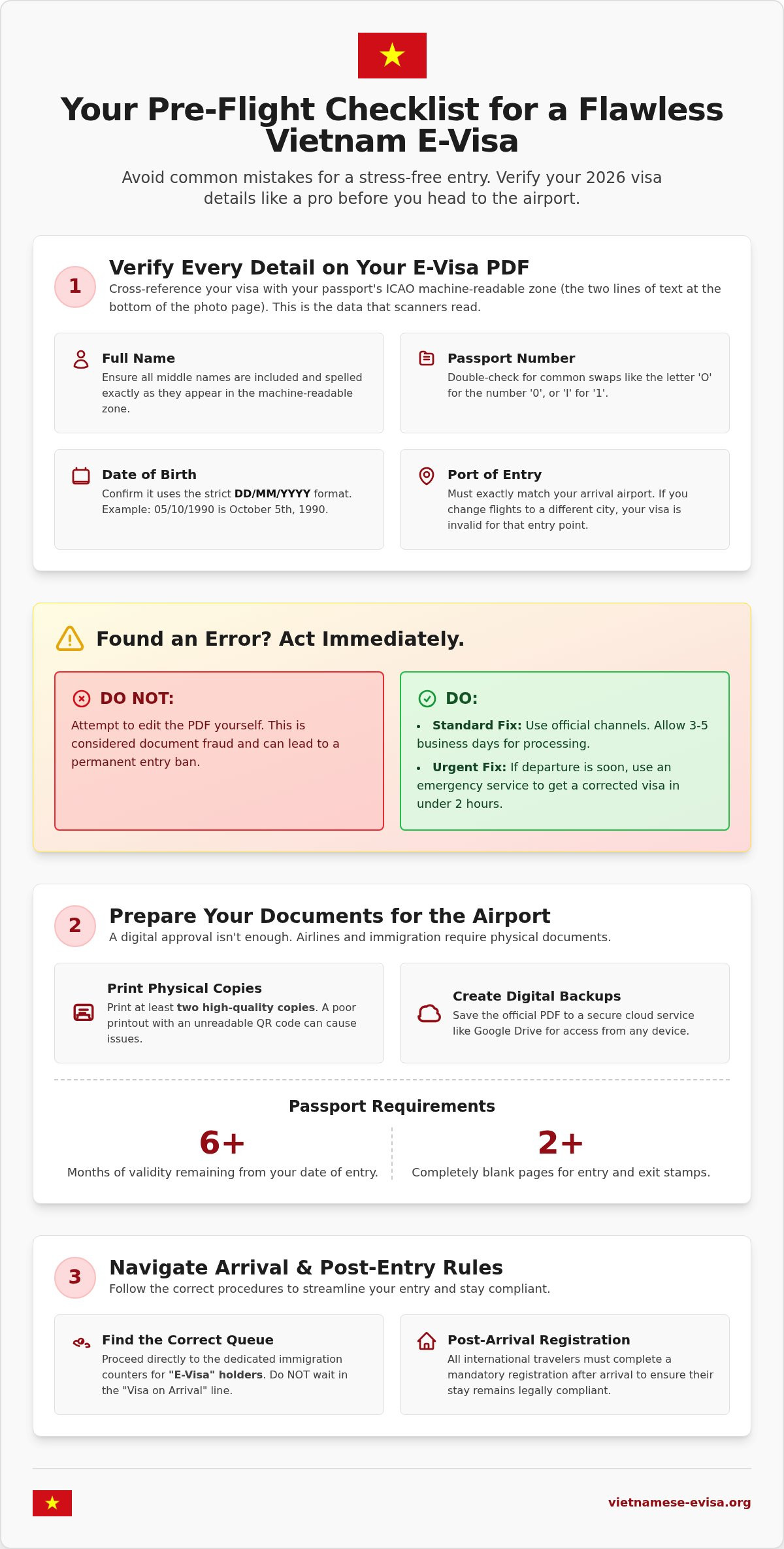
Common Data Mistakes: Verifying Your E-visa PDF Details
Receiving your approval email is just the first step; the real work begins with a forensic review of the document itself. Don’t rely on low-resolution mobile screenshots for your records. Download the official .pdf file immediately to ensure you’re viewing the exact version that border officials will scan. Identifying common vietnam evisa mistakes at this stage is the only way to prevent a stressful boarding denial at the airport. Many travelers assume the approval means the data is perfect, but the system simply processes what was submitted, whether it’s accurate or not.
The most reliable way to verify your data is to cross-reference every character against the ICAO (machine-readable) zone at the bottom of your passport. This two-line code is the ultimate source of truth for international immigration systems. Understanding Vietnam’s visa policy helps you realize that even a minor discrepancy between your passport and the visa PDF can lead to immediate rejection. Immigration officers in 2026 use automated scanners that flag these mismatches instantly, leaving no room for manual negotiation at the desk.
Critical Data Points to Cross-Check
- Full Name: Your middle names must be present and spelled exactly as they appear in the machine-readable zone of your passport. If your passport lists “John Quincey Public” and your visa only says “John Public,” you’ll likely face issues.
- Passport Number: Systems often flag errors where travelers swap the letter ‘O’ for the number ‘0’ or the letter ‘I’ for the number ‘1’. Check these characters twice.
- Date of Birth: Vietnam strictly uses the DD/MM/YYYY format. If your PDF shows 05/10/1990, it signifies October 5th. Verify this doesn’t conflict with your home country’s standard format to prevent administrative rejections.
Your ‘Port of Entry’ must exactly match your 2026 arrival airport. If you’ve changed your flight and are landing at a different international checkpoint than what is listed on your PDF, you won’t be allowed to enter. Similarly, confirm your ‘Entry’ and ‘Exit’ dates cover your entire itinerary. If your flight lands at 11:55 PM but your visa validity begins the following day, you’ll be forced to wait in the transit area until the clock strikes midnight.
What to Do if You Find an Error
If you spot a typo, never attempt to edit the PDF yourself using digital software. This is considered document fraud and can result in a permanent entry ban. Standard government correction channels typically require 3 to 5 business days to process a fix. If your departure is imminent, you should use an emergency Vietnam visa service to secure a legally corrected document in under 2 hours. This professional safety net ensures you don’t lose your flight or prepaid hotel bookings due to a simple data entry oversight.
Physical Documentation Errors: Preparing for Your Flight
Securing your digital approval is only half the battle. One of the most common vietnam evisa mistakes occurs at the departure gate, where travelers rely solely on their smartphones. Many airlines and border officers in 2026 still require physical paper. If your phone battery dies or the local Wi-Fi fails, you could be denied boarding without a hard copy in hand. Print at least two physical copies of your document before leaving for the airport to ensure you have a reliable backup.
Printing Requirements and Digital Backups
Your printout must be perfectly legible for the scanners. While the official Vietnam e-visa portal issues the document as a high-resolution PDF, a poor-quality print can prevent scanners from reading the vital QR code. Use a laser printer for high-quality black and white or color results. Store a backup version in a secure cloud folder like Google Drive. This ensures you can access it from any device if you lose your physical papers. Keep one copy in your carry-on for immediate access and tuck a spare into your checked luggage.
Passport and Port of Entry Rules
Your passport itself must meet strict criteria. It must be valid for at least 6 months beyond your intended entry date. Additionally, check that you have at least two entirely blank pages. These are necessary for the 2026 entry and exit stamps. Airline staff often check these requirements before they issue your boarding pass. Have your return or onward flight itinerary printed and ready for inspection. This proves you intend to leave within your visa’s validity period.
Double-check that the physical passport you’re holding is the exact one used for the application. If you’ve renewed your passport since applying, the visa is void. Also, verify your arrival port. You cannot land at a seaport if your visa specifies an airport. If you discover a port mismatch on the day of travel, urgent Vietnam visas are your only solution to avoid a cancelled trip. Resolving these common vietnam evisa mistakes early is the only way to safeguard your travel plans. If you’re unsure about your documentation status, you can verify your approval details to ensure everything is compliant before you fly.
Arrival Port Blunders: Navigating Vietnam Immigration Halls
Navigating the arrival hall is the final hurdle, yet it’s where many travelers stumble. One of the most common vietnam evisa mistakes is simply following the crowd into the wrong queue. Immediately after deplaning, ignore the large groups gathering at the ‘Visa on Arrival’ or ‘Landing Visa’ counters. These desks are specifically for travelers who do not yet have an approval document. Since you already hold a valid E-visa, you must proceed directly to the immigration booths marked ‘Foreigners’ or ‘Passport Control’.
Proceed with your physical passport and printed E-visa held ready in your hand. Officers in 2026 prioritize travelers who are organized and prepared. You should also have your temporary address, such as your hotel name or residential street, easily accessible. This information is frequently requested to complete the entry record. If you’re unsure about your documentation status before you land, you can apply for a professional document review to ensure your paperwork is flawless.
Distinguishing Between E-visa and Visa on Arrival Lanes
Identifying the correct queue is vital to avoid wasting hours in the wrong line. Look for digital signage specifically mentioning ‘E-visa holders’ or ‘All passports’. Present your documents clearly to the officer to facilitate a smooth 2026 processing experience. In addition to your visa, keep your boarding pass accessible; immigration officials often scan it to verify your flight data and arrival time. If you realize at this moment that your document contains common e-visa application errors, such as a misspelled name or incorrect passport number, you may be pulled aside for secondary inspection.
The Stamping Process and Final Verification
Once the officer processes your entry, they’ll return your passport with a fresh entry stamp. Don’t walk away from the booth immediately. Examine the stamp carefully while still standing at the counter. Ensure the ‘Permitted to stay until’ date aligns perfectly with your E-visa’s validity and your planned departure. Discrepancies in stamping dates are rare but can cause immense legal trouble when you try to leave the country. Report any errors to the officer instantly so they can void and restamp the page correctly.
If you find yourself stuck at the border due to a port mismatch or a data error found during the scan, our team is ready to help. You can access emergency Vietnam visa corrections 24/7 to resolve these issues in under 2 hours, ensuring your holiday stays on track.
Post-Entry Oversight: Staying Legal After Your Arrival
Crossing the border successfully is a major milestone, but legal compliance doesn’t end at the immigration booth. One of the most overlooked common vietnam evisa mistakes is assuming your documentation is no longer needed once you’ve received your entry stamp. In reality, your printed E-visa remains a vital legal document throughout your entire stay. You’ll need to present it for every hotel check-in and during any domestic travel between provinces. Keeping this document safe prevents unnecessary delays during routine identity checks or when moving between different regions.
Monitoring your visa expiry date is non-negotiable. Overstay penalties in 2026 have become increasingly severe, often involving heavy fines and potential blacklisting from future entry. If your plans change and you decide to stay longer than originally intended, review the Vietnam E-visa 90-day guide to understand your options for extended stays. Staying proactive about your status ensures that your trip ends as smoothly as it began, without legal complications at the departure gate.
Mandatory Temporary Residence Registration
Under national law, every foreigner must be registered with the local police. This process, known as ‘Khai báo tạm trú’, is usually handled by your hotel or guesthouse. If you are staying in a private home or an Airbnb, it’s your responsibility to ensure your host completes this registration online. This record is critical because immigration authorities check your registration history if you ever apply for a visa extension or an exit-entry permit. Failure to register is one of those common vietnam evisa mistakes that can lead to complications during your stay or when you try to apply for future visas.
Planning for Extensions or Re-entry
If you’ve entered on a single-entry visa but wish to explore more of the region, you must plan your re-entry carefully. You should familiarize yourself with the Vietnam visa fees for various extension services or new applications. For travelers whose visas cannot be extended internally, the ‘visa run’ to a neighboring country remains a standard 2026 procedure. Always verify the latest entry requirements if you plan a multi-country itinerary to ensure your return to the country is as seamless as your first arrival. Being organized with your documentation allows you to focus on your journey rather than bureaucratic hurdles.
Secure Your 2026 Vietnam Entry Today
Your journey to Vietnam in 2026 should be defined by discovery, not documentation disputes. By auditing your approved PDF against your passport’s machine-readable zone and ensuring your physical printouts meet strict gate requirements, you’ve already bypassed the most frequent hurdles. Remember that staying legal involves more than just a successful entry; it requires active residence registration and vigilant monitoring of your visa expiry dates throughout your trip.
Even with careful preparation, administrative errors can occur. Identifying common vietnam evisa mistakes at the last minute doesn’t have to mean a cancelled flight or a denied boarding pass. If you’ve discovered a discrepancy on your documentation, our team is ready to provide an immediate solution. Found an error on your E-visa? Get a 2-hour emergency correction here.
We provide 24/7 emergency support and an official approval guarantee, a service already trusted by 100,000+ travelers. Don’t let a simple typo stand between you and your destination. With your paperwork verified and your checklist complete, you’re ready to experience everything this incredible country has to offer. We wish you a seamless and memorable trip.
Frequently Asked Questions
Do I need a physical photo for Vietnam immigration if I have an E-visa?
You don’t need to bring a physical portrait photo to the immigration counter if you hold an E-visa. Your digital photo is already stored in the secure database and linked to your passport number. However, you must carry two printed copies of the visa itself. This prevents common vietnam evisa mistakes like arriving at the booth without the hard-copy documentation required by officers for their physical records and scanning procedures.
What happens if I arrive at a different airport than the one on my E-visa?
You’ll be denied entry if you arrive at an airport that doesn’t match the port of entry listed on your visa. The document is only valid for the specific international gateway you selected during the application. If your flight plans change last minute, you must secure a corrected document immediately. We specialize in fast-tracking these updates to ensure you can pass through immigration at any designated national checkpoint without delay.
Can I enter Vietnam before the start date listed on my E-visa?
You can’t enter the country before the specific start date printed on your approval PDF. The visa only becomes legally active at 12:01 AM on the “Entry date” listed. If your flight lands early, you’ll have to wait in the transit area until the validity period begins. Many travelers face this issue by miscalculating time zones, which is one of the most common vietnam evisa mistakes seen at the border.
Is a digital copy of the E-visa on my smartphone sufficient for entry?
A digital copy on your smartphone isn’t sufficient for entry at most national checkpoints. Airline staff and immigration officers require a physical, printed version to scan the QR code and apply the entry stamp. Relying on your phone can lead to boarding denials if your battery fails or if you can’t access your email. Always carry two high-quality paper copies in your carry-on luggage to ensure a secure transition through passport control.
What should I do if the immigration officer finds a typo on my visa at the booth?
If an officer identifies a typo at the immigration booth, you’ll likely be sent to a secondary inspection area. Don’t try to edit the document yourself, as this is considered fraud. Instead, contact our support team immediately for an emergency correction. We operate 24/7 and can often resolve data errors in under 2 hours, helping you avoid a forced departure and ensuring your 2026 travel plans remain on schedule.
How do I extend my stay in Vietnam after entering on an E-visa in 2026?
Extending your stay in 2026 usually involves applying for a new E-visa or completing a visa run to a neighboring country. Since the 90-day visa is standard for all nationalities, you should plan your stay within this timeframe. If you need more time, consult a specialist to review current temporary residence registration rules. We can help you navigate the latest immigration policies to ensure your stay remains legal and compliant with national regulations.